A car that feels strong on the first pull but soft on the third is usually telling you something. If you are asking how to improve intake air temps, the answer is rarely just “buy a bigger intake.” On modern turbocharged European platforms, stable intake air temperature is a complete system issue involving the turbocharger, intercooler, airflow path, engine bay heat, cooling circuit, and calibration.
Lower IATs help preserve ignition timing, reduce knock intervention, and keep power repeatable when ambient temperature rises. That matters on a tuned MQB Golf R, Audi RS3 or TTRS, BMW S58, Mercedes AMG, or any boosted build being pushed beyond stock airflow and power levels. The right solution depends on how the car is used, how much boost it runs, and where the temperature sensor is located.
How to Improve Intake Air Temps: Start With Data
Before choosing parts, log the car. A single dashboard reading after commuting is not enough to diagnose an intake temperature problem. Use a reliable scan tool or data-logging software and record ambient temperature, intake air temperature, boost pressure, ignition correction, coolant temperature, and, where available, charge-air temperature before and after the intercooler.
The key figure is IAT above ambient during a repeatable wide-open-throttle pull. Seeing IAT rise a few degrees above ambient is normal. Seeing it climb rapidly through a gear, then continue rising on repeated pulls, points to limited charge cooling capacity or heat soak. On a hot day, a stock intercooler on a tuned vehicle can become saturated quickly, especially after a low-speed cruise followed by a hard acceleration run.
Sensor location changes the interpretation. Some vehicles report temperature near the intake manifold, after the intercooler, while others use a sensor earlier in the intake tract. A post-intercooler reading is generally the number that matters most for combustion safety and timing. Do not compare raw IAT figures between platforms without knowing what the ECU is actually measuring.
Also test in the conditions that reflect the car’s job. A street car needs strong recovery after traffic and heat soak. A road-course car needs sustained cooling lap after lap. A drag-focused car may prioritize a short, high-load pass and benefit from a different package than a daily-driven car.
Upgrade the Intercooler Before Chasing Intake Hardware
For most tuned turbocharged cars, the intercooler is the highest-value answer to high intake air temperatures. Compressing air with a turbocharger creates heat. The intercooler’s job is to reject that heat before the air reaches the intake manifold. Once boost, turbo size, or repeated load exceeds the factory intercooler’s capacity, an open-element intake alone will not solve the problem.
A quality upgraded intercooler adds core volume, effective fin design, and improved heat-transfer capacity. More core is not automatically better, though. The intercooler must fit the vehicle correctly, maintain sensible pressure drop, and receive enough airflow through the front bumper. An oversized core with poor end-tank design or restricted airflow can trade temperature reduction for lag or inconsistent performance.
For Audi, Volkswagen, BMW, and Mercedes applications, choose an intercooler engineered specifically for the chassis and power target. A mildly tuned daily driver may need a high-quality direct-fit replacement. A hybrid-turbo or big-turbo build running elevated boost needs a core designed to handle higher charge temperatures and airflow without becoming a restriction.
Water-to-air charge cooling is another consideration on applications designed around it, including many high-output BMW and Mercedes platforms. In these systems, the heat exchanger, pump capacity, coolant volume, reservoir design, and coolant circuit routing all affect IAT control. Upgrading only one component can help, but the best results usually come from treating the complete low-temperature cooling circuit as a package.
Feed the Intake With Cooler Outside Air
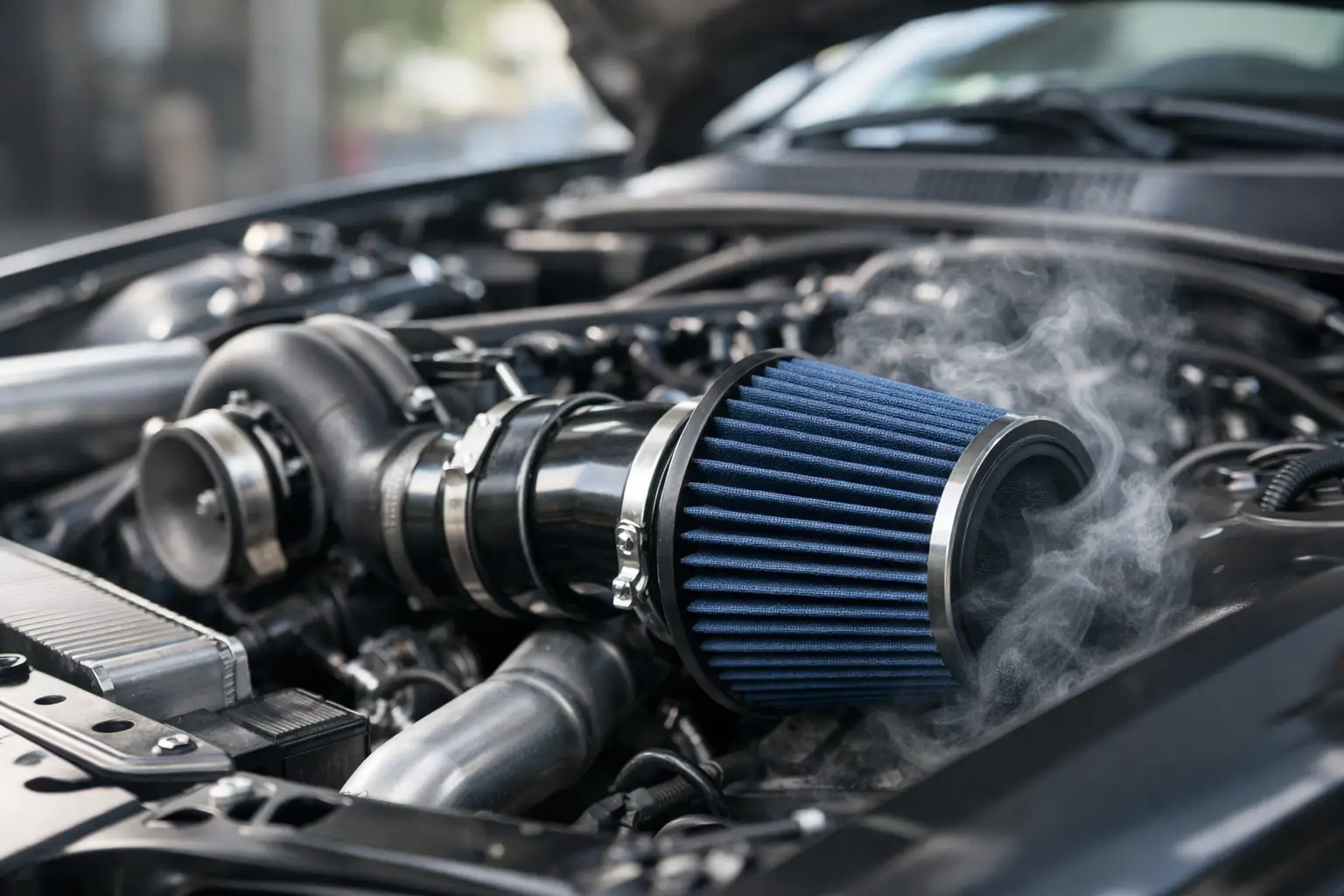
An intake system should reduce restriction while drawing from a stable source of outside air. That is why sealed or well-shielded cold-air designs are often the better choice for a street-driven European performance car. They separate the filter from radiant engine-bay heat and use factory or enlarged fresh-air inlets to supply the turbo efficiently.
An open intake can make excellent power when the engine bay has adequate airflow and the design is properly shielded. It can also produce more induction sound, which many owners want. The trade-off is heat soak at idle, in traffic, or during staging. If the intake filter sits beside a hot turbocharger, exhaust manifold, or radiator outlet without a heat shield and ducting, underhood air will raise inlet temperature before the turbo compresses it even further.
Inspect the details around the intake rather than focusing on the filter alone. A sealed airbox, functional inlet scoop, smooth turbo inlet pipe, and correctly sized intake tube work together. Removing factory ducting without replacing it with a better airflow path can make a premium intake perform like a hot-air kit.
For high-horsepower setups, make sure the intake diameter and turbo inlet match the turbocharger’s demand. A restrictive stock inlet may create a pressure drop that makes the turbo work harder, increasing compressor outlet temperature. At the same time, installing an oversized intake on a stock-turbo street car may add sound without making a meaningful difference in post-intercooler IAT. Build for the actual hardware and tune.
Control Underhood Heat and Airflow
Underhood temperature affects every part of the air path, particularly after the car has been sitting or moving slowly. Heat shielding, turbo blankets, ceramic-coated exhaust components, and properly fitted undertrays can reduce radiant heat exposure to nearby intake piping and components.
These parts are supportive upgrades, not substitutes for charge cooling. A turbo blanket may reduce heat radiating into the engine bay, but it will not fix a saturated intercooler. Likewise, hood vents can help extract heat from the engine compartment, but their benefit depends on placement, underhood pressure zones, weather exposure, and the vehicle’s intended use.
Front-end airflow deserves the same attention. Intercoolers, radiators, auxiliary coolers, and heat exchangers share limited airflow through the bumper opening. Poorly mounted auxiliary coolers, blocked ducts, damaged seals, or debris between heat exchangers can reduce cooling performance. Proper duct sealing forces incoming air through the cooling stack instead of allowing it to escape around the sides.
On track-oriented builds, radiator and oil-cooler upgrades often support IAT consistency indirectly. If engine coolant and underhood temperatures remain under control, the entire thermal system recovers more effectively between hard pulls and sessions.
Use the Right Fuel and Calibration Strategy
Lower IATs reduce the ECU’s need to pull timing, but tuning determines how the engine responds when heat does build. A conservative, well-developed calibration includes appropriate intake-temperature compensations, knock control, boost targets, and fueling for the fuel being used. It should not depend on unrealistically cold weather to make its advertised power.
Higher-octane fuel and ethanol blends can offer more knock resistance, allowing a tuner to maintain safer timing under higher charge temperatures. That does not mean fuel replaces cooling. High IAT combined with excessive boost and an aggressive tune can still produce inconsistent performance and unnecessary stress.
If your car shows repeated timing correction at elevated IAT, do not immediately assume the tune is at fault. Check for boost leaks, intercooler restrictions, a dirty heat exchanger, weak pumps on water-to-air systems, incorrect sensor readings, and fuel-quality issues. The correct diagnosis may involve more than one system.
Avoid the Common IAT Mistakes
The most common mistake is measuring success by intake sound or peak dyno output. A loud intake may feel faster, while a short dyno pull in a cool shop may show a gain, yet neither proves the car will hold power after multiple runs on a 90-degree day.
Another mistake is wrapping every intake pipe without considering the result. Thermal insulation can protect a pipe from radiant heat, but it can also trap heat depending on the location and material. Focus first on airflow, shielding, and charge cooling capacity.
Do not overlook maintenance. Bent intercooler fins, leaves in the condenser stack, failing fans, low coolant in a charge-cooler circuit, degraded hoses, and loose couplers all hurt performance. On older or heavily modified cars, pressure-test the intake system. A leak after the turbo can force it to work harder and create more heat for less actual airflow.
Validate the Upgrade Under Real Load
After installing an intercooler, intake, ducting, or cooling upgrade, repeat the same logs taken before the work. Compare similar ambient conditions, gear selection, road speed, fuel, and boost target. Look for a lower IAT rise over the pull, faster recovery afterward, and more consistent ignition timing across repeated runs.
The best result is not necessarily the lowest number at idle. It is a car that delivers repeatable power when the engine is hot, the weather is warm, and the throttle stays open. For serious builds, EAS Store can help match premium intake and cooling components to your engine code, chassis, turbo setup, and horsepower goal.
Build the air path as a system, then let the data confirm the result. A properly sized intercooler, a well-fed intake, effective ducting, and a calibration suited to the fuel and power level will keep your European performance car pulling hard when conditions are least forgiving.