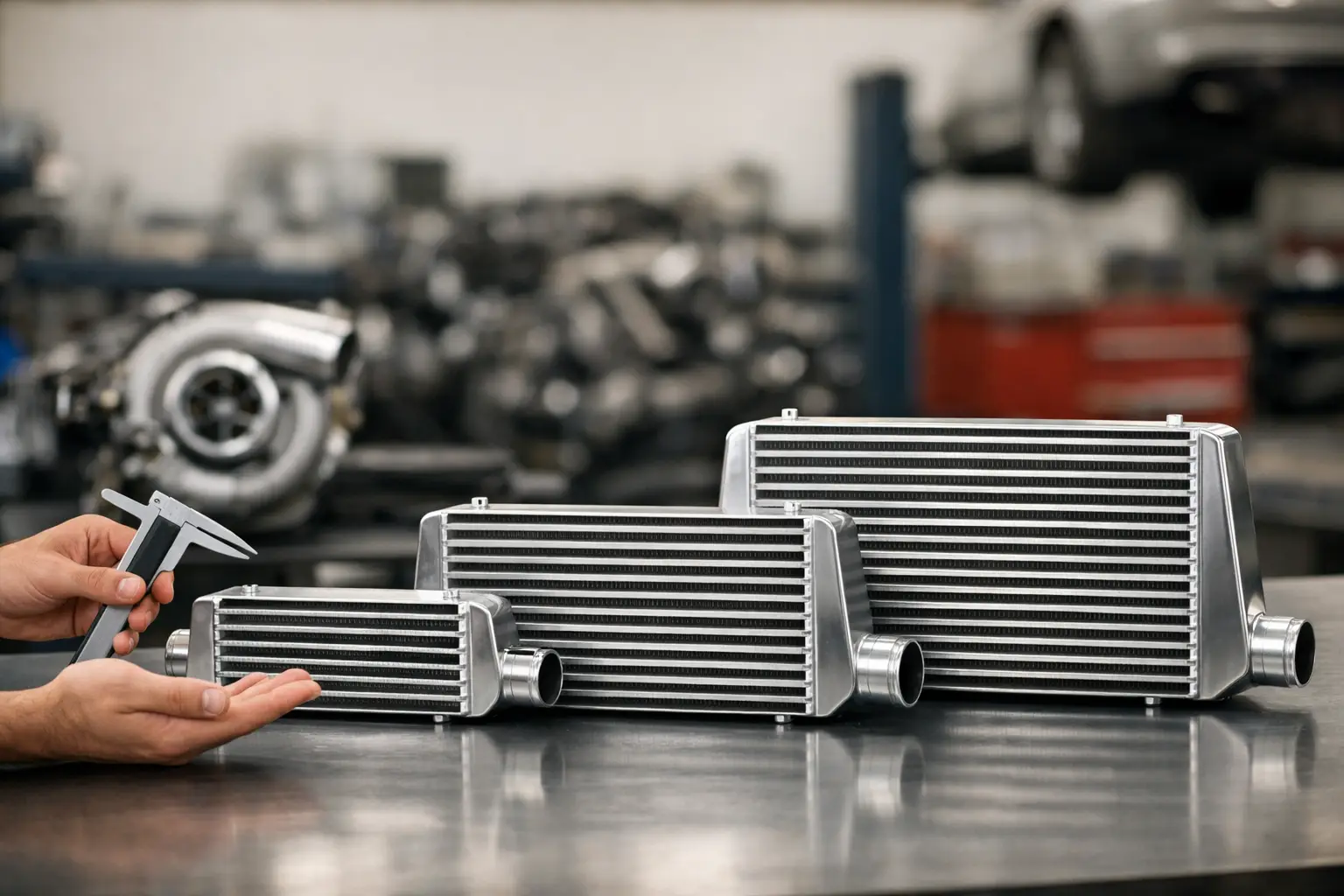
If your intake air temps climb after one hard pull, your intercooler is not just a bolt-on – it is a limit. That is why knowing how to choose intercooler size matters. Too small, and the car heat soaks, timing gets pulled, and power falls off. Too large, and you can create packaging issues, unnecessary pressure drop, and slower transient response without gaining the cooling performance your setup actually needs.
For serious European performance builds, intercooler sizing is less about buying the biggest core that fits and more about matching airflow, horsepower, usage, and platform constraints. A street-driven MQB GTI running a conservative tune does not need the same solution as an Audi RS3 chasing repeated high-speed pulls, or a BMW S58 build spending time on track in hot ambient conditions. The right size is the one that supports your power target consistently, fits the chassis correctly, and does not compromise the rest of the system.
How to choose intercooler size for your build
Start with the question most people skip: what problem are you trying to solve? If the car only sees occasional spirited driving and your current setup is not showing major intake air temperature issues, a moderate upgrade may be the smart move. If you are seeing heat soak after one or two pulls, planning a turbo upgrade, or asking the car to perform repeatedly on the road course or drag strip, you need to size for sustained thermal load, not just peak dyno numbers.
Horsepower is the first filter, but it is not the only one. Intercoolers support airflow, and airflow rises with power. As boost and turbo efficiency change, charge air temperature and volume change too. That means two cars making similar horsepower can still want different intercooler sizes depending on turbo choice, boost pressure, fuel, and intended use.
As a general rule, stock-turbo street cars benefit from a well-designed core that improves thermal efficiency without going excessive on volume. Hybrid turbo and big turbo cars need more core capacity because they generate more heat and move more air. Track cars need even more margin because they spend longer periods under load with less recovery time between pulls.
Core size is only part of the story
People often focus on frontal area and thickness because those numbers are easy to compare. They matter, but they do not tell the whole story. A larger core can reject more heat, but the internal design, fin density, end tank shape, and overall flow path have just as much to do with whether the intercooler works well.
A thick core that looks impressive on paper can become a poor choice if airflow through the bumper opening is limited or if the internal construction creates unnecessary restriction. On many European platforms, especially tightly packaged turbo cars, there is a point where adding thickness produces diminishing returns. If the outer rows of the core are not getting enough cooling airflow, the extra volume does not help as much as buyers expect.
That is why quality matters. A properly engineered bar-and-plate core with efficient end tanks often outperforms a larger but less refined unit. Premium intercoolers earn their price through design, not just dimensions.
Match intercooler size to how the car is used
Street use, drag use, and track use place very different demands on an intercooler.
For a street car, the goal is usually fast recovery, stable intake air temps during spirited driving, and clean fitment with no compromises to drivability. In that case, choosing a moderate-to-large intercooler from a reputable brand is often better than chasing the absolute largest core available.
For drag racing, short bursts of wide open throttle are the focus. You still need cooling capacity, especially if the car hot laps, but pressure drop and response also matter. An oversized intercooler that adds internal volume can slightly soften response, which may not be ideal depending on the setup and powerband.
For road course use, you need thermal endurance. Repeated load, limited cooldown, and high ambient temperatures punish an undersized intercooler quickly. Here, more core capacity makes sense, but only if the bumper opening, ducting, radiator stack, and airflow management support it.
Pressure drop is the trade-off that matters
When deciding how to choose intercooler size, pressure drop has to stay in the conversation. Every intercooler creates some restriction as charge air moves through the core. A better intercooler can cool more efficiently while keeping pressure drop low. A poorly chosen one can force the turbo to work harder to hit the same manifold pressure.
That extra work means more heat and less efficiency upstream. So bigger is not automatically better. If a core gains a little cooling but adds a meaningful pressure penalty, the result may be worse than a slightly smaller, better-flowing option.
This is especially relevant on modern turbocharged Audi, Volkswagen, and BMW applications where response, midrange torque, and calibration sensitivity all matter. You want lower intake air temperatures, but not at the expense of creating a bottleneck.
Fitment and airflow are real sizing limits
The available space behind the bumper sets the boundaries. Crash bars, AC condensers, radiators, ducting, and factory shutters all affect what can realistically fit and function. If an intercooler requires heavy trimming, blocks too much of the cooling stack, or sits in poor airflow, the largest advertised option may not be the best-performing choice in the real world.
This is where platform-specific engineering makes a difference. A well-developed intercooler for an MQB GTI, 8V RS3, or G8X M3 is designed around the vehicle’s airflow path, mounting points, and pressure requirements. Universal sizing logic only gets you so far on modern European cars.
Pay attention to end tank placement, inlet and outlet sizing, and whether the design works with your charge pipes, turbo outlet, and manifold path. If the intercooler is large but the piping transitions are awkward or undersized, the system can still underperform.
Think one step ahead on power goals
One of the most common buying mistakes is sizing only for the current tune. If you know a turbo upgrade, ethanol blend, or more aggressive calibration is coming, choose for the next stage rather than replacing the intercooler twice.
That said, there is no reason to spec an extreme motorsport core for a car that will stay near stock-turbo power and spend its life on the street. The smartest move is to buy enough intercooler for your realistic next step, with some margin for climate and usage.
For many enthusiast builds, that means selecting an intercooler rated comfortably above the current power level, from a manufacturer with proven data on the specific platform. The buffer helps maintain consistency without overcomplicating the setup.
Signs you need a larger intercooler
If you are unsure whether to step up in size, look at the car’s behavior. Rising intake air temperatures after one or two pulls, noticeable power fade in warm weather, timing correction linked to heat, and inconsistent performance lap after lap all point to insufficient cooling capacity.
If the current intercooler keeps temps under control and the car performs consistently, larger may not bring a meaningful benefit. At that point, your money may be better spent on ducting, fueling, tuning, or other supporting hardware.
Data helps here. Intake air temp logs before and after a pull, ambient-to-IAT delta, and recovery time between runs tell you more than marketing claims ever will.
What serious buyers should prioritize
The best intercooler choice usually comes from balancing five things: horsepower target, usage, pressure drop, fitment, and product quality. If one of those gets ignored, the setup becomes a compromise.
For European performance platforms, the safest path is not chasing the biggest dimensions on the page. It is choosing a platform-specific intercooler with proven thermal performance, low restriction, and the right size for the power and duty cycle. That is where experienced support matters. A serious parts supplier should be able to tell you whether a given core is right for a stock-frame turbo street car, a hybrid setup, or a full high-output build.
At EAS Store, that is the standard serious buyers expect – not generic advice, but fitment-aware guidance built around actual platforms and performance goals.
The right intercooler size should make the car more repeatable, not just more impressive on a spec sheet. If you choose with airflow, temperature control, and real use in mind, you end up with a setup that stays fast when the first pull is over and the next one still matters.