A restrictive factory downpipe can be one of the first bottlenecks behind a turbocharger. So, what does a downpipe do? It carries exhaust gas away from the turbine outlet, and on a turbocharged vehicle, improving that path can reduce backpressure, sharpen boost response, and support more power when the rest of the setup is matched correctly.
For platforms such as the Audi RS3/TTRS 2.5T, BMW S58, Mercedes-AMG turbo engines, and VW/Audi MQB models, a downpipe is not simply a louder exhaust part. It is a major component in the exhaust system directly after the turbocharger, where flow and heat matter most.
What Does a Downpipe Do in an Exhaust System?
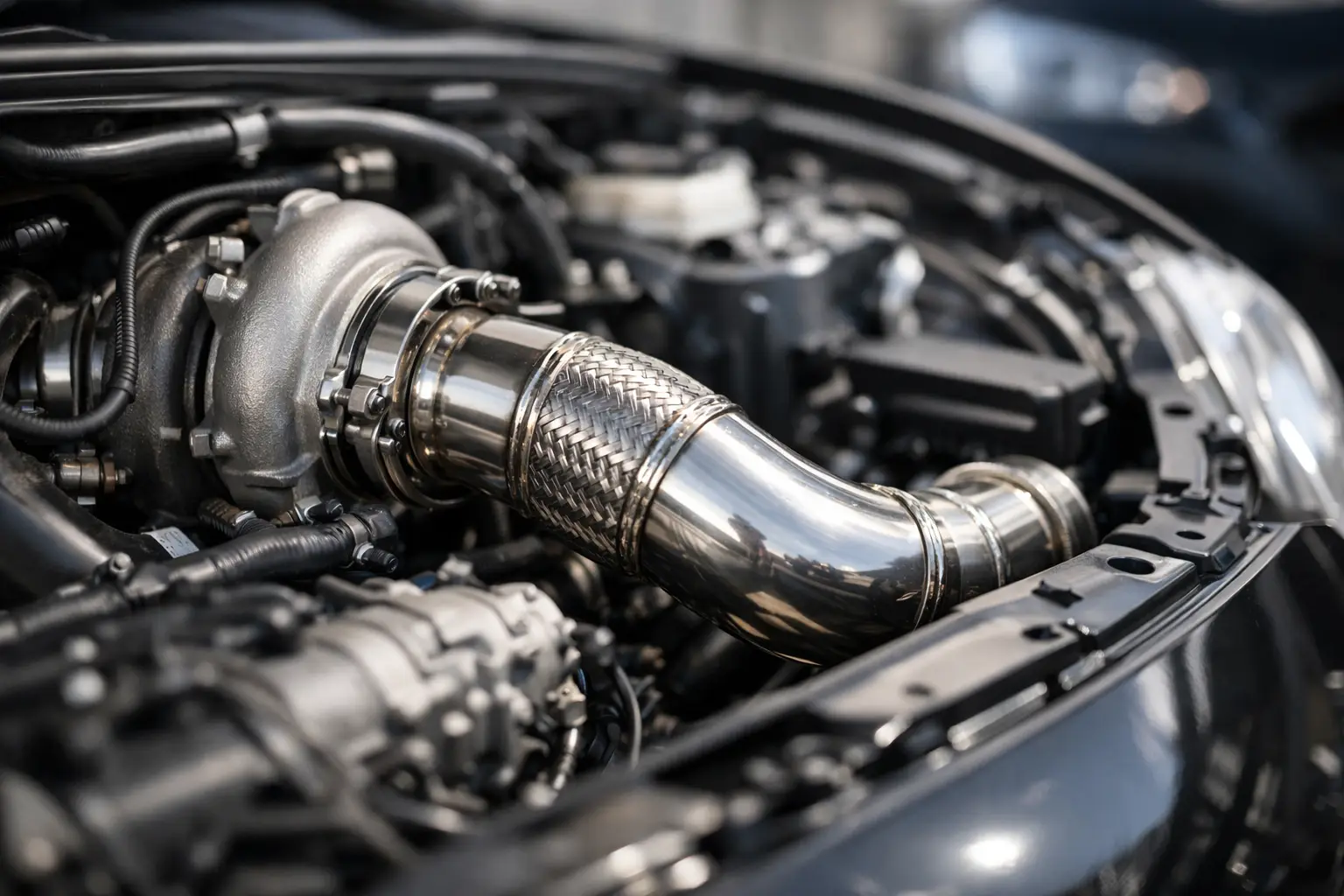
The downpipe connects the turbocharger’s turbine housing to the rest of the exhaust. On many factory turbo cars, it contains one or more catalytic converters, oxygen sensor bungs, heat shielding, and a deliberately restrictive pipe design intended to meet emissions, noise, packaging, and long-term durability requirements.
As exhaust exits the engine, it spins the turbine wheel inside the turbocharger. After it passes through that turbine, the gas needs somewhere to go. The downpipe is that first exit path. If the factory pipe, catalyst, or bends create substantial restriction, pressure builds behind the turbine. Higher post-turbine pressure makes it harder for exhaust gas to leave the turbo efficiently.
A performance downpipe typically uses smoother bends, a larger effective diameter, and a less restrictive catalyst design where applicable. Those changes lower exhaust backpressure after the turbo. The result can be quicker spool, improved midrange torque, and greater horsepower potential, particularly on a tuned car running higher boost than stock.
Why Downpipes Matter More on Turbocharged Cars
On a naturally aspirated engine, exhaust upgrades can still change flow and sound, but gains often depend heavily on headers, camshaft design, displacement, and the complete exhaust layout. A turbocharged engine is different because the turbine itself sits in the exhaust stream and creates a significant point of restriction.
Reducing restriction after the turbine can help the turbo operate more effectively. This does not mean every large downpipe automatically makes more power on every calibration. Turbo size, boost targets, fueling capacity, intercooling, ignition timing, and engine safety strategies all affect the final result. But on a well-calibrated turbo platform, the factory downpipe is often a practical limitation once power goals move beyond a mild software tune.
This is why many tuners consider a downpipe a supporting modification for higher-output street and track builds. It is especially relevant when a vehicle is moving toward a Stage 2-style calibration, upgraded turbochargers, or elevated ethanol-blend power targets.
Backpressure, Boost Response, and Power
The key benefit is not that a downpipe somehow forces more air into the engine by itself. Its job is to make it easier for spent exhaust gas to leave the turbine. Lower pressure after the turbo can reduce the work required to push exhaust through the system.
That can improve transient response when the driver gets back into the throttle. It can also allow the engine to hold power more effectively at higher rpm, where exhaust volume rises rapidly. On a tuned S58 or DAZA 2.5TFSI, this breathing room can be valuable when the calibration is asking the turbo system to produce substantially more airflow than stock.
The difference is often more noticeable in the midrange and upper rpm range than during normal low-load commuting. Drivers may feel a more immediate pull, faster boost recovery between shifts, and a stronger surge as the engine approaches redline.
Catted vs. Catless Downpipes
The biggest decision is usually whether to choose a high-flow catted downpipe or a catless version.
A high-flow catted downpipe uses a performance catalytic converter designed to flow more freely than the factory unit. For many serious street builds, this is the more balanced choice. It can support meaningful performance gains while reducing exhaust odor and maintaining a more civilized experience than a catless setup. Quality matters here. A cheap catalyst may not withstand high exhaust temperatures, can fail prematurely, or may still trigger catalyst-efficiency faults.
A catless downpipe removes the catalytic converter entirely. It offers the least restriction, but it also brings clear trade-offs: significantly more odor, a sharper and often louder exhaust note, increased likelihood of check-engine lights, and emissions compliance concerns. A catless downpipe is generally intended for off-road or competition applications where permitted. It is not legal for use on public roads in many areas, and owners must verify local, state, and federal requirements before purchasing or installing any emissions-related component.
For a street-driven European performance car, the best choice is rarely just the part with the largest advertised flow number. Consider your location, inspection requirements, tolerance for sound and odor, power target, and whether the vehicle will see daily use.
Does a Downpipe Require a Tune?
A downpipe can physically be installed without changing engine software, but whether it should be is a different question. On many modern turbocharged vehicles, the factory ECU closely monitors catalyst performance, oxygen sensor readings, boost, fueling, and exhaust temperature. A freer-flowing downpipe can change the conditions the ECU expects to see.
Without an appropriate calibration, a vehicle may trigger a check-engine light, enter reduced-power modes in certain situations, or fail to capture the full performance benefit of the hardware. A properly developed tune can adjust boost control, fueling, timing, torque modeling, and diagnostic strategies to suit the new exhaust flow characteristics.
That does not mean every car needs an aggressive calibration. The correct tune depends on the exact engine, turbocharger, fuel, intake and intercooler setup, and intended use. A conservative daily-driver file for premium pump gas has very different needs than a flex-fuel, upgraded-turbo build targeting 700-plus horsepower.
Before ordering parts, verify the downpipe manufacturer’s fitment notes and the tuning company’s hardware requirements for your engine code and model year. This is where compatibility details matter more than broad claims such as “fits all” or “Stage 2 ready.”
What Changes Will You Notice?
A downpipe changes more than peak dyno numbers. The most obvious change for many owners is sound. With less restriction immediately after the turbo, the exhaust note becomes deeper, louder, and more aggressive. You may hear more turbo spool, wastegate activity, and crackles or overrun noise if the tune commands them.
How dramatic the sound becomes depends on the rest of the exhaust. A downpipe paired with a factory cat-back may remain relatively controlled. The same downpipe with an open exhaust, resonator delete, or aggressive valved system can become much louder, with more cabin drone at highway speed.
Heat is another consideration. The downpipe sits in a tightly packed, high-temperature area of the engine bay. Premium stainless construction, quality welds, properly located sensor bungs, and effective heat shielding are not cosmetic details. They affect durability, fitment, nearby component temperatures, and serviceability.
Choosing the Right Downpipe for Your Build
Fitment comes first. A downpipe must match the vehicle’s exact engine, turbo configuration, drivetrain, model year, and emissions layout. An MQB Golf R, an Audi S3, and an RS3 may share certain family traits, but their downpipes are not interchangeable. The same is true across BMW B58, S58, N55, and S55 applications.
Look closely at the material, catalyst specification, sensor provisions, flange design, flex section, and connection style to the factory or aftermarket cat-back. A well-engineered part should install without forcing alignment, stressing turbo hardware, or creating exhaust leaks.
Also think about the complete system. If you are already at the limit of factory fueling or intercooling, a downpipe alone will not solve those constraints. For high-horsepower builds, it works alongside the right fuel system, intake, charge cooling, turbocharger, and calibration. Build the car around a realistic power goal rather than collecting parts at random.
Installation and Reliability Considerations
Downpipe installation is more involved than a basic cat-back swap. Access around the turbo can be tight, hardware may be heat-cycled and corroded, and oxygen sensors must be removed and reinstalled carefully. Exhaust leaks at the turbo flange or downstream connection can create noise, faults, inaccurate sensor readings, and unpleasant fumes.
Use new gaskets, seals, and hardware where the manufacturer specifies them. Confirm sensor routing before final tightening, inspect heat shields and nearby wiring, and check all connections after a few heat cycles. On premium European platforms, professional installation is often worthwhile if you do not have proper lifting equipment, specialty tools, and experience working around hot-side turbo components.
A downpipe is one of the most effective exhaust upgrades available for a turbocharged performance car, but the right result comes from matching the part to the vehicle and the plan. Choose for fitment, legal use, tuning support, and long-term build goals – then let the added flow serve a package that is ready to use it.