Ask anyone building a fast EA888, S58, or 2.5TFSI where the fueling conversation gets serious, and the answer shows up quickly: port injection versus direct injection. It stops being a theory question once boost climbs, ethanol content goes up, or injector duty cycle starts getting uncomfortably high. At that point, your fueling strategy is no longer a background detail. It becomes one of the main factors that determines power ceiling, drivability, and long-term reliability.
Why port injection versus direct injection matters on a performance build
For a stock or lightly modified street car, direct injection usually does exactly what the factory intended. It supports clean emissions, strong fuel economy, and sharp throttle response while keeping packaging tight and control strategies advanced. OEMs did not adopt direct injection by accident. It offers real benefits, especially on modern turbocharged European platforms where efficiency and torque targets matter.
But performance builds do not stay inside factory limits for long. Larger turbos, upgraded high-pressure pumps, ethanol blends, and aggressive calibrations all raise fuel demand. That is where port injection starts entering the conversation. Not because direct injection is bad, but because every system has a limit, and those limits show up faster when the goal is big horsepower.
The right answer depends on the platform, target power, fuel type, and how the car is used. A street-driven daily on pump gas has different needs than an RS3 chasing four-digit power or a track car that spends long sessions at high load.
How direct injection works
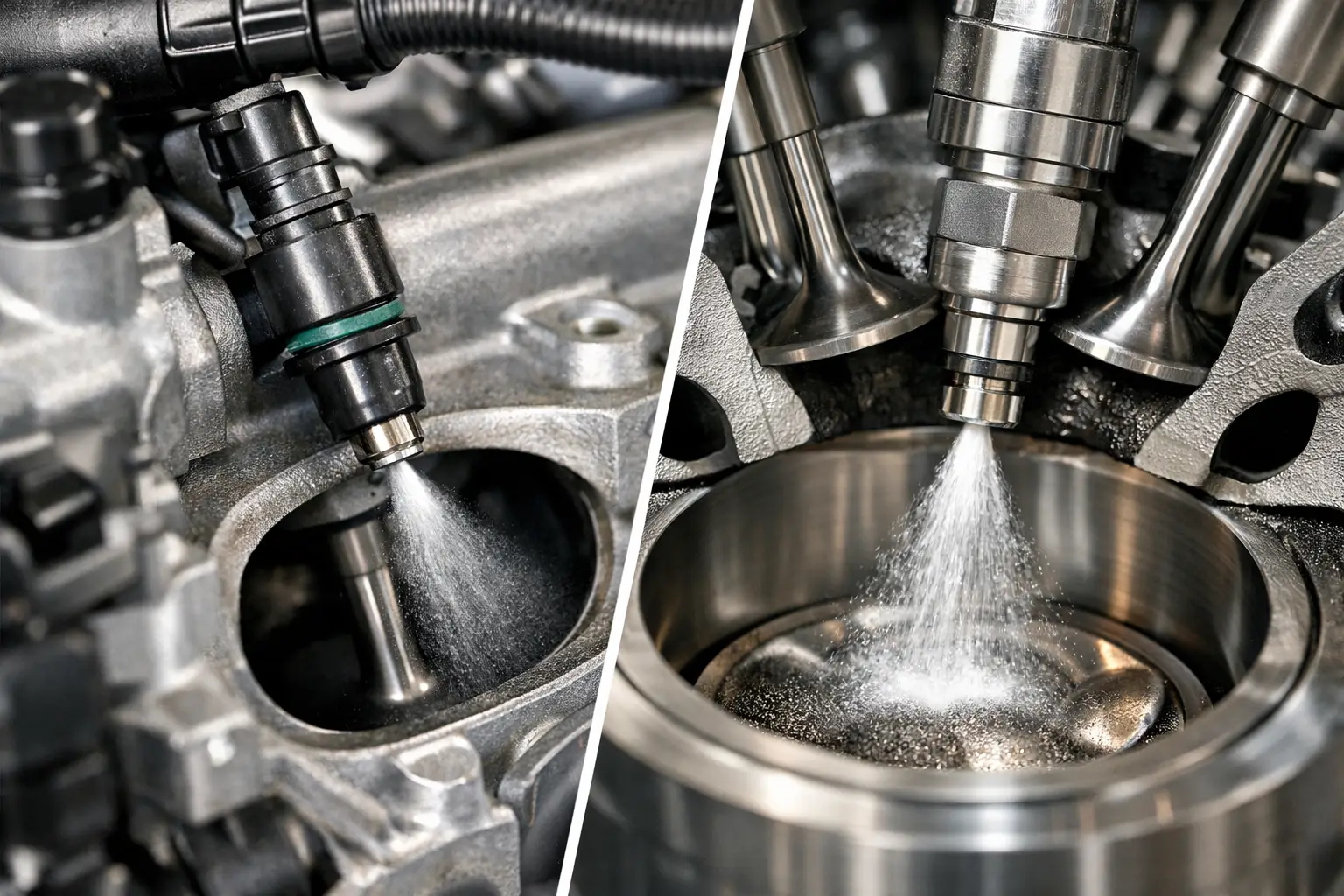
Direct injection sprays fuel straight into the combustion chamber at very high pressure. The injector is mounted in the cylinder head so fuel enters the chamber itself rather than the intake port. This gives the ECU very precise control over injection timing and fuel delivery, which helps with combustion efficiency, emissions, and low-speed response.
On modern turbo engines, that precision is a major advantage. Direct injection also has a cooling effect inside the chamber, which can help suppress knock. That is one reason many factory turbo performance engines respond so well to tuning before they reach the edge of the stock fueling system.
For enthusiast platforms from Audi, Volkswagen, BMW, and Mercedes, direct injection is often the foundation of the build. Upgraded high-pressure fuel pumps, low-pressure pumps, injectors where available, and proper tuning can stretch the factory architecture surprisingly far. On some setups, that is all you need.
The catch is cost and capacity. Direct injection components operate at very high pressure and with very tight control windows. As airflow increases, the system has less time to deliver enough fuel during the combustion cycle. Eventually, injector pulse width and pump capacity become real bottlenecks. This is especially true once ethanol enters the picture, since ethanol requires more fuel volume than gasoline to achieve the same air-fuel target.
How port injection works
Port injection places the injector in the intake port, upstream of the intake valve. Fuel mixes with incoming air before entering the combustion chamber. This is a more traditional setup and one that still works extremely well in performance applications.
From a power-building perspective, port injection offers a simpler path to adding fuel volume. It is not constrained by the same in-cylinder timing window as direct injection, and it can support substantial horsepower when designed correctly. That is why many high-output turbo builds add a supplemental port injection system instead of trying to force the factory direct injection hardware to do everything.
There is another benefit enthusiasts already know well: port injection washes the intake valves with fuel. On engines that rely only on direct injection, intake valves do not get that cleaning effect, which can contribute to carbon buildup over time. Port injection does not magically solve every maintenance issue, but it does help address one of the most common complaints tied to DI-only engines.
The trade-off is that port injection on a modern DI engine is usually an added system, not the native one. That means extra hardware, additional tuning complexity, and more decisions about controller strategy, injector sizing, and integration.
Port injection versus direct injection for power
If the question is which system is better for outright fueling capacity, port injection often wins once the build moves well past stock turbo territory. It is easier to scale, especially for high-horsepower ethanol combinations. On cars aiming for serious output, supplemental port injection can provide the extra headroom that the factory direct injection system simply cannot maintain on its own.
If the question is which system is better for precision and OEM-like operation at moderate power, direct injection has a strong case. It delivers excellent control at idle and part throttle, and manufacturers have spent years refining it for street use. For many owners, especially those staying on pump gas with a sensible turbo upgrade, a properly supported DI setup remains the cleaner solution.
That is why this is rarely an either-or debate in the aftermarket. On many of the most capable European performance builds, the real answer is both. Direct injection handles what it does best, and port injection supplements fuel mass where the setup needs more capacity.
Carbon buildup, drivability, and daily use
Carbon buildup is one of the biggest real-world talking points in port injection versus direct injection. Because direct injection sprays fuel directly into the chamber, the intake valves are exposed to crankcase vapors and deposits without the cleaning effect of fuel spray. Over time, especially on engines known for valve deposits, buildup can affect airflow and performance.
Port injection helps here because fuel passes over the valves. That does not eliminate maintenance, but it is a real advantage. For owners who keep cars long term or put heavy street mileage on them, this matters beyond the dyno sheet.
Drivability is more nuanced. Factory direct injection systems are exceptionally well calibrated from the start. Supplemental port systems can be made to run extremely well, but the result depends on component quality, tuning quality, and how the added fueling is staged. A poorly integrated setup may make big power but feel less refined in daily traffic. A well-designed one can be nearly transparent until load rises.
When direct injection is enough
Direct injection is often enough when the build goals are realistic, the turbo setup is modest, and the fuel choice is not pushing volume demand through the roof. A street car running premium pump gas, a conservative tune, and supporting fuel upgrades may never need supplemental port injection.
This is especially true for owners who prioritize factory-style behavior, emissions compliance where applicable, and lower system complexity. In those cases, pushing the OEM-style DI system with the right supporting parts can be the smartest path.
There is also a cost argument. Adding port injection usually means a manifold or rail solution, injectors, lines, controller integration, and custom calibration. If the car does not need that extra fuel, spending money there instead of on cooling, tires, or braking is not always the best move.
When port injection makes sense
Port injection makes sense when fuel demand outpaces what the direct injection system can safely support. That usually shows up on bigger turbo builds, higher ethanol blends, and combinations where the owner wants more safety margin instead of running the factory-style system near its limit.
It also makes sense when the platform already has a known aftermarket path for it. Some engines have mature port injection solutions with proven tuning strategies, injector data, and fitment support. In those cases, supplemental port fueling is not an experiment. It is a standard next step for serious power.
For shops and experienced enthusiasts, the appeal is straightforward: more fueling headroom, better flexibility with ethanol, and a broader ceiling for future upgrades. If the plan is to grow into the build rather than redo it twice, port injection can be a smart investment.
The best answer is often a matched system
The strongest modern performance setups rarely treat port injection versus direct injection as a winner-take-all argument. They treat fueling like the rest of the build – as a system. Turbo size, intercooling, engine internals, clutch or transmission limits, and tuning all need to agree with the fuel strategy.
A mismatch creates problems fast. Adding port injection without the tuning to control it correctly is asking for trouble. Trying to hold aggressive power targets on a maxed-out direct injection system can be just as risky. The right setup is the one that supports the horsepower target with margin, fits the fuel you plan to run, and works with the platform’s known strengths.
That is where informed parts selection matters. On serious European performance platforms, the difference between a clean, repeatable build and a frustrating one often comes down to choosing components that actually match the engine code, power goal, and calibration strategy. That is exactly why enthusiasts and shops lean on specialists like EAS Store when the build moves past basic bolt-ons.
If you are deciding between these two approaches, start with the honest version of your goal, not the temporary one. Build for the power level and fuel type you actually want, and your fueling system will make a lot more sense from day one.