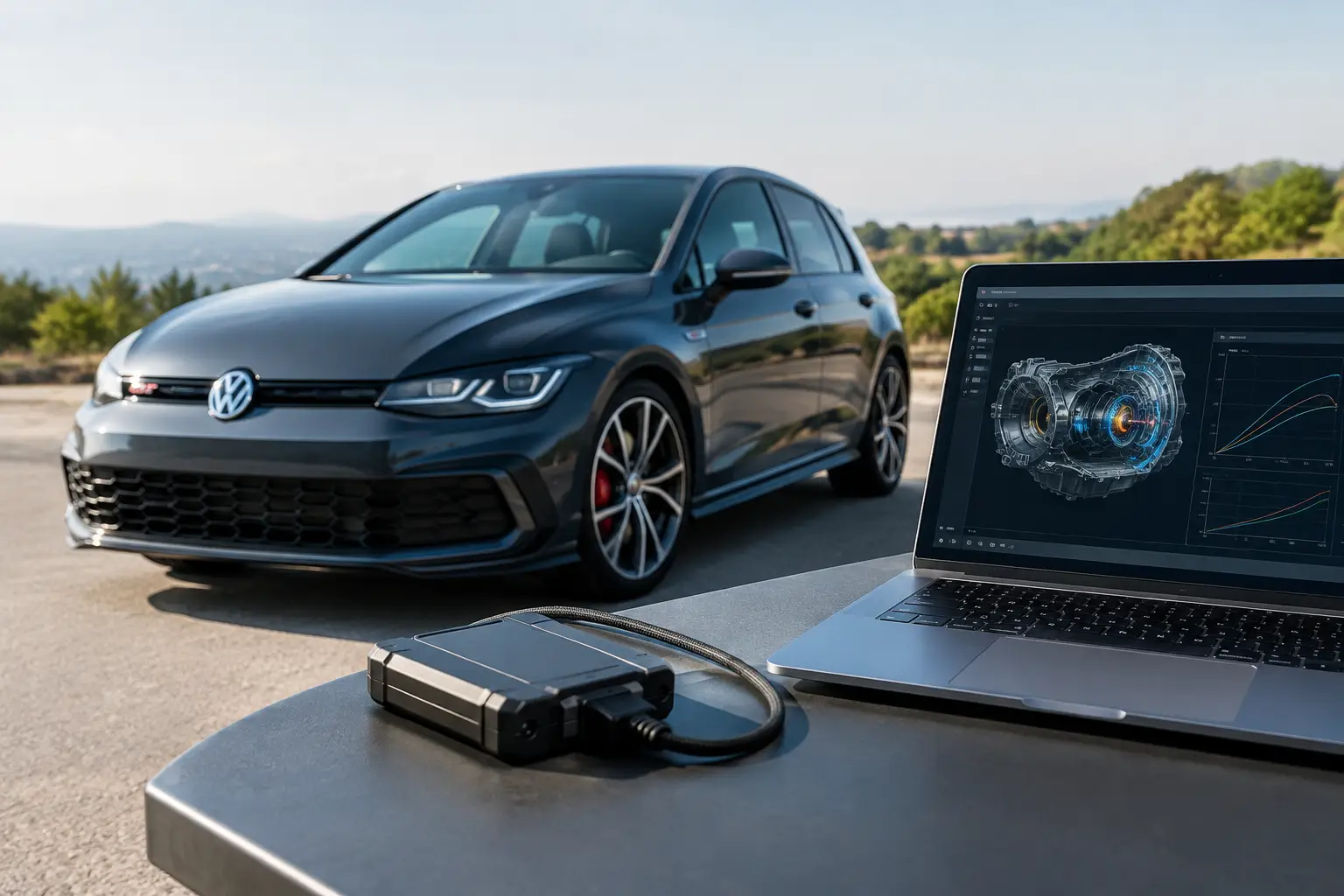
A tuned Golf can make excellent power while its DSG still behaves like the engine is stock. That disconnect is exactly where Golf TCU tuning earns its place. The transmission control unit governs shift pressure, clutch engagement, torque intervention, launch behavior, and the rev limit strategy that determines how effectively your DSG-equipped Volkswagen delivers power.
For a lightly modified GTI, Golf R, or other MQB Golf, TCU software can make the car feel sharper and more consistent. For a high-torque turbo upgrade build, it can become a necessary supporting modification rather than an optional refinement. The right calibration is not about making every shift harsh. It is about giving the transmission the appropriate control strategy for the torque, use case, and hardware behind it.
What Golf TCU Tuning Actually Changes
The DSG is a dual-clutch transmission, not a conventional torque-converter automatic. Its clutch packs, hydraulic controls, and software are all working together to select the next gear and transfer engine torque. The factory TCU calibration is designed around stock output, emissions requirements, broad driver behavior, and long-term comfort for a general ownership audience.
A performance TCU tune recalibrates those operating parameters. Depending on the transmission and software provider, that commonly means higher clutch clamping pressure, revised shift points, quicker shift commands, increased torque limiters, improved manual-mode behavior, and a raised RPM limit. On applicable vehicles, launch control settings and torque intervention during shifts may also be revised.
The result is most noticeable when the car is driven hard. A factory DSG can request significant torque reduction during an upshift or choose to upshift before the engine is operating in its most productive RPM range. A well-developed TCU calibration can reduce those compromises while keeping the transmission controlled and predictable.
Torque Limits Are a Major Reason to Tune the TCU
Engine tuning and transmission tuning should be considered as a system. The ECU calculates and reports torque, while the TCU uses torque models and internal limiters to decide whether it will accept that load. When engine output exceeds the transmission’s programmed expectations, the DSG may reduce power, close the throttle, soften the shift, or trigger fault protection.
This is why an ECU-tuned Golf can benefit from a matching TCU tune even if the driver is not chasing record-setting quarter-mile times. The TCU calibration raises or recalibrates the relevant torque thresholds so the transmission can operate correctly with the engine’s new power delivery.
That does not mean software creates unlimited mechanical capacity. A TCU tune helps the gearbox use its available capability more effectively. It cannot repair worn clutch packs, compensate for contaminated fluid, or make an unsuitable transmission indefinitely tolerate torque far beyond its hardware limits.
Golf TCU Tuning by Transmission Type
Not every Golf uses the same DSG, and compatibility matters. Model year, engine, drivetrain, and market specification can all affect transmission identification. A Mk7 GTI with a DQ250 six-speed DSG has different hardware and calibration requirements than a later Golf R equipped with the DQ381 seven-speed DSG.
The DQ250 is a proven wet-clutch unit with substantial aftermarket support. It is commonly found in earlier MQB GTI, Golf R, and Audi applications. The DQ381, used across newer MQB performance models, brings seven forward gears and its own control strategy, clutch behavior, and software options. Older dry-clutch DSG variants and traditional automatic-equipped Golfs require a different approach entirely.
Before choosing software, verify the exact transmission code and confirm compatibility by VIN, model year, and engine configuration. This prevents a common mistake: selecting a tune based solely on the car’s badge rather than the gearbox installed in that specific vehicle.
Stage Matching Matters
Many TCU software options are organized into stages. These are useful shorthand, but they are not universal industry standards. One company’s Stage 2 TCU file may be designed for a bolt-on ECU tune, while another is intended for an upgraded turbo and significantly higher torque.
Choose the calibration that matches your actual engine tune, fuel type, turbocharger, and intended use. A conservative street car usually benefits from smooth clutch engagement, intelligent automatic shift behavior, and enough torque capacity to support its power level. A drag-focused Golf may prioritize aggressive launch settings, maximum clutch pressure, and rapid shift execution.
The highest setting is not automatically the best setting. More clutch pressure, firmer shifts, and more aggressive launch behavior can increase stress and reduce refinement. The best tune is the one that supports the car’s output without adding unnecessary harshness or operating outside the transmission’s practical limits.
What You Will Feel From a Proper DSG Tune
The first change many drivers notice is shift quality. Under full throttle, gear changes tend to be more decisive and less interrupted by engine torque reduction. The car stays on boost more effectively, which is especially valuable on turbocharged EA888-powered GTIs and Golf Rs where momentum between shifts matters.
Manual mode often becomes genuinely useful. Factory programming may upshift automatically near redline or downshift when the driver would prefer to hold a gear. A performance-oriented TCU tune can offer a more committed manual mode, allowing the driver to select gears with the paddles or shifter until the programmed RPM protection point.
Launch behavior can also improve, though expectations should remain realistic. Increased launch RPM and revised clutch engagement can help a well-prepared AWD Golf R leave harder, particularly with tires, road surface, and engine calibration working together. On a front-wheel-drive GTI, traction remains the main limitation. More aggressive launch programming cannot overcome inadequate tires or a cold, dusty surface.
Daily driving should not be ignored. A quality Golf TCU tune can improve part-throttle behavior by reducing indecision and choosing gears more logically. But the feel is calibration-dependent. Some drivers prefer a very direct, motorsport-style shift; others want near-stock smoothness during commuting and stronger behavior only in Sport or manual mode. Selectable modes can make a meaningful difference for a dual-purpose car.
Supporting Hardware and Maintenance Come First
Software works best when the car is mechanically ready for it. DSG service intervals should be followed, using the correct fluid and filter specification for the transmission. If the car has delayed engagement, slipping, flashing gear indicators, fault codes, or unusual noises, diagnose those issues before adding power or altering TCU logic.
Engine-side upgrades also influence the transmission’s workload. An intercooler, intake, downpipe, fuel system upgrades, and a larger turbo can all change how quickly torque arrives and how much load the DSG sees. Peak horsepower is only part of the picture. A broad midrange torque curve can be particularly demanding on clutch packs and internal components.
For higher-output builds, trusted parts selection is just as important as the calibration itself. EAS Store supports serious European performance applications with components selected around real platform requirements, from cooling and fueling to drivetrain-focused upgrades. Build the package around your target power level, not around isolated headline numbers.
Questions to Ask Before Flashing Your Golf TCU
Start with your goal. Is the car a daily-driven Stage 1 GTI, a road-course Golf R, or a big-turbo street and drag build? The answer affects the appropriate software file, service plan, and supporting modifications.
Next, verify whether the ECU tune is designed to work with a specific TCU calibration. Matched software strategies can improve torque reporting and shift behavior. Mixing brands is sometimes workable, but it deserves more research than simply assuming every combination will perform the same.
Ask how the software handles stock mode, flashing, future upgrades, and dealer visits. TCU flashing can affect warranty coverage, and aftermarket software may be detectable even after returning to a stock file. Local regulations and emissions requirements can also affect the legality of related engine modifications. Know the implications before changing the vehicle.
Finally, be honest about tire condition, maintenance history, and driving habits. Launching repeatedly on worn tires, skipping DSG service, and adding a high-torque file to a neglected transmission is not a performance plan. It is an expensive way to find the weak link.
Is Golf TCU Tuning Worth It?
For most tuned DSG Golf owners, the answer is yes when the calibration matches the vehicle. It lets the transmission support the engine tune instead of working against it, adds control in manual mode, and can make the car feel substantially more responsive without changing a single mechanical part.
The real value is not simply faster shifts. It is confidence that the engine, gearbox, and supporting hardware are operating as one package. Choose software for your exact DSG, maintain the transmission properly, and build around the power you can use. That is how a tuned Golf becomes faster, more consistent, and more enjoyable every time you press the throttle.