A proper Eventuri intake review starts with the question most serious owners are actually asking: does the carbon fiber hardware deliver enough beyond sound and appearance to justify its premium price? For the right European performance platform, the answer can be yes. But the result depends on the engine, supporting modifications, calibration, and how hard the car is used.
Eventuri is not trying to be a low-cost replacement panel filter or an open-cone intake built primarily for induction noise. Its systems are engineered around controlled airflow, sealed or semi-sealed carbon housings, high-flow filtration, and platform-specific ducting. That approach is especially relevant on turbocharged Audi, BMW, Mercedes, and Volkswagen applications where intake air temperature, turbo inlet restriction, and repeatable airflow matter more than a single peak dyno number.
What Makes an Eventuri Intake Different?
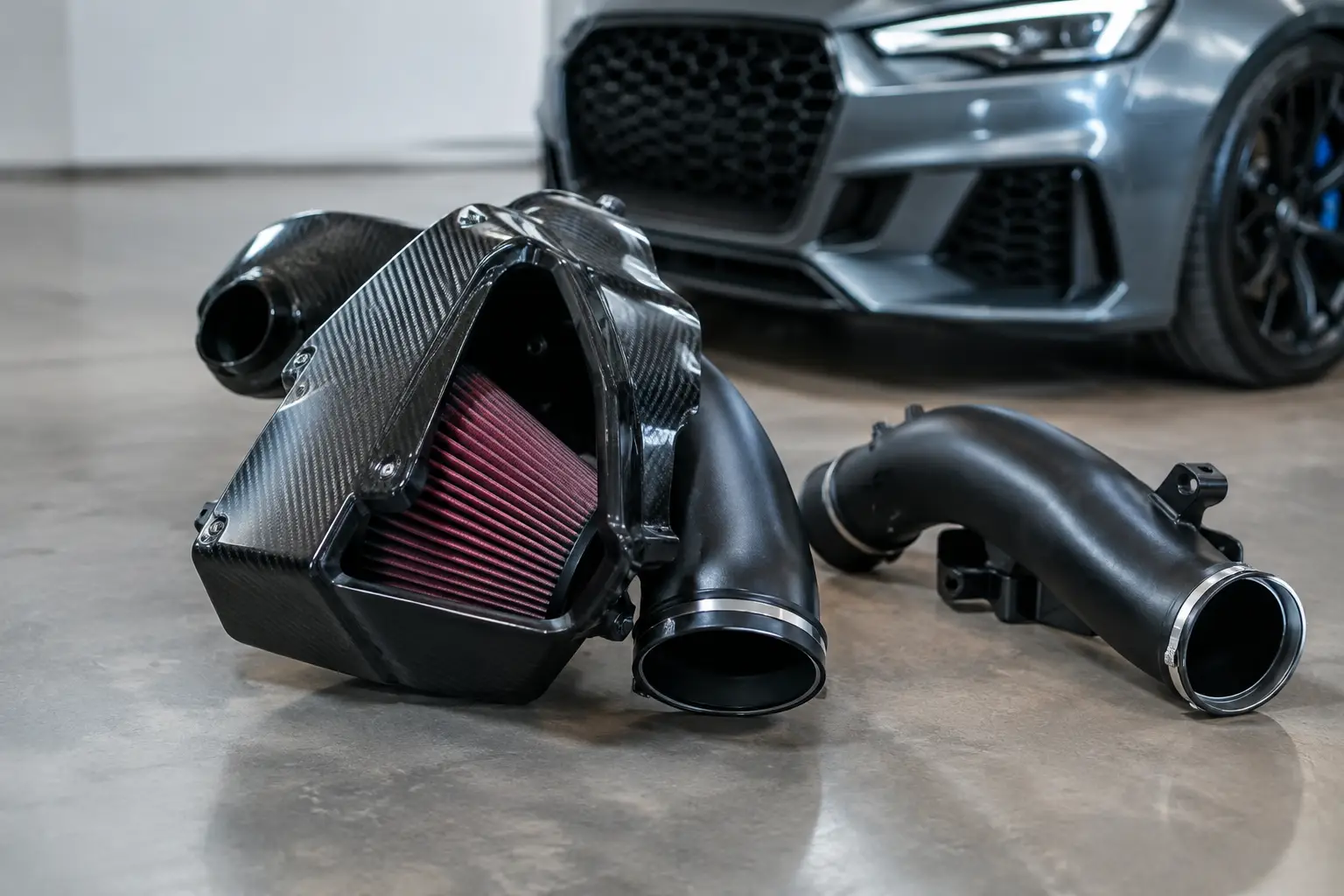
The defining feature is Eventuri’s Venturi filter housing concept. Rather than placing a filter in an oversized enclosure and calling it a performance intake, the system uses a shaped carbon fiber filter housing intended to guide air smoothly toward the outlet. The goal is to reduce turbulence and maintain more consistent flow as air moves from the filter toward the turbocharger or intake tract.
Most kits also go well beyond a cone filter and silicone coupler. Depending on the application, an Eventuri system may include a carbon airbox, revised intake tube, turbo inlet pipe, cold-air feed, ducting, or an enlarged intake scoop. The exact contents vary by chassis and engine, which matters when comparing one kit to another. An intake for an Audi RS3 2.5TFSI has different bottlenecks than one for a BMW S58 or a VW Golf R EA888.
Carbon fiber is part of the appeal, but it is not the whole story. It provides a lightweight, high-end finish and allows complex molded shapes that would be difficult to reproduce in basic sheet metal. More importantly, a properly designed enclosure can separate the filter from underhood heat and maintain a more direct path from the factory air feed.
Eventuri Intake Review: Performance Expectations
On a stock turbo engine with a factory calibration, an Eventuri intake may not transform the car’s peak horsepower figure. Modern OEM intake systems are often competent at stock power levels, and some factory airboxes are less restrictive than enthusiasts expect. Owners should be skeptical of any claim that promises a dramatic gain from an intake alone without supporting test conditions.
Where an Eventuri system can make more sense is on a tuned vehicle or a platform where the factory intake path becomes restrictive as airflow demand rises. A Stage 1 or Stage 2 calibration, upgraded turbo inlet, hybrid turbo, or larger turbocharger can increase the value of a higher-capacity intake system. At that point, reduced restriction before the compressor can support more efficient turbo operation and help the engine meet airflow targets with less pressure drop.
The strongest real-world gains are often felt in response rather than seen as a headline number. A sharper intake sound, faster spool character, and more immediate throttle response can make a turbocharged car feel more alive. On dual-turbo BMW applications, for example, the increased compressor sound under load is often one of the most noticeable changes. On Audi and Volkswagen models, the character varies by engine and whether the kit retains a tightly sealed airbox design.
Heat management is another area that deserves an honest assessment. A sealed intake drawing from the factory cold-air path generally has an advantage over an exposed filter sitting in an engine bay. Still, no intake can ignore a hot intercooler system, a high underhood temperature environment, or repeated wide-open pulls in warm weather. Intake air temperatures are influenced by the entire vehicle setup, including charge cooling, radiator capacity, ambient conditions, and driving speed.
Sound, Fitment, and Daily-Driving Behavior
Sound is not a side effect for most buyers. It is part of the purchase. Eventuri systems typically amplify turbo spool, compressor bypass noise, and induction tone without delivering the raw, open-filter sound associated with cheaper short-ram designs. Whether that is ideal depends on the driver. A daily-driven Mercedes-AMG or BMW M car may benefit from a more refined character, while a dedicated weekend car owner may prefer the loudest possible induction note.
Fitment is a major reason to choose a platform-specific premium intake. A well-developed kit should mount securely, clear factory components, retain necessary sensors, and route ducts where they belong. That said, installation quality still matters. Misaligned couplers, loose clamps, improperly seated airboxes, or disturbed vacuum and breather connections can create leaks, fault codes, or inconsistent performance.
Expect installation time to range from a straightforward hour on simpler applications to several hours on tightly packaged modern performance cars. Review the included hardware before starting, work with a cool engine, and avoid overtightening carbon fiber components. If the vehicle uses a mass airflow sensor, careful sensor handling and correct orientation are non-negotiable.
When the Premium Price Is Worth It
An Eventuri intake is easiest to justify when it is part of a complete build rather than an isolated cosmetic upgrade. The value is clearer for owners who want a system with engineered ducting, quality materials, and known fitment on a car they plan to tune or keep long term. It also suits buyers who care about an engine bay that looks as serious as the rest of the build.
It may be harder to justify for an owner whose only goal is the cheapest possible horsepower-per-dollar upgrade. In that case, a performance calibration, intercooler upgrade, tires, or brake package may produce a larger measurable change for the same budget. A premium intake is not a substitute for the supporting hardware required by a high-output build.
For cars approaching the limits of their stock turbo inlet and intake tract, compatibility needs to be checked as a system. Confirm the exact chassis, engine code, model year, turbo configuration, and existing modifications before ordering. Some combinations benefit from pairing the intake with a matching inlet or duct, while others require a specific version for the vehicle’s emissions equipment or sensor arrangement.
What to Check Before Buying
Start with the vehicle’s exact application, not just the badge on the trunk. A BMW M3 and M4 may share an engine but have packaging differences across generations. Audi S and RS models can use different intake layouts despite similar displacement. Volkswagen MQB variants also vary by engine generation, turbocharger, and factory airbox arrangement.
Then consider your build stage. A stock daily driver may prioritize sound, appearance, and a sealed cold-air design. A tuned street car may need improved airflow consistency and a larger turbo inlet. A high-horsepower or track-focused project should be evaluated alongside fueling, intercooling, turbo capacity, tuning strategy, and the vehicle’s intended operating conditions.
Finally, consider local emissions rules and warranty implications before modifying the intake tract. A high-quality part does not automatically mean it is approved for every state or model year. Verify the legal and compliance requirements that apply where the car is registered.
For owners who want premium induction hardware without guessing at fitment, EAS Store can help match an Eventuri application to the engine, chassis, and modification level. The best intake is not simply the most expensive one. It is the one that supports the airflow needs of the build, fits correctly the first time, and still makes you want to open the hood after every drive.