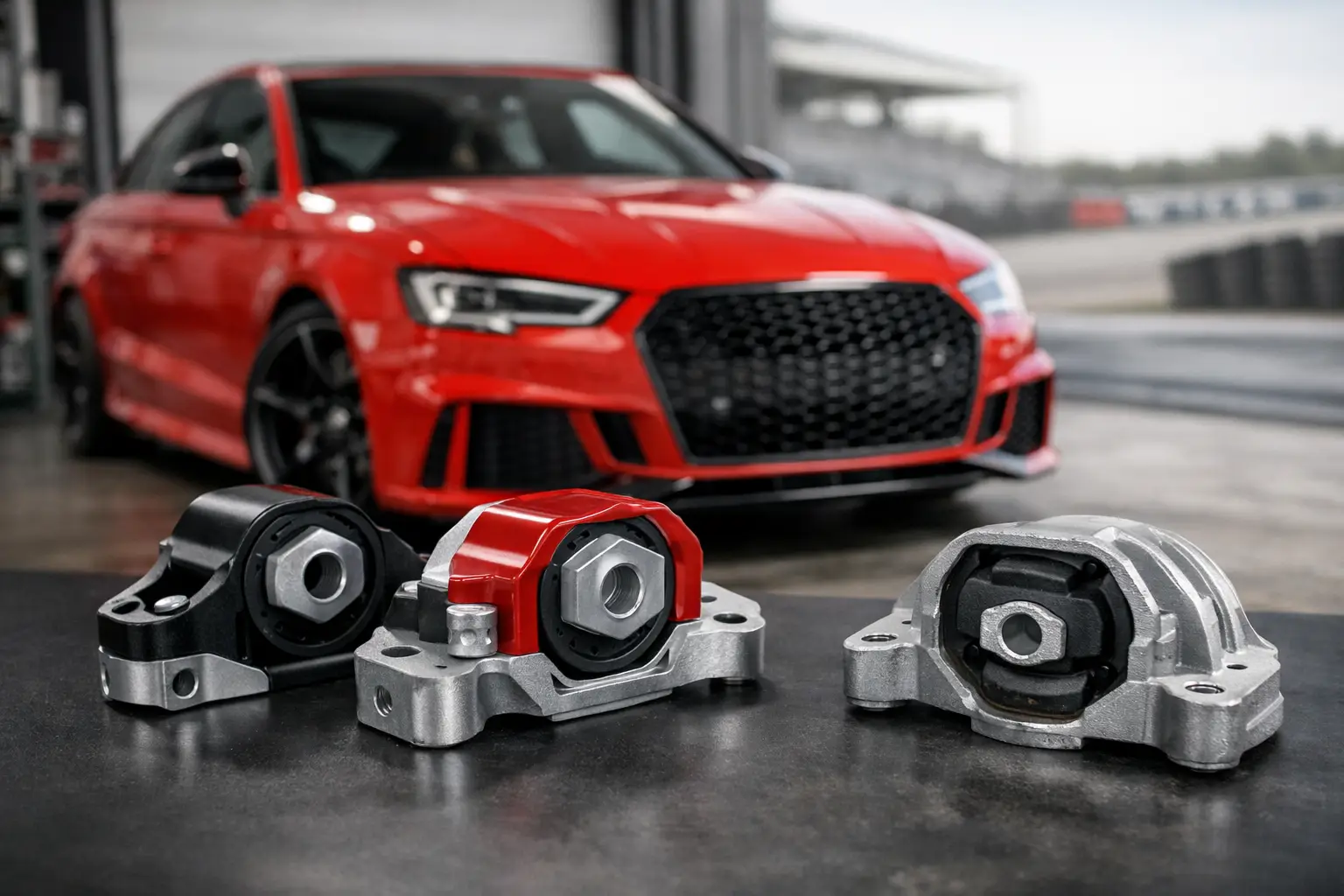
A hard-launching RS3 can make a healthy drivetrain feel surprisingly loose. Wheel hop, delayed shifts, a sharp thump on throttle transitions, and an engine that visibly rocks under load are not just annoyances – they can limit consistency and put added stress on surrounding components. The best Audi RS3 engine mounts are the ones that control drivetrain movement at your current power level without making the car miserable for how you actually use it.
For a stock or lightly tuned daily driver, that may mean a restrained upgrade with minimal added noise, vibration, and harshness. For a built 2.5 TFSI making serious torque on ethanol, drag radials, or road-course tires, a firmer mount package can be a necessary part of keeping the powertrain stable. The right answer depends on chassis, transmission, power target, and tolerance for NVH.
Why RS3 Engine Mounts Matter on a Tuned 2.5 TFSI
The Audi RS3 2.5 TFSI is exceptionally responsive to tuning, but the factory drivetrain mounting system was designed around OEM power, comfort, and long-term street refinement. Once torque climbs, especially with upgraded turbochargers and aggressive DSG calibration, the engine and transmission can move more than intended during acceleration, braking, and rapid gear changes.
That movement affects more than the feel through the chassis. Excessive drivetrain motion can contribute to inconsistent launches, wheel hop, less precise shifts, stress on hoses and wiring, and a vague response when getting back into the throttle. On a high-output RS3, movement at the mount can become movement everywhere else in the system.
An upgraded mount does not create horsepower. It helps the car use the horsepower it already has with more control. That is why mounts often make sense alongside a tune, downpipe, intake, intercooler, upgraded fueling, and transmission calibration rather than as an isolated modification.
The Best Audi RS3 Engine Mounts Depend on Your Goal
There is no single mount setup that is best for every 8V or 8Y RS3. The right product is determined by how the car is driven and how much refinement you expect to retain.
Street-focused builds: controlled without excessive NVH
For a daily-driven RS3 with a Stage 1 or Stage 2 calibration, most owners should prioritize a performance street mount or a lower-durometer polyurethane option. These designs reduce engine movement over stock while keeping cabin vibration at a reasonable level.
This is the right direction for owners who want sharper launches and cleaner throttle response but still commute, travel, and drive the car in traffic. A mild-to-medium mount upgrade can noticeably improve drivetrain behavior without turning every cold start, idle, or low-rpm cruise into an event.
The trade-off is straightforward: a street-oriented mount will not hold the drivetrain as rigidly as a race-focused solution. For most tuned stock-turbo cars, that is not a problem. In fact, accepting some controlled compliance is often the better choice for a car that spends real time on public roads.
High-horsepower street and drag builds: prioritize load control
If your RS3 has upgraded turbochargers, ethanol fueling, aggressive DSG tuning, and repeated hard launches, mount stiffness becomes more important. A higher-durometer polyurethane mount, upgraded engine and transmission mount combination, or a complete drivetrain stabilization package can better manage the torque produced by a 600-plus horsepower build.
This is particularly relevant for cars using sticky tires. More grip means more drivetrain shock, and that shock has to travel somewhere. Firmer mounts reduce the engine’s ability to rotate under load, helping make launches and gear changes more repeatable.
Expect added vibration. The amount varies by mount design, bushing material, insert geometry, and whether the rest of the drivetrain has already been upgraded. Some owners find the added mechanical character acceptable. Others quickly realize that a full race-spec setup is more than they want in a street car.
Track and dedicated competition cars: maximum stability
For a dedicated drag car, time-attack build, or extensively modified road-course RS3, the priority shifts from comfort to stability. Firmer mounts can improve consistency during high-load shifts, threshold braking, repeated corner exits, and hard launches.
At this level, the question is not whether the cabin gets louder. It is whether the mount system can reliably support the engine, transmission, and related hardware through repeated high-load cycles. Solid or near-solid solutions may have a place here, but they are rarely the best choice for a vehicle that needs OEM-like refinement.
Engine Mounts, Transmission Mounts, and Dogbone Mounts
Many buyers search for engine mounts when the real issue is a combination of mounts throughout the drivetrain. The RS3 powertrain relies on multiple mounting points, and upgrading only one component can produce a partial improvement.
The primary engine-side and transmission-side mounts manage the major movement of the powertrain. The lower pendulum mount, commonly called the dogbone mount, helps control fore-and-aft motion under acceleration and deceleration. Depending on the product, a dogbone insert can be a cost-effective first step, while a complete pendulum mount may provide a more substantial improvement for higher-output applications.
A dogbone upgrade alone can reduce wheel hop and drivetrain lash, but it may also transfer more vibration into the cabin. Pairing it with compatible engine and transmission mounts usually produces a more balanced result than installing the stiffest lower mount possible while leaving the upper mounts completely stock.
For serious builds, think in systems. A high-torque 2.5 TFSI does not care which individual mount is weakest. Under load, the entire drivetrain reacts as one assembly.
Fitment: 8V RS3, 8Y RS3, and TTRS Applications
Fitment is critical with Audi performance parts. The RS3 platform spans different generations, and the 8V RS3, 8Y RS3, and Audi TTRS can use different components even when the engines appear closely related. Model year, chassis, transmission configuration, mount revision, and aftermarket hardware already installed can all affect compatibility.
Do not buy solely based on a product title that says “Audi RS3.” Confirm the exact vehicle application before ordering. This is especially important when selecting a full mount package, where engine-side, transmission-side, and pendulum components must work together.
Owners of modified cars should also consider clearance. Larger downpipes, turbo inlet systems, charge piping, and custom fabrication can change the space around the powertrain. A premium mount with correct chassis fitment is still the wrong choice if it conflicts with the hardware on your particular build.
What NVH Really Feels Like After a Mount Upgrade
NVH is often discussed as though it is a single problem. It is not. Noise, vibration, and harshness can show up differently depending on the part and the car.
You may notice more vibration at idle, particularly during cold starts. Some setups add a low-frequency resonance at a certain rpm range. Others create a more direct, mechanical feel during shifts and throttle transitions without being intrusive during steady highway driving. DSG-equipped cars can also transmit new sensations through the cabin that were previously absorbed by softer factory mounts.
The key is to set realistic expectations. Firmer mounts are doing their job by allowing less movement. Less movement means more of the engine and transmission’s activity reaches the chassis. The best brands manage that trade-off with carefully engineered bushing material, mount geometry, and application-specific tuning rather than simply making every component as hard as possible.
When Should You Upgrade Your RS3 Mounts?
Mounts are worth considering when you have added meaningful torque, experienced wheel hop, noticed excessive drivetrain movement, or want more consistent performance at the drag strip or track. They also make sense during related service, when access is already improved and labor can be combined.
For a stock RS3 used primarily for commuting, replacement is usually unnecessary unless an OEM mount has failed or you are specifically looking for a sharper connection to the drivetrain. For tuned cars, the decision arrives sooner. The more aggressively the car is launched and shifted, the more value there is in improving mount control.
A practical approach is to match the upgrade to the build stage. Start with a quality pendulum or street-focused mount solution for moderate power. Move toward complete engine and transmission mounting upgrades as torque, tire grip, and competition use increase.
Choosing a Premium Mount Package
The strongest mount setup is not always the smartest purchase. Look for a manufacturer with proven MQB and 2.5 TFSI experience, clear vehicle-specific fitment, durable materials, and a stated intent for street, drag, or track use. Avoid treating mount stiffness as the only specification that matters.
A well-chosen package should suit your power level, transmission behavior, and intended tire. It should also leave room for the next stage of your build. If you are planning upgraded turbochargers, supplemental fueling, and ethanol, buying mounts only for a mild pump-gas tune may mean doing the job twice.
EAS Store supports serious Audi performance builds with premium components selected for correct application and real-world results. If your RS3 is moving toward higher torque, better traction, and more aggressive use, choose mounts with the same care you give the turbo, fueling, and calibration. The payoff is a car that feels more connected every time you put the 2.5 TFSI under load.