A dry sump is not a cosmetic race-car upgrade. On an engine that sees sustained lateral G-force, hard braking, aggressive launches, or high RPM for extended sessions, it can be the difference between consistent oil pressure and expensive bearing damage. The core dry sump benefits are simple: reliable lubrication, improved oil control, lower mounting height, and a system designed to support serious power instead of merely surviving it.
For a street car with occasional spirited driving, the factory wet-sump arrangement may be entirely adequate. For a track-focused BMW, a high-output Audi build, or a dedicated time attack and road-race car, oiling becomes a system decision. Before choosing components, it helps to understand what a dry sump actually changes and where the investment makes sense.
What Changes With a Dry Sump System?
A conventional wet sump stores the engine’s oil in the pan below the crankshaft. A pickup tube feeds an internally driven oil pump, which then sends oil through the engine. It is compact, affordable, and effective for normal driving. The limitation appears when oil moves away from the pickup during high-G cornering, braking, acceleration, or steep elevation changes.
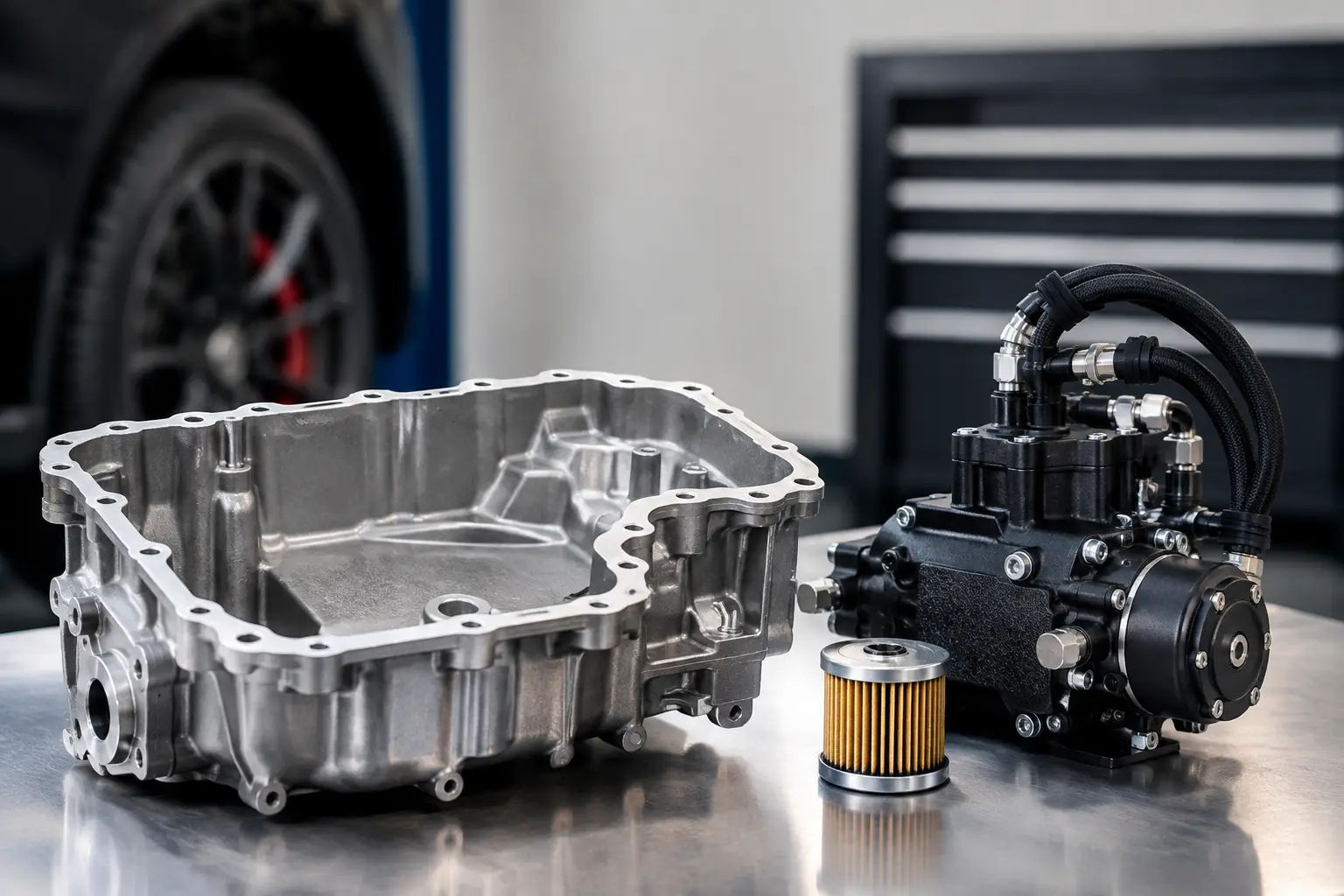
A dry sump relocates the main oil supply to an external reservoir. One or more external scavenge pump stages pull oil and blow-by from a shallow pan, then send that mixture to the tank for separation and deaeration. A pressure stage supplies clean oil back to the engine at controlled pressure.
That layout adds hardware, plumbing, and setup work, but it gives the builder much greater control over where oil goes, how it is recovered, and how the engine behaves under load.
The Most Important Dry Sump Benefits
Stable oil pressure when the car is working
The primary reason to run a dry sump is oil-pressure stability. In a wet-sump system, oil can uncover the pickup in a long corner or under braking. Even a brief pressure drop can damage rod bearings, main bearings, cam journals, turbocharger bearings, and other critical parts.
A properly designed dry-sump pan and multi-stage pump continuously scavenge oil from the engine, while the external tank maintains a controlled supply for the pressure stage. The result is far more dependable lubrication when the chassis is generating real grip and the engine is operating near its limits.
This is especially relevant for cars on sticky tires with upgraded suspension and aero. As corner speed rises, an oiling system that was acceptable on the street may become the weak point in an otherwise well-planned build.
Better crankcase control and potential power gains
A multi-stage dry sump pump does more than move oil. It can create controlled crankcase vacuum. Reducing pressure below the pistons helps limit windage, or the parasitic drag created when the rotating assembly moves through oil vapor and splash.
With less aerated oil around the crankshaft and more stable ring seal, an engine may make more usable power. The gain varies significantly by engine, RPM range, vacuum level, piston-ring package, and pump configuration. It should not be treated as a guaranteed bolt-on horsepower number.
The more meaningful advantage is repeatability. Better oil control reduces aeration and keeps the lubricant in a condition where it can protect bearings, control temperature, and do its job consistently through a session.
A lower engine position and improved packaging
Because a dry sump uses a shallow pan instead of a deep oil reservoir under the engine, it can allow the engine to sit lower in the chassis. Lowering the center of gravity is valuable in race applications, but clearance is often just as important.
Engine swaps, custom subframes, lowered track cars, and chassis with complex exhaust routing can all benefit from a compact pan design. The external tank also lets the builder place the oil volume where it is easier to access, inspect, and cool.
That does not mean every installation is simple. Tank placement must account for service access, heat, vent routing, hose length, and safe mounting. The best layout is one that works as a complete system rather than one that merely fits in the available space.
Greater oil capacity and temperature control
An external reservoir generally provides more oil capacity than a compact factory pan. More volume gives the oil additional time to shed heat and release entrained air before it returns to the pressure stage. This can improve temperature stability in endurance use, track days, drag racing, and high-horsepower forced-induction applications.
A dry sump also makes it easier to integrate a properly sized oil cooler, thermostat, and temperature monitoring strategy. More capacity is not automatically better, however. The goal is adequate volume, correct oil temperature, minimal aeration, and a tank that returns oil to the pressure stage without starvation.
For turbocharged European platforms, this matters beyond the block itself. Turbos rely on clean, stable oil supply and proper drain behavior. High exhaust temperatures, sustained boost, and extended track operation place more demand on every part of the lubrication system.
When a Dry Sump Makes Sense
A dry sump is a serious investment, so the application should justify it. It makes the most sense when the cost of an oiling failure exceeds the cost of building the system correctly from the start.
Consider it for dedicated road-course cars, endurance builds, competition engines, vehicles running sustained high lateral load, and high-RPM combinations where bearing protection is non-negotiable. It is also a strong option when an engine swap requires a shallow pan or when a builder needs maximum control over crankcase pressure.
For a modified street car that sees occasional highway pulls and limited track time, a baffled pan, upgraded pickup, improved oil cooling, and disciplined oil-level management may be the smarter solution. Some platforms have well-developed wet-sump upgrades that are proven at substantial power levels. Others have known oil-control weaknesses that need to be addressed long before adding more grip or boost.
This is why platform-specific support matters. An S58, EA888, 2.5TFSI, or built Mercedes application should be evaluated on its own oiling design, intended RPM, tire package, track use, and horsepower target. There is no universal answer based solely on a dyno number.
The Trade-Offs: Cost, Complexity, and Installation
The benefits are real, but so are the demands. A complete dry-sump conversion typically includes a pan, external pump, pulley drive, reservoir, brackets, fittings, high-quality hose, a belt system, filtration, and often an oil cooler or revised cooling circuit. Depending on the engine and chassis, fabrication may be required.
Hose routing deserves the same attention as any other critical engine component. Lines must be sized correctly, protected from heat and abrasion, secured properly, and routed to avoid restrictions. Poor scavenge routing, leaks on the suction side, an undersized tank, or an incorrectly configured vent can undermine the entire system.
Maintenance also changes. Belt tension and condition need regular inspection. Oil level is checked according to the tank manufacturer’s procedure, often with the engine at operating temperature and running or recently shut down. The tank, filter, and fittings should be inspected as part of normal track-prep service.
A dry-sump system is therefore best approached as an engineered package, not as a collection of parts. Premium components matter, but correct selection, installation, and calibration matter just as much.
Building the Right Oiling System for Your Goal
Start with the car’s real use case. Be honest about whether it is a weekend street car, a drag-focused build, a high-speed roll-race car, or a vehicle that will run repeated 20-minute sessions on slicks. Then consider engine speed, boost level, bearing clearances, turbo configuration, cooling capacity, chassis clearance, and available space for the tank.
Data logging can help validate the decision. If oil pressure falls during braking or corner entry, oil temperature climbs beyond the lubricant’s effective range, or analysis shows bearing material after track use, those are warnings to address the lubrication system before pursuing more power.
EAS Store supports performance builds where fitment and application matter as much as the part itself. Choosing the right oil-control solution for the platform can protect the engine you have already invested in and create a more dependable foundation for the next stage of the build.
The best time to think about a dry sump is before the engine is at risk, not after a momentary pressure drop turns a track session into a rebuild.