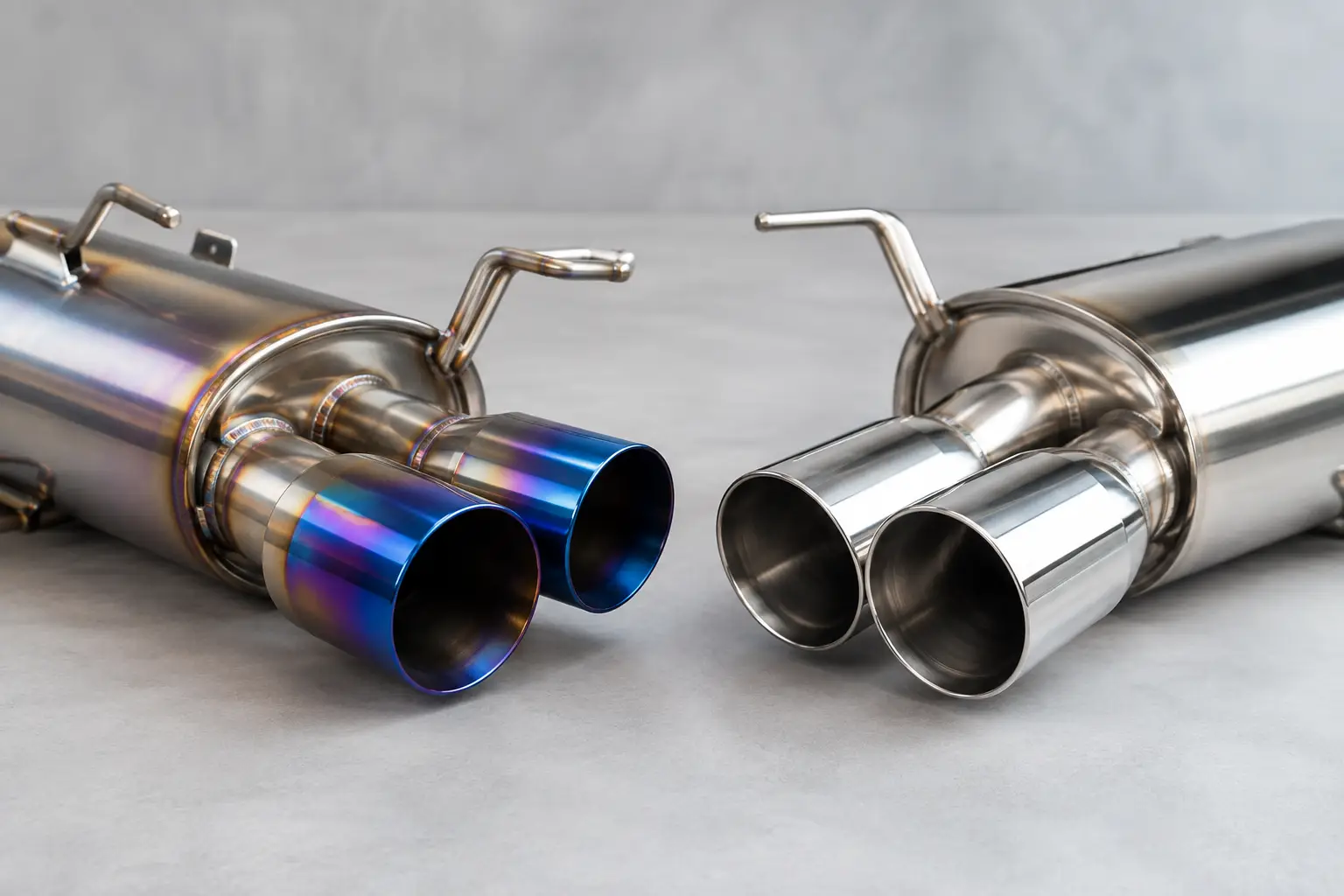
A titanium versus stainless exhaust decision can remove meaningful weight from a performance build, but material alone does not make one system automatically better. On an RS3, G80 M3, Golf R, or AMG, the right choice comes down to the car’s use, the exhaust design, the budget, and how much refinement you expect on the street.
Titanium earns its premium on vehicles where every pound matters. Stainless steel remains the smarter material for many high-power street cars because it is durable, serviceable, and delivers excellent value. The key is choosing the system that supports the entire build rather than buying material for the badge on the tip.
Titanium Versus Stainless Exhaust: The Real Difference
The largest difference is weight. Titanium has roughly half the density of common exhaust-grade stainless steels, so a properly engineered titanium cat-back can save 20 to 40 pounds or more compared with a similar stainless system. The exact number depends on pipe diameter, wall thickness, muffler construction, valve hardware, and whether the comparison includes downpipes or midpipes.
That reduction is not merely a specification-sheet win. Exhaust weight sits low in the chassis but extends over a long section of the vehicle. Taking mass out from behind the cabin can help a car feel slightly more responsive during transitions, braking, and acceleration. On a dedicated track car, time-attack build, or lightweight street project, that is a legitimate advantage.
Stainless steel is heavier, but high-quality 304 stainless exhausts are far from a compromise. They resist corrosion exceptionally well, tolerate repeated heat cycles, and provide the strength needed for daily-driven, high-output European platforms. For many owners, a stainless system provides the performance, sound, and fitment they want without committing titanium-level budget to a part that may see potholes, winter roads, and thousands of street miles.
Material is not the whole performance story
An exhaust does not create power simply because it is titanium. Horsepower gains come from flow capacity, pipe routing, bend quality, transitions, resonator design, muffler design, and how the system works with the turbochargers, tuning, and factory valves.
A well-designed 3.5-inch stainless exhaust can outperform a poorly engineered titanium system. Likewise, on a modified S58 or DAZA 2.5TFSI build, downpipe selection and calibration often have a larger impact on output than the cat-back material. Titanium’s main performance benefit is weight reduction, not a guaranteed increase in peak horsepower.
Weight Savings: Where Titanium Makes Sense
Titanium makes the most sense when the build has a defined weight target or when the vehicle regularly sees competition use. A track-focused BMW G8X, an Audi TTRS being prepared for drag racing, or a heavily modified MQB car can all benefit from removing weight without sacrificing exhaust diameter or valve functionality.
It is also a strong choice for owners who have already addressed the larger weight-saving opportunities. Lightweight wheels, brake components, seats, battery solutions, and exhaust systems can work together to make a measurable difference. Installing titanium while retaining heavy wheels and other easily replaced components may not provide the same return.
For a daily-driven car, be realistic about what 25 or 30 pounds changes. The car will not suddenly gain 50 horsepower or transform its handling balance. It can feel sharper, and it is unquestionably a premium component, but the value equation depends on how you use the vehicle.
Sound, Heat, and Daily-Driver Behavior
Titanium is known for a sharper, more exotic tone. It often produces a higher-pitched character than stainless, particularly at higher rpm. On turbocharged cars, this can bring out more turbine and induction character while keeping the exhaust note crisp. Some owners prefer that motorsport edge. Others find it less substantial than the deeper tone associated with stainless systems.
Sound quality depends heavily on the manufacturer’s acoustic engineering. Resonator placement, muffler volume, valve programming, and pipe length all matter more than a simple titanium-versus-stainless label. A valved exhaust with a properly developed quiet mode is usually the better choice for an owner who drives long distances, uses the car early in the morning, or wants to avoid drone.
Titanium also handles heat differently. It has lower thermal conductivity than stainless, which means it can retain more heat in the exhaust gas rather than transferring it through the pipe wall as quickly. That is useful in some performance applications, but it does not eliminate the need for proper heat management around fuel lines, underbody panels, diffusers, or sensitive electronics.
Both materials become extremely hot. Fitment, clearance, shielding, and correct installation hardware remain critical, especially with larger-diameter systems on tightly packaged European chassis.
Durability and Serviceability
Quality 304 stainless steel is a proven choice for a street car. It resists corrosion well, handles normal road exposure, and is relatively straightforward for experienced fabricators to repair or modify. If you live where roads are salted or your car sees year-round use, stainless offers valuable peace of mind.
Titanium is corrosion-resistant and exceptionally strong for its weight, but it demands more care during manufacturing and repair. Welding titanium requires a controlled process and proper gas shielding. A local exhaust shop that can quickly repair stainless may not be equipped to work on titanium to the same standard. If a titanium section is damaged by road debris, poor jack placement, or a track off, repairs can be more specialized and expensive.
Neither material excuses poor design. Thin tubing, weak hangers, poor valve integration, or inadequate flex sections can create rattles, cracks, and fitment problems regardless of the alloy. Buy exhaust systems from manufacturers with a documented reputation for vehicle-specific engineering, not generic universal components adapted to fit.
Cost: Pay for the Goal, Not the Label
Titanium exhaust systems commonly cost substantially more than comparable stainless options. That price reflects material cost, specialized fabrication, lower production volume, and the engineering required to build a lightweight system that remains durable and properly fitted.
For a street-driven 500- to 700-horsepower car, stainless often delivers the strongest value. You can direct the remaining budget toward tuning, intercooling, fueling, tires, brake pads, or suspension setup – upgrades that may produce a more noticeable change in lap times, traction, or reliability.
Titanium becomes easier to justify when the exhaust is part of a larger no-compromise build. If you are selecting lightweight wheels, premium braking hardware, track-capable cooling, and a purpose-built chassis package, the exhaust should match that standard. In that setting, the added cost supports a clear vehicle strategy.
Choosing the Right Exhaust for Your Platform
Start with the vehicle, not the material. Confirm the exact chassis, engine code, drivetrain configuration, model year, and whether the car has factory exhaust valves or an OPF/GPF-equipped system. Small differences can change fitment, valve behavior, and the parts required for installation.
Then decide how the car will be used. A daily-driven Audi RS3 that makes occasional spirited runs may benefit most from a refined 304 stainless valved cat-back. A BMW M2 Competition built around track days and weight reduction may justify titanium. A high-horsepower Mercedes project may need the strongest focus on exhaust diameter, thermal clearance, and compatibility with the intended turbo and fueling package before material enters the conversation.
Also consider the rest of the exhaust. Pairing a very aggressive downpipe setup with an unresonated titanium cat-back can create a volume level that is exciting for a short pull but tiring on a highway drive. Conversely, a resonated stainless system may preserve a strong exhaust character while making the car easier to live with every day.
EAS Store can help serious enthusiasts narrow the options by platform and build objective, whether the priority is low weight, a controlled valved sound, high-flow capacity, or reliable fitment on a modified European vehicle.
A titanium system is a focused upgrade for drivers chasing lower mass and a distinct motorsport character. A premium stainless system is often the long-term street performance choice. Choose the exhaust that suits the way the car actually gets driven, and the result will feel right long after the first cold start.