A boost gauge can make a build look simple: turn up the pressure, make more power. But the question, can stock rods handle boost, is not answered by a single PSI number. A factory connecting rod does not know whether the turbo is making 18 psi or 32 psi. It responds to cylinder pressure, combustion timing, torque, RPM, detonation, and the condition of every part around it.
For a street-driven MQB car, an Audi 2.5TFSI, or a BMW S58, the right answer starts with the engine code and ends with the complete combination. Stock rods can support serious performance on some modern European engines. On others, a torque-heavy tune or one bad knock event can put the rods well beyond their intended margin.
Can Stock Rods Handle Boost? The Real Answer
Yes, stock rods can handle boost – sometimes a substantial amount of it. The limitation is not boost pressure alone. It is the peak compressive load created during combustion and the repeated stress cycles the rod sees over thousands of miles, launches, pulls, and track sessions.
That is why two cars at the same boost level can have completely different outcomes. A properly calibrated setup on quality fuel, with controlled low-RPM torque and stable charge temperatures, may live reliably. Another car with an aggressive timing map, hot intake air, weak fuel delivery, and a hard-hitting midrange torque spike may bend a rod at lower boost.
Factory rods are engineered around the OEM power target, expected service life, emissions requirements, and manufacturing cost. Many are stronger than enthusiasts assume, particularly in modern turbocharged performance engines. Still, factory strength is not an unlimited invitation to chase dyno numbers.
Boost Is a Measurement, Not a Rod Rating
Boost is simply manifold pressure above atmospheric pressure. It does not show how efficiently the turbocharger is operating, how much heat it is adding, how much airflow the engine is consuming, or what the ECU is doing with ignition timing.
A larger, efficient turbo can produce more airflow at a given boost level than a smaller turbo operating near its limit. Likewise, 25 psi on a 2.0-liter engine is not comparable to 25 psi on a 2.5-liter or 3.0-liter engine. Compression ratio, cam timing, exhaust backpressure, fuel quality, and intercooler performance all change the effective load on the rotating assembly.
The more useful questions are: What wheel torque is the engine making? At what RPM does it make that torque? What fuel is being used? Is the calibration designed to protect the stock bottom end? Those answers mean more than the boost number on a data log.
Torque Is Usually the Bigger Concern
Connecting rods are heavily loaded during the combustion event, especially when cylinder pressure peaks early in the stroke. High torque at low RPM is often the most dangerous operating condition because the engine is producing substantial cylinder pressure while the rod and crank assembly have less rotational momentum to manage the load.
This is why experienced calibrators often limit torque in the lower and middle RPM range on stock-engine builds. A tune that delivers a smoother torque curve may make slightly less peak torque on paper while creating a much better survival margin for the rods, pistons, clutch or transmission, and tires.
Chasing an oversized midrange number can feel impressive on the street. It can also be the fastest route to a windowed block when the rest of the combination is already near its limit.
Detonation Changes Everything
A rod may tolerate repeated high-load pulls when combustion is controlled. Detonation and pre-ignition are different. These abnormal combustion events create extreme pressure spikes that occur outside the conditions the engine was designed to withstand.
Poor fuel, excessive timing, inadequate fueling, high intake temperatures, spark plug issues, or a calibration that is too aggressive for the conditions can all contribute. One severe event can damage a piston, ring land, bearing, or rod. A stock bottom end that has survived months at a given power level is not proof that it is safe from a bad tank of fuel, a heat-soaked track session, or an overlooked mechanical problem.
Why Engine Platform Matters More Than Forum Numbers
There is no universal stock-rod horsepower limit. Even within the same model family, changes in engine generation, rod design, piston design, compression ratio, turbo system, and factory calibration can alter the answer.
Some engines develop a reputation for taking major power because their rods, crankshaft, block, and piston design provide a healthy reserve. Others are known to fail when torque rises quickly, even if the final horsepower figure seems modest compared with another platform. A published dyno result also leaves out critical context: drivetrain type, correction factor, fuel, mileage, weather, tune strategy, and whether the engine was opened after the test.
Use community results as a starting point, not as an engineering guarantee. Look for repeated results from comparable cars running the same fuel, turbocharger, and use case. A drag car that makes a few clean passes has different needs than a daily-driven vehicle that sees heat, traffic, highway pulls, and occasional track duty.
Set a Safe Target Before Buying Parts
A reliable boosted build begins with a power target that matches the intended use. Start by defining whether the car is a responsive street build, a road-course car, a roll-race setup, or a dedicated drag project. Then work backward through the supporting hardware and calibration requirements.
For a stock-rod build, prioritize controlled torque delivery over the largest possible dyno sheet. Select a turbocharger that operates efficiently at your target airflow, use adequate intercooling, and make sure the fuel system can maintain pressure and injector headroom under full load. The calibration should account for the actual fuel in the tank, not the best fuel you hope to find every time.
Engine health is equally relevant. Compression and leak-down results, oil pressure, service history, plug condition, and cooling-system operation should be checked before adding substantial power. Increasing boost on an engine with existing ring seal, fueling, or cooling issues does not create a performance build. It accelerates a failure that was already developing.
At EAS Store, fitment and component selection should be treated as part of the power plan. An intercooler, intake, downpipe, fuel-system upgrade, and turbocharger must suit the specific engine and the intended output range. Buying premium parts is worthwhile, but no hardware combination can compensate for a tune that ignores the engine’s mechanical limits.
When Forged Rods Become the Right Move
Forged rods are not mandatory for every turbo upgrade. If the goal is a conservative street setup within a well-established stock-bottom-end range, retaining factory rods can be a sensible decision. It keeps the project simpler, less expensive, and closer to the reliability profile of an unopened engine.
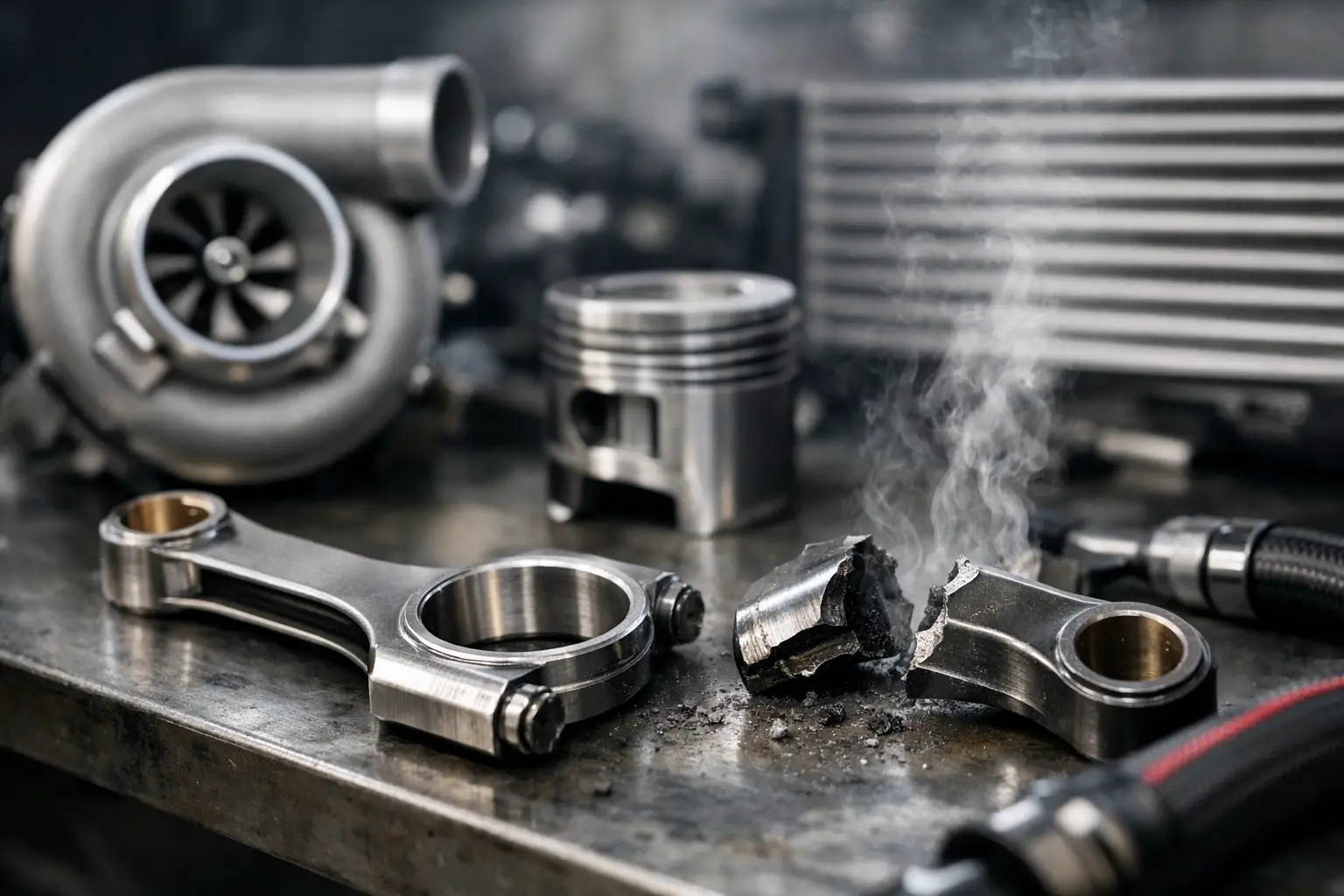
The equation changes when the target requires sustained high cylinder pressure, aggressive torque, high-RPM operation, ethanol-based fueling at elevated output, large-frame turbocharger airflow, or repeated competition use. At that point, forged rods are cheap insurance compared with the cost of rebuilding an engine after a failure.
A rod upgrade is also rarely just a rod upgrade. Opening the engine creates an opportunity to inspect the block, measure bores, address piston and ring strategy, evaluate bearings, balance the rotating assembly, and set clearances for the intended use. Building an engine correctly costs more than installing a stronger connecting rod, but it gives the entire bottom end a defined operating range rather than a hopeful one.
Stronger Parts Still Need a Smarter Calibration
Forged rods raise the mechanical ceiling, but they do not eliminate the need for fuel quality, proper tuning, cooling capacity, and data logging. Pistons, ring lands, head gasket sealing, valve train control, transmission capacity, and drivetrain durability can become the next constraints.
That is the reality of serious performance work: every weak link moved creates a new part of the system that deserves attention. The strongest build is not the one with the most expensive internal parts. It is the one with components, fuel, cooling, and calibration matched to the same honest power target.
The Practical Rule for Stock-Rod Boost Builds
Do not ask how much boost stock rods can take in isolation. Ask how much cylinder pressure and torque your specific engine can tolerate with your turbo, fuel, tune, RPM range, and intended use. Then leave margin for heat, fuel variation, mileage, and the occasional imperfect condition that real cars encounter.
If your plan sits near the known edge of the factory bottom end, build for forged rods before turning the boost up. If it sits comfortably within a proven range, invest in the supporting systems and a calibration that keeps torque controlled. A sensible power target will always make a faster, more enjoyable car than an impressive boost number followed by an expensive engine teardown.