The EA888 in a Golf R can make serious power with remarkably few hardware changes, but it asks more of its oil than a naturally aspirated commuter engine ever will. This Golf R engine oil guide focuses on what actually matters: the VW approval your engine requires, viscosity that suits its use, and an oil-change plan that matches the car rather than a dashboard reminder.
For a stock daily driver, the correct oil is straightforward. For a tuned car, a car that sees repeated full-boost pulls, or one that spends weekends at the track, the choice deserves more attention. Oil is not a horsepower part, but it is one of the most important reliability parts in the build.
Start With the Correct VW Oil Approval
The label on a bottle can be misleading if you only look at the large viscosity number. A 5W-40 and another 5W-40 may not offer the same specification, additive package, volatility control, or approval status. For a turbocharged, direct-injected Volkswagen engine, the manufacturer approval is the starting point.
Most North American Mk7 and Mk7.5 Golf R models are commonly associated with oil carrying a VW 502 00 approval. Many owners use premium full-synthetic 0W-40 or 5W-40 oils that are formally approved to that standard. The exact requirement can vary by model year, market, and service documentation, so confirm the specification in your owner’s manual or on the oil cap before ordering.
Later Golf R generations may call for a different, lower-viscosity oil specification, such as VW 508 00. That distinction is not minor. A newer engine designed around a specific low-SAPS, low-viscosity formulation should not receive a heavier oil simply because heavier sounds safer. Follow the required approval first, then consider viscosity options only where Volkswagen permits them.
Look for language stating the oil is VW approved for the relevant specification. “Recommended for,” “suitable for,” or “meets the requirements of” can indicate a quality product, but that is not identical to a formal manufacturer approval. On a modified performance car, proven oil from a reputable manufacturer and a documented approval provide a much better baseline than marketing language alone.
Golf R Engine Oil Guide: Choosing Viscosity
Viscosity is expressed with two numbers, such as 0W-40 or 5W-40. The number before the W describes cold-temperature flow characteristics. The second number describes the oil’s viscosity at operating temperature. In practical Golf R ownership, that means an oil must reach the turbocharger and valvetrain quickly on cold startup while maintaining a protective film when oil temperature rises under boost.
For many Mk7 and Mk7.5 Golf R owners using a 502 00-approved oil, 0W-40 and 5W-40 are both common choices. The best option depends on climate, usage, oil approval, and the engine’s condition.
A 0W-40 can be a strong fit for a year-round street car, especially in colder regions. It offers excellent cold-start flow while retaining a 40-weight operating-temperature rating. A 5W-40 is also a proven choice for warm climates, spirited driving, and higher-load use. Neither grade automatically makes more power or prevents every engine issue. The value comes from using the correct approved formulation and maintaining it properly.
Avoid choosing oil by internet consensus alone. A heavily tuned Golf R in Arizona, a stock commuter in Minnesota, and a road-course car in Florida do not see the same conditions. If the vehicle is consuming oil, showing abnormal wear, or running unusually high oil temperatures, diagnose the cause rather than trying to solve it with a dramatically thicker oil. PCV issues, turbocharger seal concerns, leaks, and overextended service intervals all deserve attention.
Why Turbocharged Engines Are Hard on Oil
The Golf R’s turbocharger operates in an extreme heat environment and relies on clean, stable oil for lubrication and cooling. Add direct injection, elevated cylinder pressure, short trips, and performance tuning, and the oil can degrade faster than it would in a lightly loaded engine.
Fuel dilution is one concern, particularly on cars used for frequent short trips or repeated cold starts. Excess fuel in the oil can reduce viscosity and weaken film strength. High oil temperatures are another concern during track driving, mountain runs, or sustained high-speed operation. A quality full synthetic oil with the correct approval is engineered to manage these conditions, but no oil is immune to excessive intervals.
Modified cars place an even greater premium on maintenance. More boost and torque increase cylinder pressure and heat load. Ethanol blends, upgraded fueling, larger turbos, and aggressive calibration can all change how the engine is used. That does not mean every tuned Golf R needs race oil. It means the maintenance schedule should reflect the car’s real workload.
Set an Oil Change Interval for How You Drive
Volkswagen’s factory interval may be reasonable for a stock vehicle driven primarily on normal highway and suburban routes. It is less convincing for an enthusiast car that sees launches, dyno sessions, back-road pulls, autocross, or track days.
For a stock Golf R driven normally, many owners choose a conservative interval around 5,000 miles or once per year rather than stretching oil to the longest possible service schedule. For a tuned street car, 3,000 to 5,000 miles is a practical range, with the shorter end making sense for frequent hard driving, short-trip use, or high ethanol content.
Track-driven cars require a more deliberate approach. Change the oil before an event if the current fill already has meaningful mileage, then inspect the oil level and condition after the event. A car that spends multiple sessions at sustained oil temperature, or accumulates several track weekends, may need fresh oil substantially sooner than its street mileage suggests.
Oil analysis can be worthwhile for owners who want data instead of assumptions. A laboratory report can identify fuel dilution, viscosity loss, elevated metals, coolant contamination, and whether the current interval is appropriate. It is especially useful on high-mileage engines, larger-turbo builds, and cars that run ethanol blends regularly. One report does not establish a permanent rule, but several reports can reveal a reliable trend.
Oil Level Matters as Much as Oil Choice
The right oil cannot protect an engine if the level is low. Check the level on level ground, using the procedure specified for your generation of Golf R. Let the vehicle reach the appropriate temperature and settle time before measuring. Electronic displays are useful, but they are not a replacement for paying attention between services.
Do not overfill the engine. Too much oil can aerate under crankshaft movement and may contribute to crankcase ventilation problems. Fill carefully, allow the level to stabilize, and stay within the specified range. For track use, confirm the level before each event and bring the correct approved oil in case top-off is needed.
If the car repeatedly needs oil, treat that as information. Some consumption can occur, particularly on higher-mileage or hard-driven turbo engines, but a sudden change deserves inspection. Check for external leaks around the filter housing, drain plug, and oil pan, then consider PCV function, turbocharger condition, and any smoke or misfire symptoms.
Do Not Forget the Oil Filter and Hardware
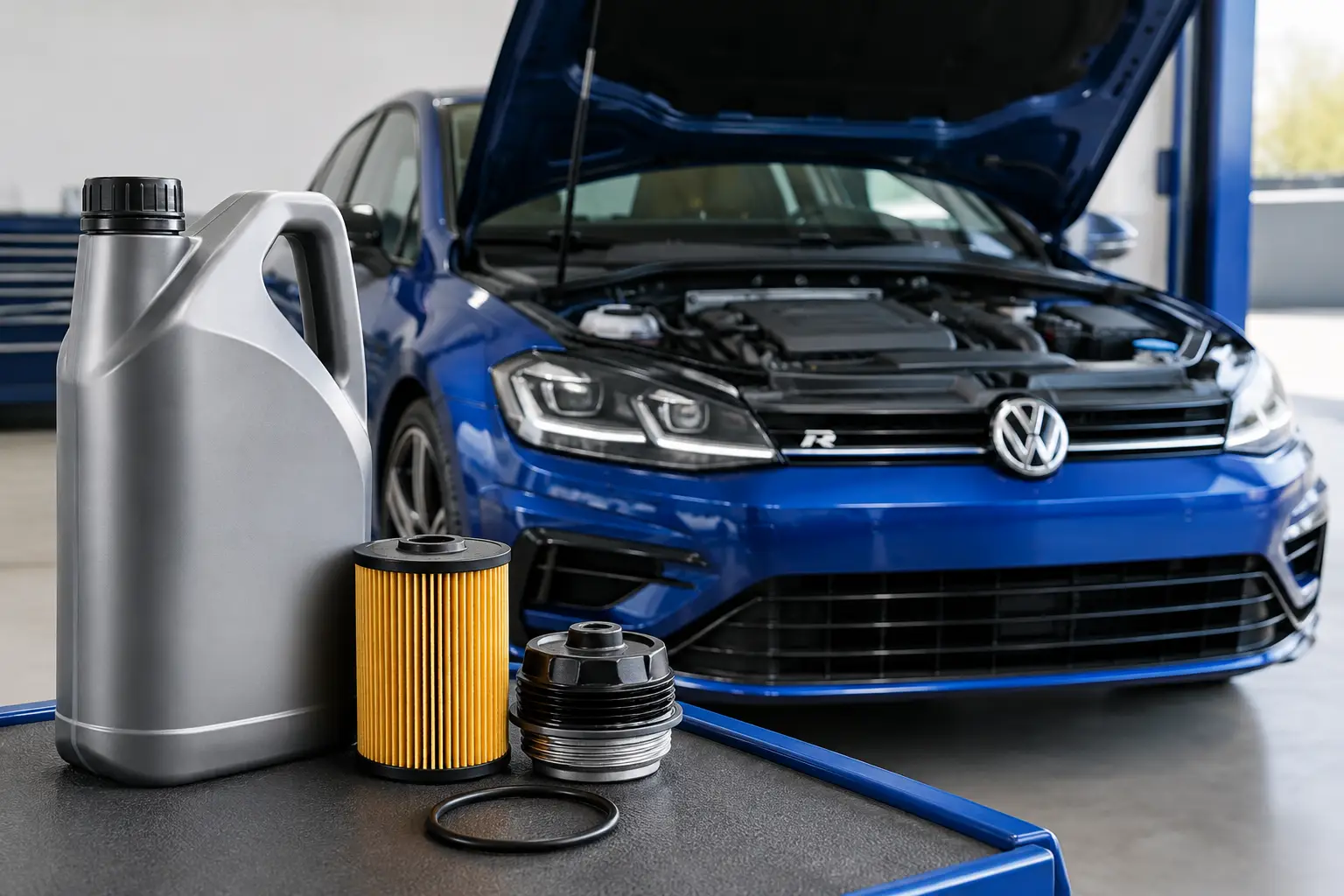
An oil change is only as good as the filter and installation. Use a quality filter designed for the correct Golf R engine application, along with the required new seals or O-rings. Cheap filters can have inconsistent media, poor bypass-valve behavior, or fitment issues that are not worth the small savings on a high-output turbo engine.
Replace the drain plug or sealing washer when the application calls for it, torque components correctly, and inspect for leaks after the first heat cycle. If you service the car yourself, keep a record of the oil brand, specification, viscosity, mileage, date, and any track events. That record helps identify consumption patterns and protects the resale story of a well-built car.
A Golf R rewards thoughtful maintenance. Choose oil by the exact VW approval your engine requires, use an interval that reflects boost and heat rather than wishful thinking, and check the level often enough to catch a problem before it becomes an engine build.