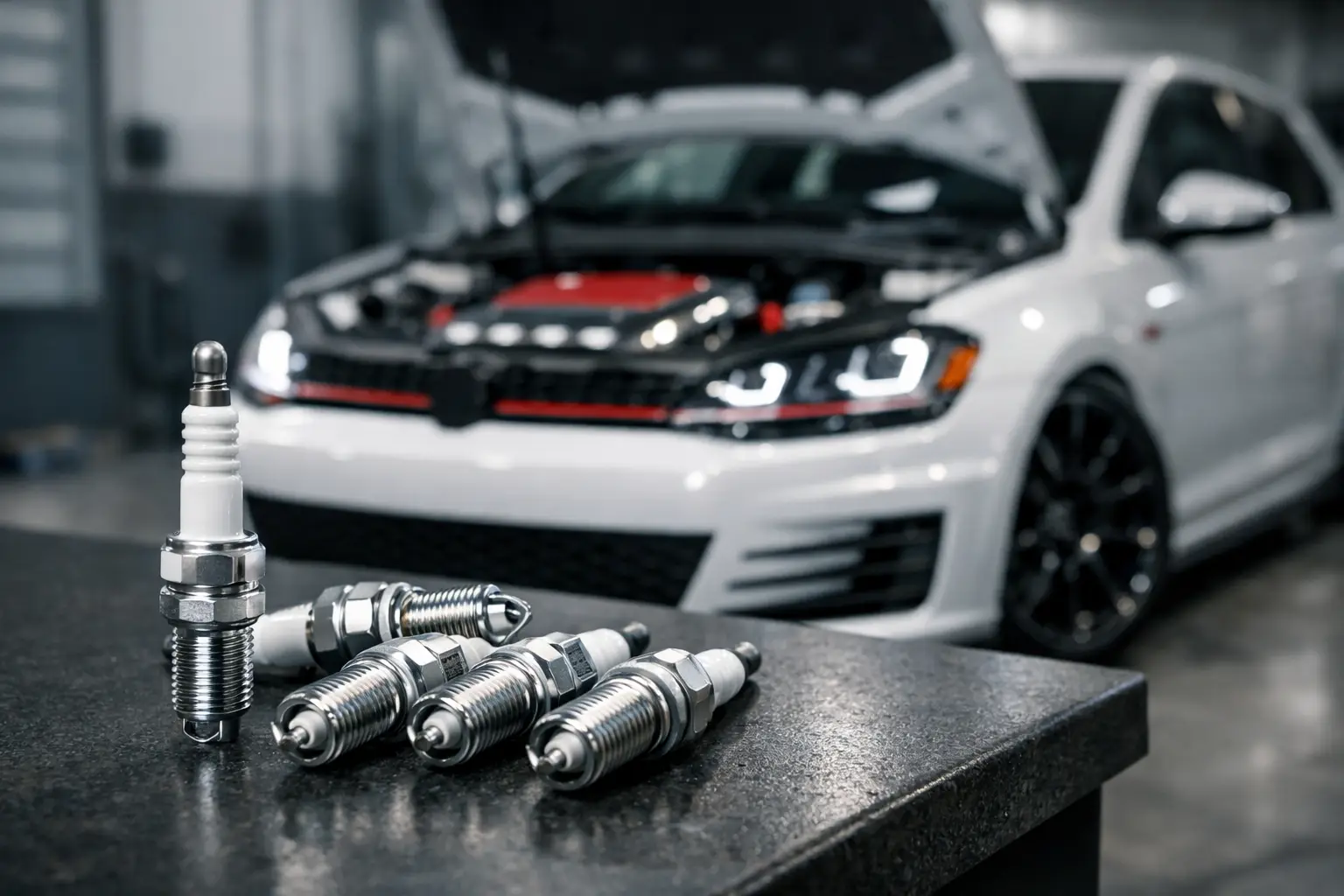
A tuned GTI will tell you pretty quickly when the spark plugs are wrong. Cold start stumble, breakup under boost, random misfire counts, or that annoying hesitation in the midrange often gets blamed on coils first. Sometimes it is coils. But if you’re asking what spark plugs for tuned GTI setups actually make sense, the answer usually comes down to power level, tune aggressiveness, fuel, and plug gap – not just buying the most expensive option on the shelf.
What spark plugs for tuned GTI setups really need
On an MQB GTI, spark plugs have a harder job once boost and cylinder pressure go up. A stock heat range plug that works fine on a factory calibration can become a weak point on a Stage 1 or Stage 2 car, especially if the tune is aggressive or the car sees repeated hard pulls. That is why tuned cars often move to a one-step-colder plug.
The reason is simple. More boost and more timing demand a plug that can control heat better and resist pre-ignition while still delivering a strong, stable spark. Go too hot and the plug can become a liability. Go too cold on a mild street setup and you can give up drivability or foul plugs sooner. There is no universal answer for every GTI, even though forum threads love to pretend there is.
For most tuned GTI owners, the sweet spot is a high-quality ruthenium or iridium plug in the correct heat range, properly gapped for the tune. Brand matters, but the right spec matters more.
Stage, fuel, and hardware change the answer
If your GTI is lightly tuned on pump gas, your plug needs are different from a car running an upgraded turbo or ethanol blend. That is where a lot of bad advice starts – someone recommends the plug that works on their setup without mentioning they are on E30, custom tuning, and a much tighter gap.
Stage 1 and mild Stage 2 GTI setups
For a typical Stage 1 GTI or a conservative Stage 2 car on 91 or 93 octane, a one-step-colder plug is usually the safe play. That gives you more thermal headroom without pushing so cold that the car becomes finicky in normal street use. On many EA888 applications, this is the baseline recommendation because it supports cleaner combustion under added boost while staying street friendly.
If the tune is known to be smooth and the car is otherwise close to stock, some owners can run a stock heat range plug with a revised gap and get away with it. That does not make it the best option. It just means the margin is wider on mild calibrations.
Aggressive Stage 2, hybrid turbo, and ethanol blends
Once boost climbs, intake temps rise, and the car sees ethanol blends or harder track use, plug selection gets more serious. A colder plug becomes more important, and gap usually needs to come down. Cylinder pressure under load can blow out the spark if the gap is too wide, even when the plug itself is technically the right heat range.
This is also where service interval shrinks. A plug that looks acceptable for daily commuting may still start showing performance issues much sooner under repeated high-load use.
Heat range matters more than marketing
The biggest thing to understand is heat range. In plain terms, a colder plug removes heat from the tip faster. That helps prevent the plug from becoming too hot under heavy load. Tuned turbo engines benefit from that because they generate more heat and pressure than stock.
For most tuned GTI applications, one step colder is the common recommendation. Two steps colder can make sense on harder builds, but that is usually not where a standard street-driven tuned GTI starts. If you jump too cold too early, you may not get the cleanest operation in normal driving, and that can show up as rougher idle, carbon buildup, or shortened plug life.
This is why serious buyers should think in terms of the whole setup, not just a catchy product label. Tune file, fuel quality, turbo setup, ambient temperatures, and driving style all matter.
The right gap for a tuned GTI
Gap is where a lot of good plugs become bad installs. A tuned GTI may use the correct plug but still misfire under load if the gap is too large. More boost increases the effort required for the spark to jump the gap, so tighter gaps are often used to maintain spark stability.
A common range for tuned GTI applications is tighter than stock, often around the mid .020s to high .020s depending on the exact setup and tuner guidance. There is no magic number for every car. Some tunes are happy at a slightly wider gap, while others want it tighter to avoid breakup at peak torque.
If you are between options, follow the tuner or plug manufacturer’s recommendation for your engine and power level first. Randomly tightening the gap because someone on social media said it fixed their misfire is not a real diagnostic process.
Too wide vs too tight
A gap that is too wide can cause spark blowout, especially in the upper RPM range under full boost. That usually feels like hesitation, breakup, or intermittent misfire during hard acceleration.
A gap that is too tight can reduce spark exposure and combustion efficiency. The car may run, but not as cleanly or as efficiently as it should. The goal is stable ignition, not the smallest gap possible.
Iridium, ruthenium, or copper?
For a tuned GTI street car, iridium and ruthenium plugs are typically the best fit. They offer strong durability, consistent spark performance, and good resistance to wear. Ruthenium plugs in particular have become popular because they tend to offer excellent longevity and stable performance in modern direct-injected turbo applications.
Copper plugs still have a place in motorsports and certain niche setups, but they wear faster and usually are not the best answer for a street-driven MQB car unless there is a very specific reason to use them. Most GTI owners looking for reliable tuned performance are better served with a premium iridium or ruthenium option from a trusted manufacturer.
That said, material alone does not guarantee results. A premium plug in the wrong heat range or with the wrong gap is still the wrong plug.
Signs your current plugs are not right
A GTI does not always throw a dramatic check engine light the first time plugs start falling behind. Sometimes the clues are subtle. If the car idles slightly rougher after tuning, feels inconsistent on back-to-back pulls, or starts showing misfire activity in logs without a clear coil issue, plugs should be high on the list.
You may also notice reduced fuel economy, slower cold starts, or a car that feels fine at part throttle but breaks up near peak boost. On a tuned car, that is often where plug gap or heat range problems show themselves first.
Reading plugs still matters too. If you are pushing the car hard, plug condition can tell you a lot about how the engine is behaving. For experienced builders and shops, that inspection can reveal whether the setup is happy, hot, rich, or simply overdue for maintenance.
How often should tuned GTI plugs be changed?
On a stock commuter, spark plug intervals can be fairly long. On a tuned GTI, that logic does not hold up. More boost and more heat shorten the useful life of the plug, even if it still looks decent to the eye.
A street-driven Stage 1 or Stage 2 car should generally see plugs inspected and replaced more frequently than factory service intervals suggest. If the car is driven hard, run on ethanol blends, or sees track days, expect to service them sooner. Waiting until the car misfires is the expensive way to manage ignition maintenance.
For many enthusiasts, plugs become a routine check item alongside coils, oil quality, and logs. That approach makes sense. Spark plugs are relatively inexpensive compared to the time wasted chasing drivability issues that come from worn or mismatched ignition components.
The best answer is the setup-specific answer
If you want the short version of what spark plugs for tuned GTI applications make sense, here it is: most lightly to moderately tuned cars do well with a quality one-step-colder iridium or ruthenium plug, gapped properly for the tune. More aggressive setups may need a colder option and a tighter gap, especially with ethanol, bigger turbos, or track use.
What you should not do is treat every tuned GTI the same. A daily-driven Stage 1 car on pump gas has different needs than a hybrid turbo car making significantly more power. Good parts selection comes from matching the plug to the actual engine setup, not chasing whatever plug is currently popular.
That is where a specialist supplier matters. EAS Store works with performance-focused European platforms every day, so the goal is not just selling a spark plug – it is helping you get the right one for your exact GTI, tune level, and use case.
If your GTI is tuned and the ignition setup is still an afterthought, start there. Few parts are cheaper, and few mistakes show up faster when you put your foot down.