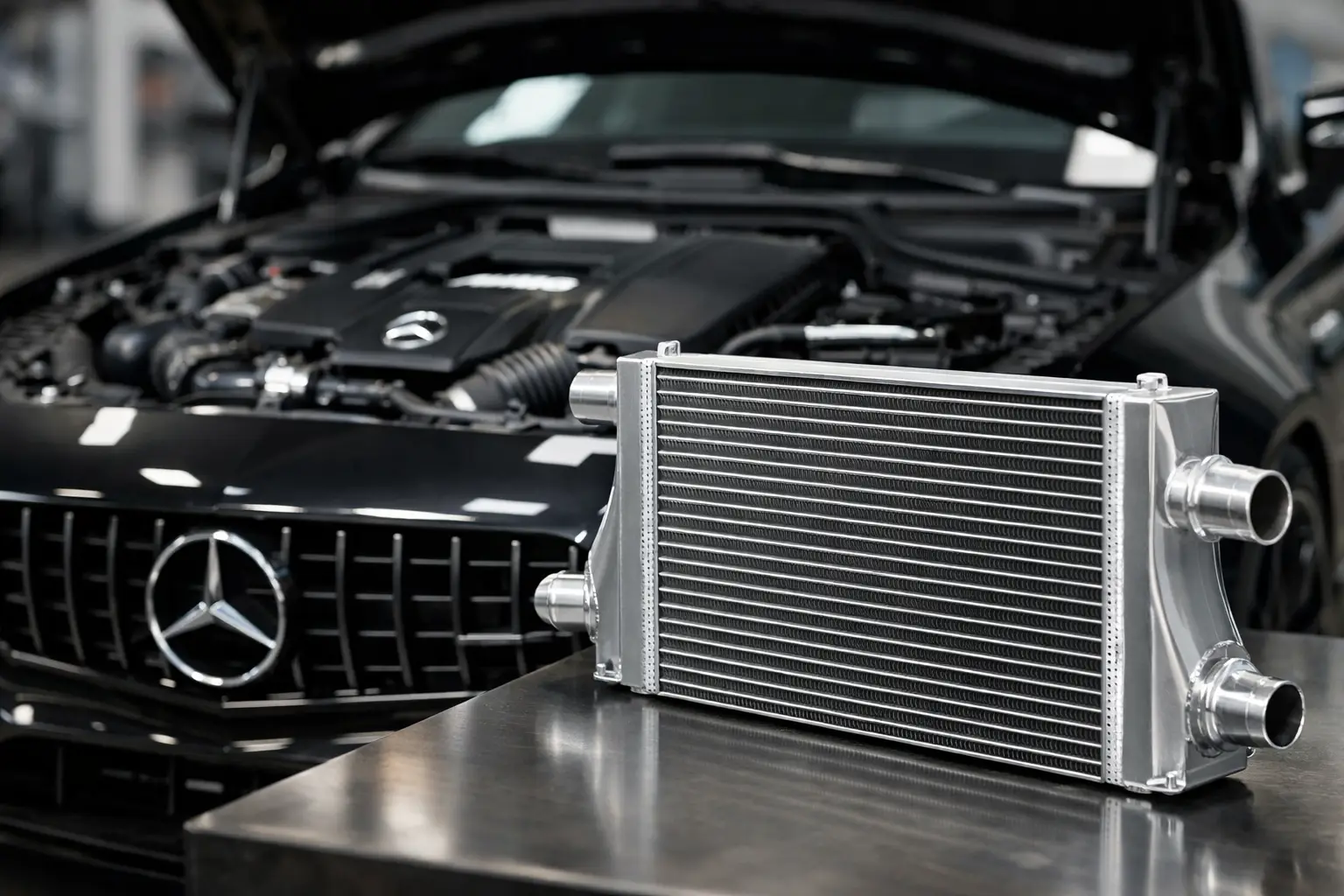
Hard pulls that feel strong at first and then softer by the third or fourth hit usually point to one thing on a boosted Mercedes platform – heat. A mercedes amg heat exchanger upgrade is one of the most effective ways to keep intake air temperatures under control, especially once you add tuning, smaller pulleys, or more aggressive driving.
For many AMG owners, the issue is not peak power on the first dyno run. It is repeatability. Supercharged and turbocharged AMG models can make serious power, but they also generate serious heat. When the cooling system for the charge air gets overwhelmed, the ECU starts protecting the engine by reducing timing and power. That is where a larger, better-designed heat exchanger earns its place.
Why AMG platforms respond so well to better cooling
Mercedes AMG applications are engineered to perform, but factory cooling systems are built around stock output, stock driving patterns, and OEM packaging limits. Once you start asking more from the car, those limits show up quickly.
On supercharged AMG models, the intercooler circuit relies on a front-mounted heat exchanger to pull temperature out of the coolant after it leaves the blower’s intercooler bricks. On turbo AMG platforms, the exact layout may differ, but the goal is the same – remove heat efficiently so the engine sees cooler, denser charge air. When temperatures climb, power consistency drops.
That matters on the street, where a tuned car may see repeated highway pulls, and it matters even more on track, where heat soak builds lap after lap. Even in warm daily driving conditions, stop-and-go traffic and short recovery windows can expose the weak point in the factory system.
What a mercedes amg heat exchanger upgrade actually changes
A quality upgrade usually increases core size, improves fin density, and uses a design that moves more coolant through more cooling surface area. Some systems also improve end tank design to reduce restriction and promote better flow.
The result is not magic horsepower from the part alone. The real gain is temperature control. Lower intake air temperatures help the car hold commanded boost and timing more consistently. That means the car feels more stable, especially after multiple pulls, during hot weather, or in demanding use.
This is why experienced builders treat cooling as a supporting mod, not an afterthought. If you are raising boost or targeting more power, protecting that power becomes part of the build plan.
The difference between peak power and usable power
A lot of owners shop for parts based on the highest number they can quote. That is understandable, but cooling upgrades are about preserving performance you already paid for. A car that makes one strong pull and then falls off is less impressive than a car that repeats the same result over and over.
A well-matched heat exchanger helps maintain usable power. It can also reduce the rate at which the car heat soaks between runs, which is a major advantage for spirited street driving and drag racing alike.
When you should consider a Mercedes AMG heat exchanger upgrade
If the car is stock and used mainly for normal commuting, the factory unit may be adequate. But once you move beyond stock intent, the conversation changes fast.
A heat exchanger upgrade makes sense when the car is tuned, running a pulley setup, upgraded turbos, ethanol blends, or any combination that raises thermal load. It also makes sense if you live in a hot climate, drive aggressively, or spend time at the drag strip or road course. Even a mildly modified AMG can benefit if it regularly sees repeated pulls.
One of the most common mistakes is waiting until the car shows obvious signs of heat soak before addressing cooling. By that point, you are already giving away performance. On many builds, cooling should be handled early, alongside intake, exhaust, or calibration work.
Street car vs track car priorities
Not every owner needs the largest core available. For a street-driven AMG with a tune and occasional pulls, a well-engineered direct-fit upgrade is often the right answer. It improves thermal capacity without pushing the build too far into race-car compromise.
A track-focused setup may justify a more aggressive solution, especially if sessions are long and ambient temperatures are high. In those cases, overall cooling strategy matters more than any single part. Heat exchanger size, coolant pump performance, ducting, and airflow management all start working together.
What to look for in a quality heat exchanger
Fitment comes first. On Mercedes platforms, small differences in chassis, engine variant, bumper design, and model year can affect compatibility. Serious buyers know that close-enough fitment is not good enough, especially on premium European cars where packaging is tight.
After fitment, core design matters. A larger core is helpful, but it is not the only factor. Efficient airflow through the core, proper end tank construction, and pressure characteristics all influence performance. A unit that looks impressive in photos but restricts flow or suffers from poor mounting design is not a premium solution.
Material and construction quality also matter. You want a part that can handle repeated heat cycles, vibration, and real-world use without leaks or mounting issues. For higher-output builds, this is non-negotiable.
Don’t ignore install and system balance
A heat exchanger is only as effective as the system around it. Coolant condition, pump health, line routing, and bleeding procedure all affect results. A poor install can make a good part perform like a bad one.
This is where platform-specific knowledge matters. Enthusiasts and workshops who understand AMG cooling layouts usually avoid the common problems – trapped air, poor hose routing, or choosing a part that interferes with other front-end upgrades.
Expected results and realistic expectations
The biggest improvement is usually consistency, not a dramatic before-and-after dyno headline. Owners often notice that the car stays sharper after repeated acceleration, recovers faster between runs, and feels less sensitive to hot weather.
How much improvement you see depends on the starting point. A tuned AMG in a hot climate with a stressed factory cooling system may show a clear difference immediately. A lightly used street car in mild weather may show a smaller but still worthwhile improvement over time.
It also depends on the rest of the setup. If the tune is aggressive and the car is producing much more heat than stock, the heat exchanger becomes even more valuable. If other parts of the system are limiting performance, results may be less dramatic until the build is better balanced.
Common mistakes buyers make
The first is buying based on price alone. Cooling parts are not where experienced builders like to gamble. Poor weld quality, questionable fitment, and inconsistent performance can turn a lower-cost option into the more expensive one.
The second is assuming all upgraded heat exchangers perform the same. They do not. Core thickness, internal design, mounting strategy, and real airflow characteristics vary a lot from brand to brand.
The third is treating the heat exchanger as a standalone fix for every temperature issue. If the car has a weak pump, poor ducting, or an overly aggressive setup without enough supporting mods, one part will not solve everything.
Building the right cooling package
For many AMG owners, the best results come from looking at cooling as a package. A heat exchanger is often the foundation, but supporting upgrades may include better coolant circulation, upgraded reservoirs, or airflow-focused front-end components depending on the application.
That does not mean every car needs every part. It means the build should match the goal. A weekend street car chasing consistent power wants a different solution than a track car running long sessions in summer heat. The right answer is usually the one that fits the platform, the horsepower target, and how the car is actually driven.
This is also why consultative support matters. On a premium European platform, choosing parts by vehicle alone is not always enough. You want to account for model specifics, current mods, and future plans so the cooling system does not become the bottleneck later.
For AMG owners who care about repeatable performance, a heat exchanger upgrade is not flashy, but it is one of the smartest moves in the build. Stronger temperature control helps the car deliver the power it already has, with less compromise when conditions get tough. If your setup is moving beyond stock, cooling is not the side note – it is part of doing the build correctly.