A Mercedes-AMG can make serious power with engine calibration, intake, exhaust, turbo, and fueling upgrades. But once torque climbs beyond the factory target, the transmission becomes more than a way to select gears. It becomes the system deciding how consistently that power reaches the tires. This Mercedes AMG transmission tuning guide explains what a TCU calibration changes, when it makes sense, and how to build around it without treating the gearbox as an afterthought.
For a street-driven C43, C63, E63, GT, or newer turbo AMG platform, the right transmission tune can sharpen a car that already feels fast. For a high-output build, it may be the difference between a calibration that repeatedly pulls torque and one that can use the engine’s power safely within the limits of the hardware.
What Transmission Tuning Actually Changes
Transmission tuning is commonly called TCU tuning because the transmission control unit manages shift strategy, clutch or converter behavior, torque intervention, and protective logic. It is not simply a request for harder shifts. A quality calibration revises the relationship between engine torque, transmission torque capacity, gear selection, and clutch pressure.
On many AMG applications, the factory TCU will request torque reduction during shifts or limit delivered torque in lower gears. That strategy protects internal components, controls heat, and preserves the refined behavior expected from a factory luxury performance car. Once the ECU is calibrated for more boost, more airflow, or higher ethanol content, those stock transmission limits can become the bottleneck.
A properly matched TCU tune may adjust torque limiters, shift points, shift speed, clutch pressure targets, manual-mode logic, kickdown behavior, launch parameters, and torque reduction during gear changes. The exact features depend on the transmission and available software support. Not every AMG gearbox responds the same way, and not every feature is appropriate for every build.
Identify Your AMG Transmission Before Choosing Software
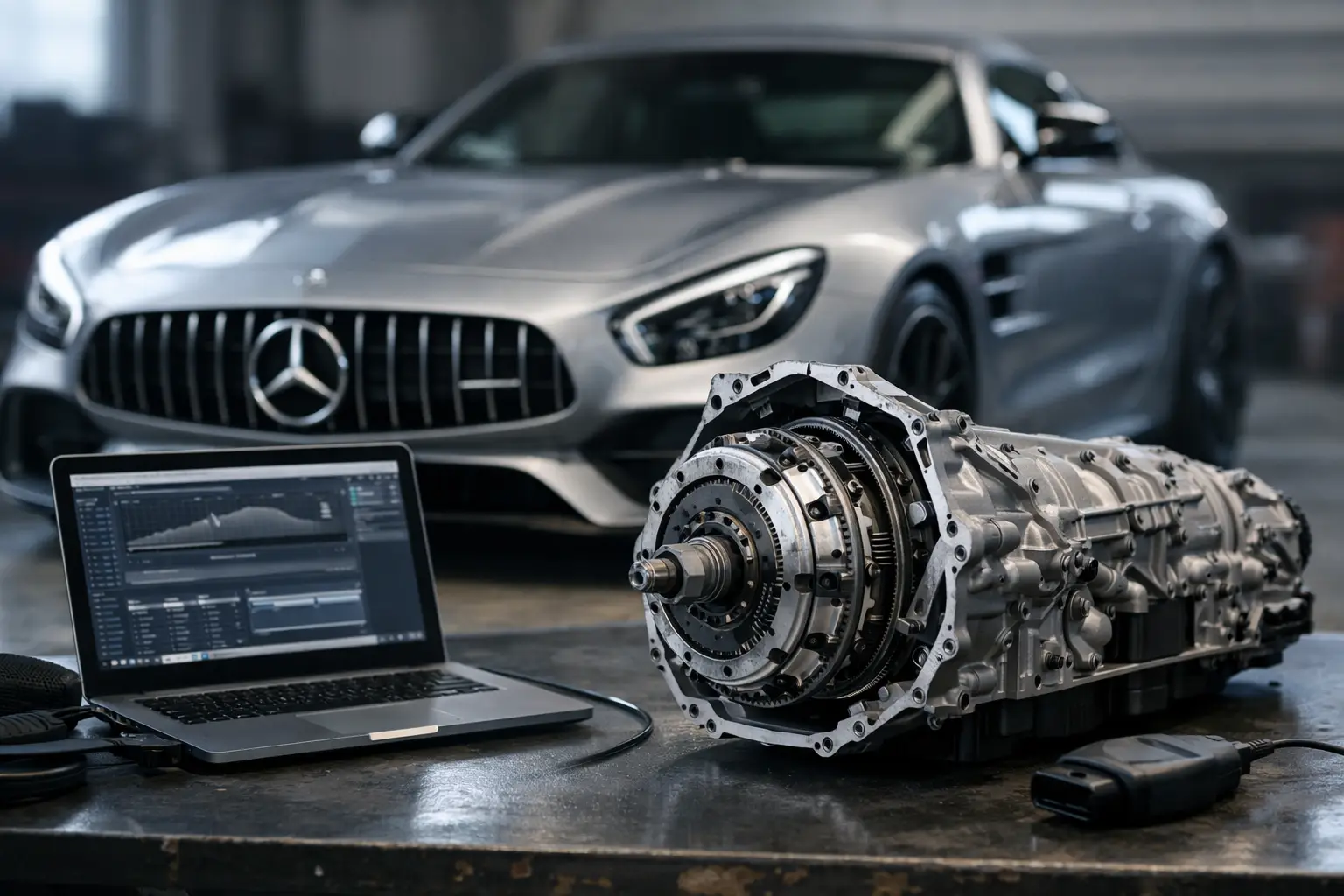
Mercedes-AMG has used several transmission designs across its lineup. Older models may use a conventional automatic with a torque converter, while many modern AMG applications use AMG SPEEDSHIFT MCT units that replace the converter with a wet start-off clutch. Some compact AMG models use dual-clutch transmissions. Newer platforms can use advanced nine-speed configurations with their own control strategies.
That matters because a DCT, MCT, and conventional automatic manage torque in fundamentally different ways. A dual-clutch transmission depends heavily on clutch clamping pressure, clutch temperature, and precise adaptation values. An MCT transmission has its own wet-clutch behavior during launch and low-speed operation. A torque-converter automatic may respond well to changes in shift scheduling and torque management, but it still has mechanical and thermal limits.
Start with the full vehicle identification, model year, engine code, transmission code, drivetrain layout, and current ECU tune. A 4MATIC AMG and a rear-wheel-drive AMG with a similar engine can have different transmission hardware, different software versions, and different launch behavior. Parts and calibrations should be selected by confirmed application, not by a forum post about a similar-looking car.
ECU and TCU Calibrations Must Agree
The strongest results come when the engine and transmission calibrations are designed to work together. An ECU tune may raise requested torque well beyond stock. If the TCU retains restrictive torque monitoring or lower torque ceilings, the transmission can intervene, reduce throttle, alter boost delivery, or generate inconsistent shift behavior.
The reverse is also true. Raising TCU torque limits without considering the actual torque curve, fuel quality, turbocharger capability, and clutch capacity is not a performance strategy. It is simply removing a layer of protection. The best calibrations use realistic torque modeling and gear-based management rather than applying maximum torque everywhere.
For example, a torque-heavy ethanol tune may need controlled low-gear torque to preserve traction and reduce shock loads, while allowing stronger delivery in higher gears. A rear-wheel-drive C63 on street tires has different needs than an all-wheel-drive E63 with upgraded cooling and a prepared drag-strip surface.
When a TCU Tune Is Worth It
A transmission calibration can be worthwhile on a stock-engine AMG if the owner wants faster, more predictable shifts and improved manual control. However, its biggest value usually arrives with ECU tuning. If your AMG is running a stage-one calibration, upgraded downpipes, larger turbos, ethanol blends, or other power-producing hardware, the factory transmission programming deserves close attention.
Look for a TCU solution when you experience delayed upshifts, unwanted automatic kickdown in manual mode, torque closures during acceleration, soft or inconsistent gear changes, or a transmission torque limit that prevents the engine calibration from delivering its intended output. These are not always tuning issues, though. A worn mount, aging fluid, adaptation problem, misfire, boost leak, or drivetrain fault can create symptoms that software will not fix.
For track and drag-strip cars, launch consistency and shift repeatability matter as much as peak horsepower. A tune that improves shift response but produces excess heat over repeated runs may be a poor choice for that use case. The correct answer depends on vehicle weight, tire, power level, ambient temperature, and how often the car is driven at full load.
Shift Firmness Is Not the Only Goal
Enthusiasts often describe a good transmission tune as “firmer.” There is some truth in that. Increased clutch pressure and reduced torque reduction can make a shift feel more direct. But maximum firmness is not automatically maximum performance or reliability.
An overly aggressive calibration can create driveline shock, expose weak engine or transmission mounts, reduce traction, and make low-speed driving unpleasant. On a high-mileage AMG, harsh shifts can also reveal clutch wear or adaptation issues that were previously masked by factory softness. Premium tuning should improve decisiveness without turning every commute into a mechanical event.
The target should be controlled shifts: fast enough to maintain acceleration, smooth enough to manage hardware, and consistent enough that the driver can trust the car at wide-open throttle. For most street builds, that is more valuable than the hardest possible shift setting.
Supporting Upgrades for Higher-Torque AMGs
Transmission tuning is one piece of the drivetrain plan. As power rises, fluid condition, cooling capacity, mounts, axles, driveshafts, differential components, and tires all deserve attention. The right supporting parts depend on the platform, but ignoring them is how a strong engine build becomes an unreliable vehicle.
Transmission fluid service is especially easy to overlook. Use the correct specification for your exact gearbox and service it at an interval that reflects the vehicle’s use, not just its original factory schedule. Repeated launches, high ambient temperatures, road-course driving, and elevated torque load fluid far harder than normal commuting. A transmission cooler upgrade may be a smart investment where a supported solution exists, particularly on cars that see repeated pulls or track sessions.
Engine and transmission mounts are another practical consideration. Excessive movement can make shifts feel less precise and add stress to couplers, exhaust components, and driveline parts. Stiffer mounts improve control but can add noise, vibration, and harshness. A street car may benefit from a restrained upgrade, while a dedicated drag or track build can accept more NVH in exchange for stability.
Tires deserve the same level of attention. A TCU tune can make a powerful AMG shift faster, but it cannot create grip. If the car spins through first and second gear, torque management and tire selection will produce better real-world results than simply raising every limit.
Installation, Adaptations, and Validation
Use a tuning provider with confirmed support for your specific ECU and TCU software versions. Some Mercedes platforms have locked control units, bench or unlock requirements, or software compatibility restrictions. Attempting an unsupported flash can create a costly recovery process, especially if a module loses communication during programming.
Before tuning, scan the vehicle for faults and address existing problems. Record baseline performance, fluid condition, and any unusual shift behavior. After flashing, follow the calibrator’s instructions for adaptation resets or relearn procedures. Adaptations are not a detail to skip. The transmission uses learned values to manage clutch fill, pressure, and shift quality, and the proper process varies by gearbox.
Then validate the car in stages. Begin with normal driving, confirm clean engagement from park and reverse, check light-throttle shifts, and gradually introduce higher load. Log relevant data if your tuning platform supports it. Watch for slipping, flare between gears, repeated torque intervention, abnormal temperatures, warning messages, or inconsistent launch behavior. Stop and diagnose the issue rather than adding more power.
Mercedes AMG Transmission Tuning Guide: Choosing the Right Build Path
For a lightly modified daily driver, a conservative TCU tune paired with a proven ECU calibration can improve shift response and remove unnecessary factory intervention while maintaining civilized behavior. For a stage-two street car, prioritize software that manages the larger torque curve intelligently and supports your fuel and hardware combination.
For big-turbo, ethanol, drag, or road-course builds, start with an honest assessment of transmission capacity and thermal control. Software can optimize the use of available hardware, but it cannot permanently compensate for worn clutches, inadequate cooling, or a gearbox operating beyond its mechanical capability. At serious power levels, upgraded internal components or a built transmission may become part of the plan.
EAS Store serves enthusiasts who expect premium parts, verified fitment, and straight answers before money is spent. Build the transmission package around your exact AMG platform and intended use, then let the engine calibration, cooling, drivetrain hardware, and tire package support the same goal. The quickest car is not the one with the most aggressive file – it is the one that delivers its power cleanly, repeatedly, and with the right components behind it.