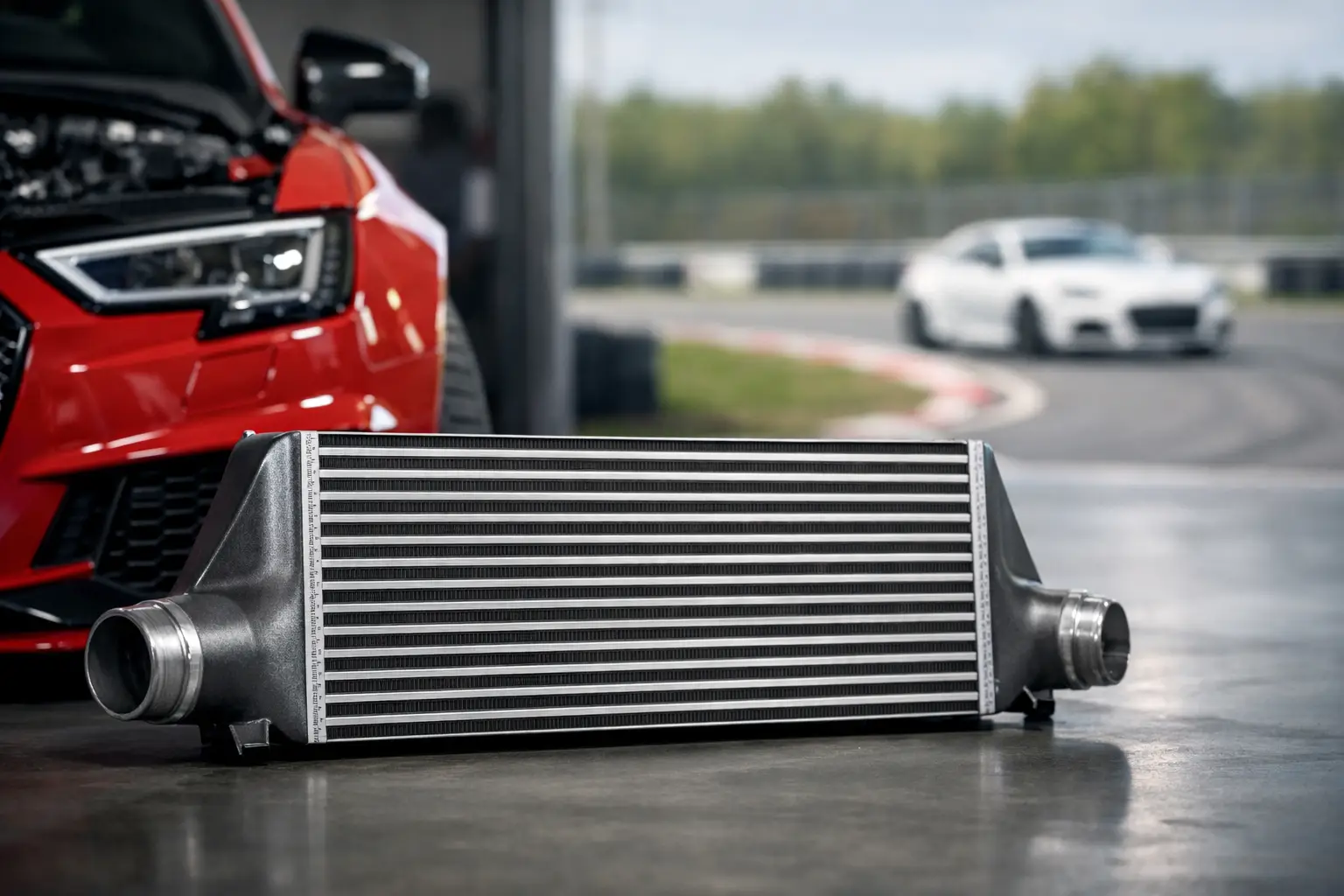
Heat is what exposes a fast RS3. The first hard pull feels great. The third on a warm day is where the factory system starts showing its limits. That is why an RS3 intercooler review matters for anyone running tuned boost, ethanol blends, repeated pulls, or track sessions in the 2.5TFSI platform.
The Audi RS3 responds well to power, but it also responds quickly to intake air temperature. Once charge temps climb, the ECU starts protecting the engine with timing and torque intervention. You feel that as softer acceleration, less consistency, and a car that never quite repeats its best run. A quality intercooler upgrade is not just about peak horsepower. It is about keeping the car stable when you actually use the power.
What an RS3 intercooler upgrade actually changes
On the 8V and 8Y RS3, the stock intercooler is competent for factory output and light bolt-on use. It is not built with the same margin as the rest of the car once boost and airflow go up. The issue is usually not one single pull. It is heat soak over repeated runs.
A better intercooler increases thermal capacity and improves heat rejection. In plain terms, it keeps charge air cooler for longer and recovers faster between pulls. That usually leads to more consistent timing, better resistance to knock correction, and less power drop as ambient temperatures rise.
That does not mean every aftermarket intercooler will feel the same. Core design, end tank shape, pressure drop, frontal area, and installation quality all matter. A giant core on paper is not automatically the best choice if it adds unnecessary restriction or creates fitment compromises.
RS3 intercooler review – what matters more than marketing
Most buyers start with one number – core size. That is understandable, but it is not enough on its own. A well-designed intercooler balances cooling efficiency with airflow. If a core is too restrictive, the turbo works harder to make the same boost. That can increase outlet temperatures and reduce the real-world gain you expected.
The strongest RS3 intercooler options usually get three things right. First, they use a dense but efficient bar-and-plate core designed for sustained load. Second, they use properly shaped cast end tanks that distribute airflow evenly across the core. Third, they are engineered around the chassis so fitment is clean, sensor placement is correct, and there is no guessing during install.
For most street-driven RS3 builds, the real benefit is consistency rather than a huge dyno headline. If your car holds power on the second, third, and fourth pull instead of fading, that is a meaningful upgrade. For road course use, that consistency becomes even more valuable.
Street performance versus track performance
This is where expectations should be realistic. A street car on pump gas with a moderate tune does not need the same intercooler strategy as a full ethanol setup seeing repeated abuse. If your use case is quick highway pulls and spirited weekend driving, a proven direct-fit unit with moderate volume and low pressure drop is usually the right answer.
If the car sees hot climates, drag strip back-to-back passes, or circuit driving, thermal mass becomes more important. Bigger and more efficient cores help delay heat soak, but they can also add cost and sometimes require more involved installation. The right choice depends on how the car is used, not just how high the horsepower goal sounds.
How the best RS3 intercoolers perform in the real world
On a tuned RS3, a strong intercooler upgrade typically improves temperature control in the midrange and upper RPM where the turbo is working hard. That can translate into cleaner power delivery and more repeatable acceleration. The difference is often more obvious in warm weather than in cool conditions.
Some owners expect a dramatic seat-of-the-pants jump after install. Sometimes that happens, especially if the stock unit was getting overwhelmed. More often, the improvement shows up as less fade and stronger repeatability. The car feels sharper later in the pull and more stable after multiple runs.
That is also why logs matter. Intake air temperature after the intercooler, ignition timing stability, and correction data tell a much clearer story than a single dyno number. A well-matched intercooler supports the tune instead of becoming the next bottleneck.
Pressure drop is not a side note
It is easy to chase the largest available core, but pressure drop deserves just as much attention as cooling. If boost response worsens or the turbo has to work harder to hit target, the setup may be giving back some of the gains elsewhere.
For the RS3, the best-performing intercoolers are usually the ones that show a smart balance – enough mass and surface area to control charge temps, without turning the system into a restriction. This is especially relevant on stock-turbo cars, where response and transient behavior are part of what makes the platform enjoyable.
Fitment, quality, and install considerations
A premium RS3 intercooler should install like it belongs there. Clean welds, durable finishing, accurate mounting points, and properly engineered end tanks are not cosmetic details. They affect reliability, airflow, and how much time gets wasted during installation.
Some kits are designed as true direct-fit solutions. Others may require trimming, modified shrouds, or additional hardware choices depending on the model year and supporting setup. That is not always a deal breaker, but it should be understood before purchase. For a street car or customer build, straightforward fitment has real value.
Build quality also matters over time. These cars generate serious heat, and poor manufacturing tends to show up quickly in boosted applications. A proven intercooler from a reputable performance brand is usually worth the premium over an unknown option with impressive dimensions but limited testing.
Choosing the right intercooler for your RS3 build
The best way to approach an RS3 intercooler review is to match the part to the car, not the other way around. If you are running a stock turbo with Stage 1 or Stage 2 power, you want efficient cooling, minimal pressure drop, and easy fitment. Going too extreme can add cost without adding a meaningful advantage.
If you are planning hybrid or larger turbo power, aggressive ethanol content, or sustained motorsport use, the margin matters more. That is where a higher-capacity core becomes easier to justify. Future plans matter here. Buying once can be smarter than upgrading twice.
Climate should also shape the decision. A car in Arizona or Florida needs more thermal control than the same setup in a cooler region. The same applies to driving style. A daily-driven RS3 that sees occasional pulls has different needs than a car doing repeated drag passes in summer.
Supporting mods still matter
An intercooler is not a magic fix for every temperature issue. Intake design, turbo efficiency, tune quality, fuel quality, and overall cooling strategy all play a role. On higher-output builds, the intercooler should be viewed as one piece of a complete package.
That is why informed part selection matters. The strongest results usually come from choosing components that work together, rather than buying the largest or loudest option in each category. For serious 2.5TFSI builds, compatibility and tested performance matter more than marketing claims.
Is an RS3 intercooler worth it?
For many owners, yes – especially once the car is tuned. If you use the power more than occasionally, an intercooler upgrade is one of the smarter reliability and performance purchases on the platform. It helps the car repeat what it already does well instead of fading after one good hit.
The value goes up as power, boost, and ambient temperatures rise. On a lightly driven stock car in a mild climate, it may not be urgent. On a tuned RS3 that sees repeated acceleration, ethanol, or track time, it moves much closer to essential.
That is the trade-off. It is not always the most dramatic modification on day one, but it often becomes one of the most appreciated over time. Serious buyers understand that stable performance is real performance.
At EAS Store, that is exactly how we look at the category. The right RS3 intercooler is the one that matches your chassis, power level, and driving use without guesswork. If you choose carefully, you are not just buying cooler air – you are buying consistency every time the car gets pushed.