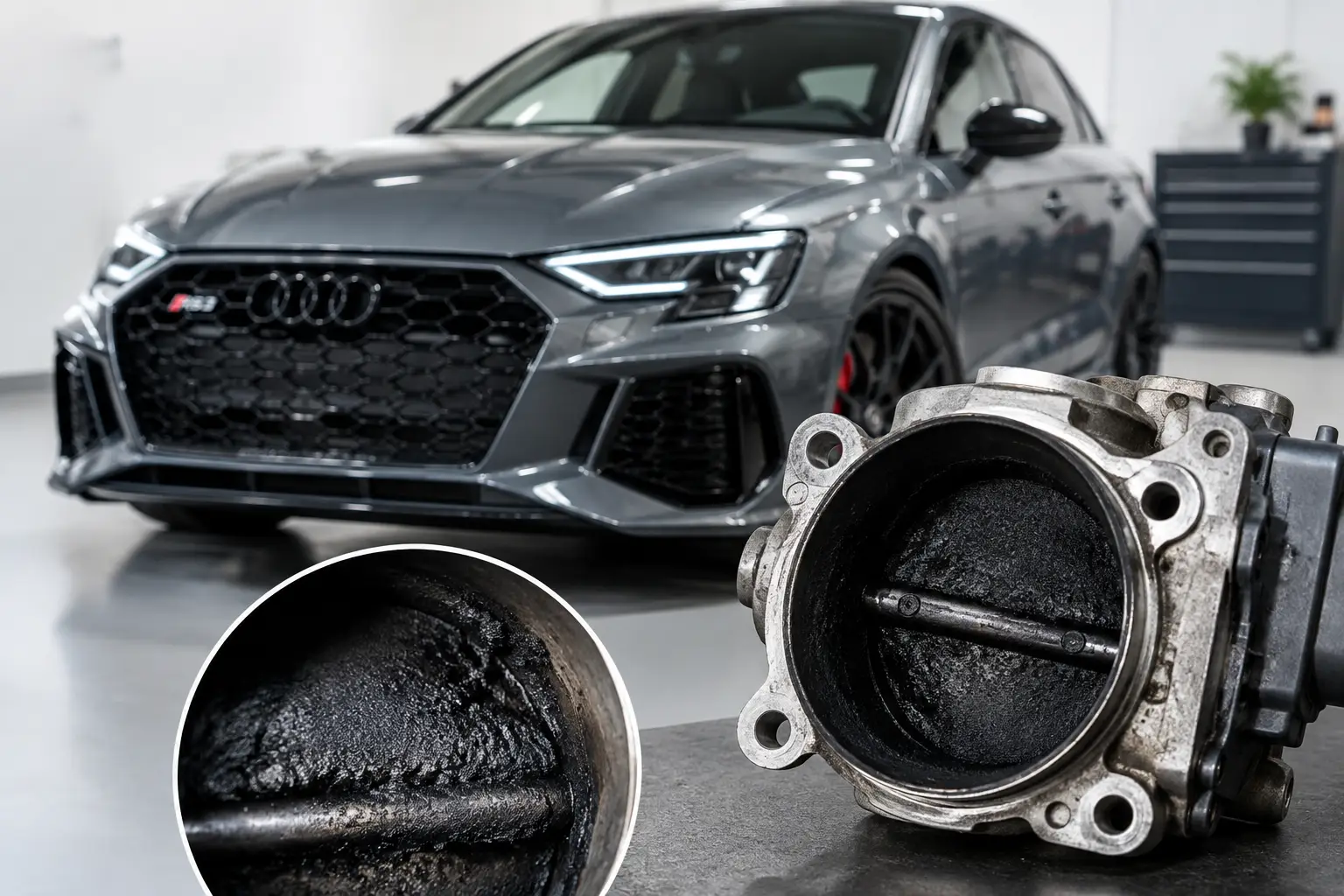
The Audi RS3 2.5T is exceptionally capable, but RS3 carbon buildup is a real maintenance consideration once mileage, short-trip use, and performance modifications begin to stack up. A healthy DAZA, DNWA, or earlier 2.5 TFSI engine can make serious power with the right supporting hardware. Restrict airflow at the intake ports, however, and even a well-sorted tune, intake, and exhaust package cannot perform at its best.
Carbon accumulation is not a reason to avoid the platform. It is a service item to understand, diagnose correctly, and address before it turns into a frustrating loss of response, consistency, and top-end power.
Why RS3 Carbon Buildup Happens
The RS3 uses direct injection, meaning fuel is sprayed directly into the combustion chamber rather than across the intake valves. On a conventional port-injected engine, fuel helps wash light oil residue from the backs of the intake valves. Direct injection removes that cleaning effect.
Oil vapor from the crankcase ventilation system, along with residue carried through the intake tract, can adhere to hot intake valves and ports. Over time, that residue bakes into hard carbon deposits. The process is influenced by driving style, oil condition, ambient temperature, fuel quality, and how frequently the car reaches full operating temperature.
This is especially relevant to lightly driven street cars. An RS3 that sees repeated cold starts, short commutes, and extended idling may build deposits faster than one that is driven consistently at operating temperature. That does not mean a hard-driven car is immune, either. Higher boost pressure and increased crankcase vapor can make maintenance more important on tuned builds.
The exact service interval depends on the vehicle, not a universal mileage number. Some cars show meaningful deposits around 40,000 to 60,000 miles, while others remain relatively clean longer. The right move is to assess symptoms, inspect when warranted, and service the engine based on its condition.
RS3 Carbon Buildup Symptoms to Watch For
Carbon buildup rarely announces itself with one unmistakable warning light. More often, it slowly takes away the sharpness that makes the 2.5T platform special. The driver adapts to the decline until a fresh cleaning restores the engine’s character.
Common signs include a rough or uneven idle, hesitation during low-rpm acceleration, inconsistent throttle response, reduced fuel economy, and power that falls off more noticeably near the top of the rev range. Some cars may develop intermittent misfire faults, particularly when deposits are severe enough to disrupt airflow into one or more cylinders.
A stock RS3 may simply feel less eager. A tuned car often makes the issue more obvious because the calibration expects airflow that dirty intake valves cannot deliver. If the vehicle previously logged or dynoed consistently and now shows unexplained performance variation, carbon deposits deserve a place on the diagnostic list.
Those symptoms are not exclusive to carbon. Worn spark plugs, weak ignition coils, injector issues, boost leaks, PCV faults, fuel pressure problems, and intake-air leaks can create similar complaints. Do not authorize an intake cleaning solely because the car feels flat. Scan for faults, verify the basics, and inspect where possible.
What a Proper Inspection Looks Like
The most reliable confirmation comes from visual inspection of the intake valves after removing the intake manifold. A borescope can be useful for an initial assessment, although viewing angle and lighting may limit what it reveals. A qualified Audi specialist can evaluate deposit thickness, port condition, and whether the buildup is light surface staining or substantial enough to restrict airflow.
This is also the right time to inspect surrounding components. Intake manifold seals, PCV plumbing, vacuum connections, injector seals, and brittle hoses are easier to evaluate while access is available. On a higher-mileage RS3, preventing a small air leak during reassembly is just as valuable as removing the carbon itself.
Walnut Blasting Is the Preferred Cleaning Method
For meaningful RS3 carbon buildup, walnut shell blasting is the proven answer. The intake manifold is removed, each cylinder’s intake valves are closed, and crushed walnut media is used to remove deposits from the ports and valve backs. A dedicated vacuum system captures the media and debris during the process.
When performed correctly, walnut blasting is effective because it physically removes the hardened deposits that chemical additives cannot reach in a direct-injected intake tract. The technician must rotate the engine carefully, confirm the valves are fully closed on the cylinder being serviced, and thoroughly extract media before reassembly.
Chemical induction treatments can have a place as a light maintenance measure, but they should not be marketed as a substitute for a proper mechanical cleaning when deposits are already heavy. Pouring a fuel-system cleaner into the tank may help support injector cleanliness and combustion-chamber deposits, but it does not wash the intake valves on a direct-injected RS3.
A complete service should include new intake manifold gaskets when appropriate, careful reassembly, a scan for faults, and a road test. For modified cars, it is smart to log requested versus actual boost, ignition correction, fuel pressure, and airflow afterward. Cleaning the valves can reveal the performance the calibration was already asking the engine to produce.
How Modifications Affect Carbon Management
An intake system, turbo inlet, intercooler, downpipe, and ECU calibration can transform the RS3 without causing carbon buildup on their own. The trade-off is that more airflow and boost make any restriction upstream of the combustion chamber more consequential.
A high-output street build should be treated as a system. If you are investing in fueling upgrades, larger turbos, ethanol capability, or an aggressive calibration, the intake valves should not be an unknown variable. Establishing a clean baseline before major tuning work helps avoid chasing inconsistent power later.
A catch can is often discussed as a solution. It can reduce the amount of oil vapor entering the intake tract when properly designed and maintained, but it is not a guarantee against deposits. Fitment, internal baffling, hose routing, climate, and service habits all matter. A poorly selected catch can system can create its own problems, including crankcase pressure issues or moisture accumulation.
For most owners, a quality PCV system in good condition, regular oil changes using the correct approved oil, and occasional inspection are more important than adding parts simply because they sound preventative. For dedicated track cars and high-boost builds, the case for upgraded crankcase ventilation management becomes stronger, but it should be selected around the complete setup.
Reducing the Rate of Future Deposits
You cannot eliminate carbon formation entirely on a direct-injected 2.5T, but you can avoid making it worse. Let the engine reach operating temperature before demanding full load, avoid an ownership pattern made entirely of very short trips when possible, and keep oil service intervals sensible for a turbocharged performance engine.
Use quality fuel from reputable stations, especially when the car is calibrated for premium fuel or ethanol blends. Fuel quality will not clean intake valves, but consistent fuel quality supports combustion stability, injector health, and the calibration’s intended performance.
Pay attention to oil consumption and PCV behavior. Excessive oil use, smoke, unusual crankcase pressure, or fresh oil pooling in the intake plumbing are reasons to investigate rather than simply schedule another cleaning. Carbon buildup is sometimes the visible result of an underlying ventilation or sealing problem.
For owners building an RS3 beyond basic bolt-ons, preventive planning saves time. Schedule intake valve inspection alongside other access-intensive work, such as turbocharger upgrades, injector service, or major cooling-system repairs. Combining labor intelligently keeps the build moving and prevents duplicate teardown costs.
When It Is Time to Book Service
If your RS3 has developed a rough idle, unexplained misfires, dulled throttle response, or inconsistent performance at higher mileage, start with a proper diagnostic process. Verify ignition, fueling, boost integrity, and fault codes, then inspect the intake valves if the evidence points there.
For an otherwise healthy car, intake cleaning is best viewed as performance maintenance, not a panic repair. A clean intake tract gives the 2.5T the airflow consistency it needs to respond crisply, support reliable tuning, and make the power your hardware was chosen to deliver.
Whether the goal is a refined daily driver or an 800+ horsepower build, choose components and service procedures that match the application. EAS Store supports serious European performance projects with premium parts and guidance built around real fitment and power goals. Keep the intake valves on the maintenance plan, and your RS3 will have a far better chance of delivering the sharp, repeatable performance that made you choose the platform in the first place.