A fast Mercedes can expose brake limitations long before it runs out of engine power. A tuned AMG, a heavy GLE, or even a spirited C-Class can build enough speed to overwhelm stock pads and fluid on repeated hard stops. This Mercedes brake upgrade guide focuses on selecting the right system for how you actually drive, not simply installing the largest calipers that fit behind the wheel.
The best upgrade is usually the one that solves your current problem: fade after a few canyon pulls, a soft pedal during track sessions, excessive dust on a daily driver, or inconsistent braking on a high-horsepower build. Start there, then choose components that work together.
Start With the Braking Problem, Not the Parts List
Brake upgrades are often sold as a single category, but pads, rotors, fluid, lines, calipers, tires, and cooling all affect the result. A factory brake system in good condition can be very capable for street use. If it feels weak during normal driving, first rule out worn pads, glazed rotors, old fluid, sticking calipers, and damaged hoses.
For a street-driven Mercedes, the goal is typically stronger initial response, stable pedal feel, and predictable stopping in traffic and occasional spirited driving. For canyon use and autocross, heat control becomes more relevant. For track use, the system must repeatedly manage high temperatures without pad fade, boiling fluid, rotor cracking, or a pedal that gets longer every session.
More brake torque is not automatically better. The tire is still the final limit. If your current tires cannot use additional braking force, a huge caliper kit may offer less real-world benefit than premium tires, track-capable pads, fresh fluid, and proper alignment.
Mercedes Brake Upgrade Guide: Build in the Right Order
A staged approach protects your budget and makes it easier to identify what changed. Most owners do not need a full big brake kit as their first move.
Stage 1: Pads, Rotors, and Fluid
This is the strongest starting point for most street and occasional track cars. A performance street pad can improve bite and resist fade better than an economy replacement pad, while still remaining quiet enough for daily use. For heavier AMG models and vehicles with engine tuning, choose a pad compound with a temperature range that matches your intended use.
Street-focused compounds generally provide better cold performance, lower noise, and less rotor wear. Track-oriented compounds tolerate more heat and offer a firmer, more consistent feel under repeated braking, but they can be noisy, dusty, and harsh on rotors. A true race pad may be frustrating on a commuter car, especially in cold weather.
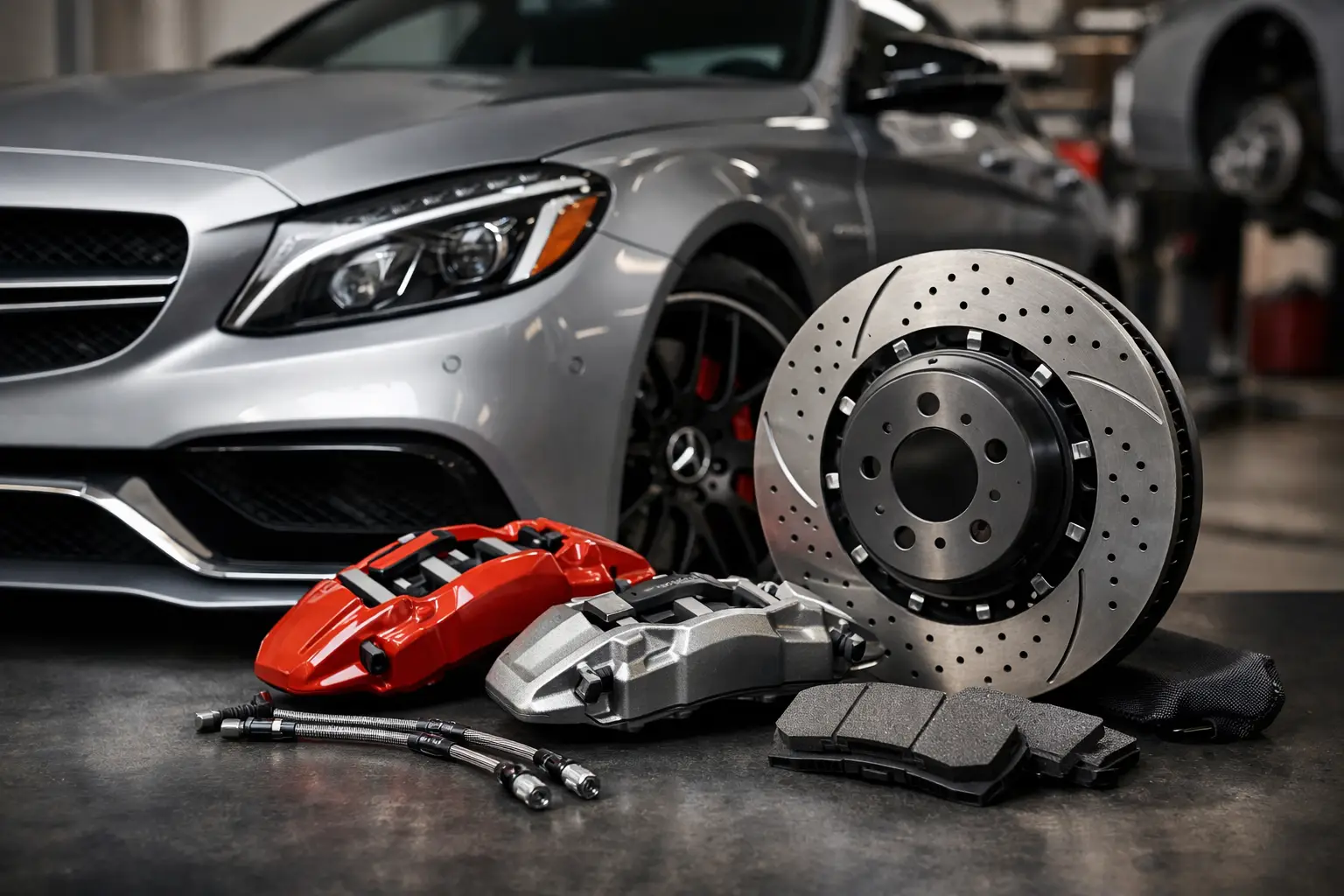
Pair pads with high-quality blank or slotted rotors designed for the exact Mercedes chassis and brake package. Slotted rotors can help maintain pad surface consistency under hard use. Drilled rotors can reduce mass and look excellent, but repeated high-heat track use can increase the chance of cracking around the holes. For serious lapping, a quality blank or slotted two-piece rotor is often the more durable choice.
Fresh high-temperature brake fluid is one of the most cost-effective upgrades available. Brake fluid absorbs moisture over time, lowering its boiling point. Once fluid boils, pedal feel can deteriorate rapidly because vapor compresses. A high-quality DOT 4 or DOT 5.1 racing-oriented fluid can make a major difference for track-driven Mercedes platforms, provided it is changed on schedule. Do not confuse DOT 5.1 glycol-based fluid with silicone DOT 5 fluid, which is not interchangeable in typical performance brake systems.
Stage 2: Stainless Steel Lines and Brake Cooling
Braided stainless steel brake lines can sharpen pedal response by reducing hose expansion under pressure. They are not a substitute for pads and fluid, and they will not cure pad fade, but they can add confidence when paired with a properly bled system. Buy vehicle-specific lines from a trusted manufacturer and inspect fittings carefully during installation.
Brake cooling becomes valuable when stock components repeatedly exceed their thermal limit. Proper ducting sends air toward the rotor hat and internal vanes, where it can actually carry heat away. Simply aiming a hose at the rotor face is less effective. Cooling requires thoughtful routing, secure mounting, and enough clearance for steering and suspension travel.
On some Mercedes models, factory brake shields, wheel design, and suspension packaging leave limited room for ducting. That does not make cooling impossible, but it does mean fitment needs to be treated as a chassis-specific project rather than a universal add-on.
Stage 3: Big Brake Kits and Two-Piece Rotors
A big brake kit makes sense when the vehicle is consistently used at high speed, carries substantial weight, runs significantly more power, or sees regular track duty. The main advantages are greater thermal capacity, lower unsprung weight in many configurations, improved pad volume, and better access to motorsport-grade pad shapes.
A well-engineered kit is more than a large caliper. Caliper piston sizing, rotor diameter, rotor thickness, pad area, brake bias, master cylinder compatibility, and ABS behavior all matter. The wrong combination can create an overly sensitive pedal, poor front-to-rear balance, or reduced confidence at the limit.
Two-piece floating rotors are particularly worthwhile for drivers who generate sustained heat. Their aluminum hats can reduce rotating and unsprung mass, while replaceable iron rings can lower long-term service costs. They also better accommodate thermal expansion than a conventional one-piece rotor. For a Mercedes that sees only street mileage, however, the added expense may not deliver a proportional gain.
Fitment Is a Performance Requirement
Mercedes brake fitment is rarely as simple as matching model year and engine badge. Brake systems may vary by trim, production date, axle option, wheel diameter, AMG package, and regional specification. A C43, C63, E53, E63, GLC 63, or GT may use dramatically different caliper and rotor configurations even where wheel sizes look similar.
Before ordering, confirm the chassis code, VIN-specific brake configuration where possible, front and rear rotor dimensions, wheel diameter, and wheel barrel clearance. Big brake kits can require templates because spoke profile matters as much as nominal wheel size. An 18-inch wheel may clear one kit and fail to clear another, while certain 19-inch factory wheels may still contact a large caliper.
Also account for electronic parking brake hardware on the rear axle. Rear upgrades can be more complex than front upgrades because they may need to retain factory parking brake functions and integrate correctly with vehicle electronics.
For customers balancing street use and serious performance, EAS Store can help narrow components by chassis, intended power level, wheel setup, and driving use before expensive parts are installed.
Do Not Ignore Brake Bias, Tires, and Suspension
Front brakes handle the majority of braking load because weight transfers forward during deceleration. That is why many builds begin with front pads, rotors, and calipers. Still, the rear axle matters for stability, especially in high-speed braking zones and on vehicles with substantial aero, altered ride height, or aggressive tire setups.
Changing only one end of the car can be appropriate when using a proven platform-specific kit, but mixing random components is not a strategy. Brake bias is engineered into the system. Preserve predictable ABS and stability-control behavior by choosing matched components designed for the application.
Tire selection has an equally large influence on stopping distance. A 500-horsepower Mercedes on worn all-season tires will not realize the full benefit of expensive brakes. Performance tires with the correct load rating, proper pressures, and sufficient tread provide the grip needed to convert braking force into deceleration.
Suspension condition also affects braking. Worn control arm bushings, tired dampers, or poor alignment can make a car wander or feel unstable under hard braking. If the steering wheel shakes, do not assume the rotors are warped. Uneven pad deposits, hub runout, worn suspension parts, or improper wheel torque can produce similar symptoms.
Install, Bed, and Maintain the System Correctly
Even premium brake hardware performs poorly if installed without preparation. Clean hub faces thoroughly, measure rotor runout where applicable, use the manufacturer’s specified torque values, and bleed the system with the correct procedure. On Mercedes models with advanced brake electronics, a scan tool or service mode may be required for certain rear brake service procedures.
After installation, bed the pads and rotors according to the pad manufacturer’s process. Bedding transfers an even layer of friction material to the rotor surface and stabilizes performance. Skipping it can cause uneven deposits, vibration, noise, and inconsistent bite.
Track drivers should inspect pad thickness, rotor surfaces, fluid condition, caliper seals, and line routing before every event. Replace components based on measured wear and condition, not guesswork. The most expensive brake system on the car still needs routine attention after a season of hard heat cycles.
Choose the brake package that gives your Mercedes repeatable, controlled stopping at the speeds you genuinely drive. A disciplined pad, fluid, rotor, and tire combination often transforms the car first. When the build demands more thermal capacity, step into a correctly engineered big brake system with fitment and balance confirmed from the start.