A tire in the air, a wet launch, or a tight corner on corner exit can expose the limits of an open differential immediately. The limited slip differential versus locker decision is not simply about getting more traction. It determines how your car puts power down, how predictable it feels at the limit, and whether the drivetrain still suits the street miles between events.
For a high-output Audi, BMW, Volkswagen, or Mercedes build, the right answer depends on the chassis, power level, tire, transmission, and intended use. A differential that feels exceptional on a loose-surface trail can be frustrating in a road-course car. Likewise, a street-friendly limited-slip setup may not provide the absolute wheel-to-wheel lock needed for certain drag or off-road situations.
What a Limited-Slip Differential Does
A limited-slip differential, usually called an LSD, allows the left and right drive wheels to turn at different speeds while sending meaningful torque to the tire with more available grip. That distinction matters in any corner. The outside tire travels farther than the inside tire, so it must rotate faster. An LSD supports that normal speed difference rather than fighting it completely.
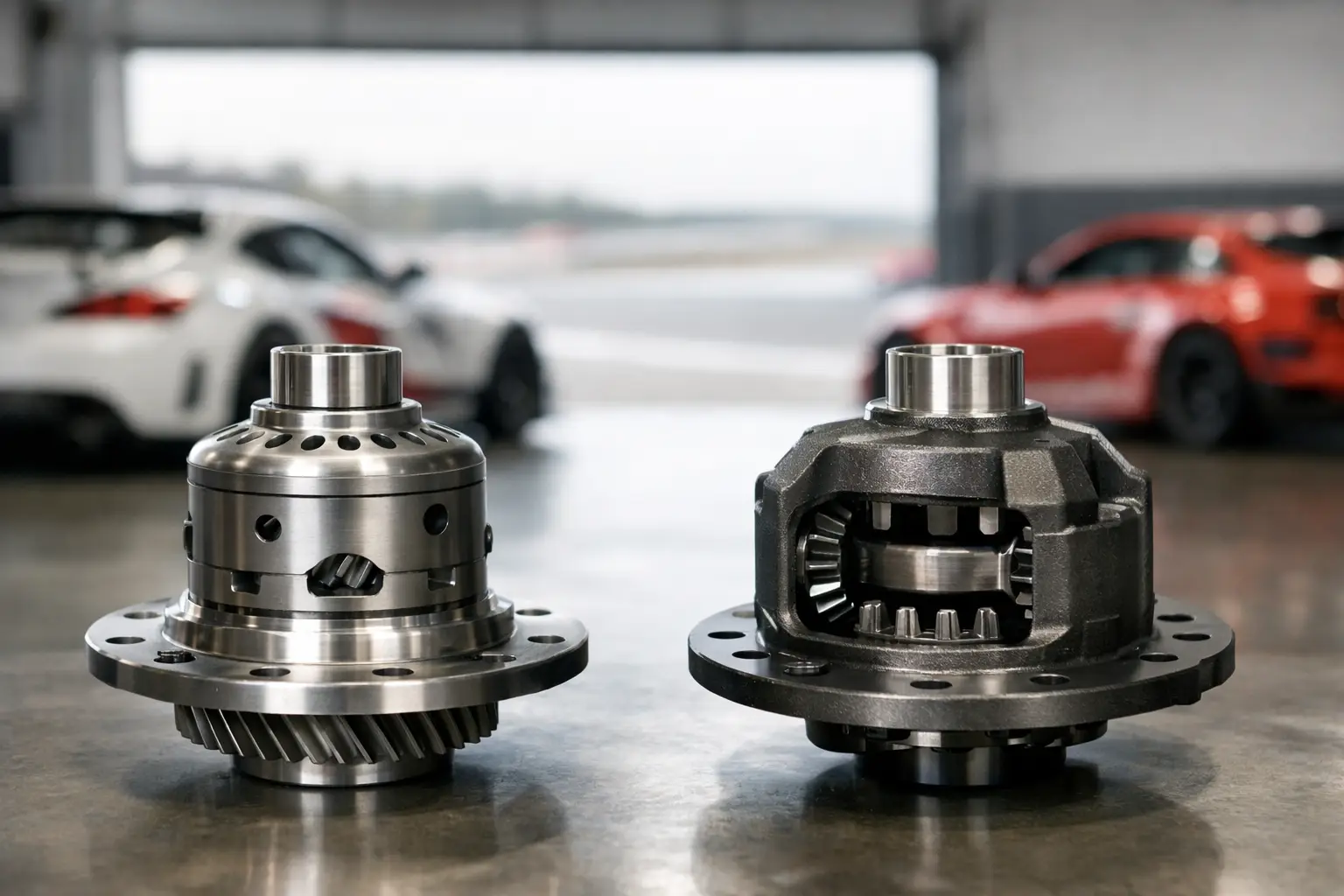
The amount of torque transfer depends on the design. Helical or gear-type units use internal gears to bias torque smoothly and are popular for responsive street and track applications. Clutch-type LSDs use friction plates and can be configured with preload, ramp angles, and locking characteristics to suit aggressive motorsport use. Modern electronically controlled differentials add another layer, using sensors and clutch packs to vary locking behavior based on vehicle conditions.
For front-wheel-drive MQB cars, a properly matched LSD can transform corner exit by reducing inside-wheel spin and helping the car pull forward under throttle. In rear-wheel-drive BMW applications, it can make power delivery more progressive when accelerating out of a corner. The key benefit is controlled traction without eliminating differential action.
How a Locker Changes the Equation
A locker mechanically couples both drive wheels so they rotate at the same speed when locked. With both axleshafts turning together, torque is not lost through the path of least resistance. If one tire has little or no traction, the other can still drive the vehicle.
That is maximum traction in a straight line or on highly uneven surfaces, but it comes with a compromise. During a paved turn, the inside and outside wheels naturally need different speeds. A fully locked differential resists that difference, which can cause tire scrub, increased steering effort, drivetrain windup, and abrupt behavior as the vehicle transitions in and out of lock.
Some lockers are selectable, allowing the driver to run open and engage full lock only when needed. Others lock automatically under torque. A spool is even more committed, permanently tying both axles together with no differential action at all. For a dedicated drag car built around repeatable straight-line launches, that simplicity can be an advantage. For most dual-purpose European performance cars, it is a major concession.
Limited Slip Differential Versus Locker on Pavement
On pavement, an LSD is usually the stronger choice because it preserves the wheel-speed difference required for clean cornering. You gain traction under throttle without turning every low-speed parking maneuver or freeway cloverleaf into a drivetrain event.
A clutch-type LSD can feel more assertive than a helical unit, particularly with higher preload or aggressive ramp settings. That can be exactly what a competition car needs, but it may also create noise, chatter, or additional steering influence in a street-driven vehicle. Helical designs are typically quieter and lower maintenance, although they need some resistance at both wheels to bias torque effectively. If one wheel is completely unloaded, such as over a tall curb or deep hole, their effectiveness can be reduced.
A locker offers more complete traction when one wheel is nearly free-spinning, but that advantage rarely outweighs the cornering compromises for road-course, canyon, or daily-driven use. On high-grip pavement, locking both wheels can push a rear-drive car toward understeer on corner entry or make it eager to rotate when throttle is applied, depending on the chassis and driving phase. It demands a setup and driving style that accept those traits.
Choosing for Your Build and Driving Style
Start with the surface and the job your car must do most often. A road-course car, autocross build, spirited street car, or high-power roll-racing vehicle generally benefits from an LSD. It improves traction while keeping the car composed through the corners that define real pavement performance.
For a front-drive Volkswagen GTI, Golf R running in front-drive conversion, or Audi-based track project, a helical LSD is often an excellent foundation. It reduces the frustrating one-tire fire on corner exit and works well with street tires, endurance sessions, and predictable steering behavior. A plated unit may be the better fit for a serious competition car where tunability and hard-use consistency matter more than quiet operation.
For rear-drive BMW and Mercedes platforms, the factory differential deserves close attention before selecting an upgrade. Some performance models already use electronically controlled locking differentials, while others use open units or systems that rely heavily on brake-based traction control. The best upgrade may be a mechanical LSD, a motorsport-spec plated differential, or a recalibration and supporting hardware strategy for the factory electronic unit. Treating every rear-drive car as though it needs a generic locker is a fitment mistake.
A locker makes more sense when maximum straight-line or low-traction drive is the primary mission. Think purpose-built drag cars, certain drift applications, off-road vehicles, or cars where cornering refinement is secondary. Even then, a selectable locker is easier to live with than a permanently locked arrangement if the vehicle sees public roads.
Power level matters, but not in isolation. An 800-horsepower S58 or 2.5TFSI build on drag radials places enormous load on the differential, yet the tire, launch method, suspension geometry, and transmission calibration all affect what survives. More lock is not automatically more usable traction. Too much locking can overwhelm the tire or make the car less controllable when conditions change.
Setup, Fitment, and Supporting Parts Matter
A differential upgrade is not a universal bolt-on. Confirm the transmission or rear differential housing, final-drive ratio, spline count, axle compatibility, and whether the car uses a factory electronic differential. On many European platforms, production changes within the same model generation can alter the correct part selection.
Installation quality is equally critical. Ring-and-pinion backlash, bearing preload, gear contact pattern, seals, fluid specification, and break-in procedure all affect noise, durability, and performance. A premium differential installed with incorrect setup can fail quickly or create whine that no software calibration will fix.
Also plan for the rest of the traction package. Fresh mounts can reduce wheel hop, the right alignment can improve how the tire loads under acceleration, and proper tire selection often delivers more real-world benefit than chasing an extreme locking percentage. On electronically managed cars, coding or calibration may be necessary to prevent traction and stability systems from working against the new hardware.
EAS Store supports performance-focused builds where part compatibility matters as much as the part itself. Before ordering, identify the exact chassis, drivetrain, transmission, factory differential configuration, power target, and how the car is actually driven. That information turns a broad drivetrain upgrade into a correctly matched solution.
The best differential is the one that makes your car faster and easier to trust at the limit, not the one with the most aggressive description. Choose the locking behavior your tires, chassis, and driving environment can use, then build the supporting package to match.