A turbo inlet is easy to underestimate because it sits before the compressor rather than after it. But when a tuned engine begins demanding more airflow, the factory inlet can become a real restriction. A narrow passage, abrupt internal transitions, soft rubber sections, or an undersized connection can make the turbo work harder than necessary. Knowing how to select a turbo inlet means matching the part to the turbocharger, intake system, power target, and exact vehicle application – not simply choosing the largest pipe in the catalog.
For MQB, BMW, Audi, Mercedes, and other European performance platforms, fitment details matter as much as flow. The right inlet supports efficient airflow, consistent boost response, and a clean installation. The wrong one can create an air leak, interfere with surrounding components, or fail to deliver a meaningful improvement for the build.
Start With the Turbo, Not the Inlet
The turbocharger determines the inlet dimensions you need. Factory turbochargers, hybrid units, and full-frame conversions often use different compressor inlet diameters, mounting styles, and coupler requirements. A turbo inlet made for a stock IS38-equipped VW Golf R, for example, may not fit a larger hybrid turbo even if both are installed on the same engine family.
Confirm the turbo’s compressor inlet outside diameter and connection style before selecting any intake-side component. Some applications use a direct-fit, vehicle-specific inlet that bolts or clamps into the factory turbo location. Others require a reducer coupler, a specific silicone elbow, or a complete intake system designed around the upgraded turbo.
This is especially important on high-output builds. A larger inlet may be a practical requirement for a hybrid or big-turbo setup, while it can be an optional response and sound upgrade on a lightly tuned factory-turbo car. Buying for the turbo you have now is sensible only if you are not planning a near-term turbo upgrade. Otherwise, selecting components around the future turbo can prevent paying twice for the same section of the intake tract.
Match the Inlet to the Entire Intake Path
A turbo inlet is one section of an airflow system. Its benefit depends on what feeds it and what follows it. A large-diameter inlet connected to a restrictive factory intake hose or airbox may still improve the transition into the turbo, but it cannot compensate for every restriction upstream.
For a balanced setup, look at the air filter, intake tube, turbo inlet, compressor housing, intercooler piping, intercooler, and calibration as connected pieces. The goal is not simply maximum pipe diameter. The goal is a smooth, adequately sized path with secure connections and no unnecessary turbulence.
On a stock or stage 1 vehicle, a quality inlet can sharpen induction sound and reduce a known bottleneck without forcing a complete intake replacement. On a stage 2 or ethanol-fueled vehicle, pairing the inlet with a properly matched intake often makes more sense. For a serious hybrid-turbo build, the inlet should be selected as part of a complete air-intake package built for that turbo’s flow range.
Diameter: Bigger Is Not Automatically Better
Diameter is the first spec many buyers compare, and it matters. A larger internal diameter can reduce restriction as airflow demand rises. However, an oversized inlet with poorly designed transitions or mismatched couplers can hurt packaging and create fitment headaches without offering a proportional performance gain.
The most effective inlet has a smooth internal path from the intake tube into the compressor housing. Look for gradual transitions, a true internal diameter that matches the intended application, and a design that avoids sharp steps at the turbo connection. A well-engineered inlet sized correctly for a stock-frame turbo can outperform a larger universal-looking pipe that introduces turbulence or necks down at a coupler.
For most street-driven factory-turbo cars, a vehicle-specific inlet sized for the stock turbo is the right choice. For hybrid and larger turbochargers, use the turbo manufacturer’s required inlet size as the baseline. Do not assume that a 4-inch intake tube means the turbo itself accepts a 4-inch inlet.
Verify Vehicle, Engine Code, and Model-Year Fitment
European performance vehicles frequently have changes within the same chassis generation. A part that fits one Audi S3 may not fit another due to engine-code revisions, turbocharger changes, emissions equipment, intake routing, or left-hand versus right-hand-drive packaging. BMW and Mercedes applications can be equally specific, particularly where factory intake systems and turbo inlet connections vary by engine variant.
Confirm the chassis, model year, engine code, turbocharger, drivetrain where relevant, and any existing aftermarket intake components. This is not excessive caution. It is how you avoid receiving an inlet that is nearly correct but cannot properly connect to your current hardware.
Pay close attention to product descriptions that distinguish between factory turbo, hybrid turbo, and aftermarket turbo compatibility. Terms such as “requires aftermarket intake,” “for 2.5-inch compressor inlet,” or “not compatible with factory airbox” are installation requirements, not minor notes.
If your vehicle has been modified by a previous owner, inspect what is actually installed. An intake listed as factory-location may use a nonstandard coupler or altered tube diameter. A quick measurement and a few clear photos can save a failed install.
Choose Materials Built for Heat, Movement, and Boost
Turbo inlet assemblies are exposed to underhood heat, engine movement, oil vapor, and repeated heat cycles. Material quality affects long-term reliability as much as appearance.
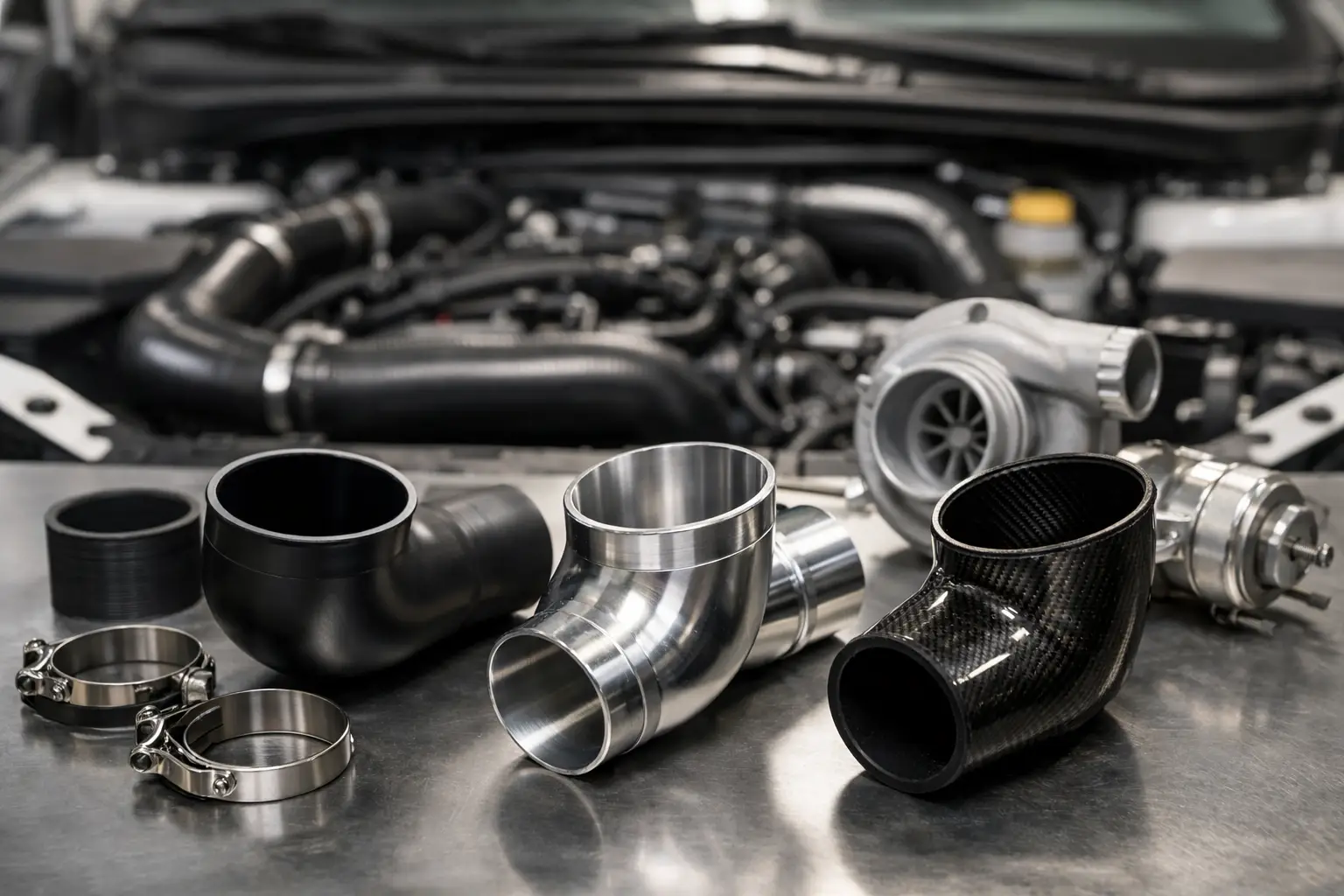
Aluminum and composite hard inlets are common choices. A properly designed aluminum inlet offers a rigid, smooth flow path and is well suited to high-performance applications. Composite materials can manage heat transfer effectively and may provide excellent fitment when engineered specifically for the platform. Neither material is automatically superior. Design quality, wall thickness, internal finish, and installation hardware matter more than the material label alone.
Silicone couplers should be high-quality, correctly sized, and reinforced for the temperature and pressure environment. Cheap or overly soft couplers can collapse, sweat oil, loosen under boost, or split near clamps. On high-boost cars, use the clamps supplied by a reputable manufacturer and position them exactly as instructed. An inlet leak before the turbo may not always look like a conventional boost leak, but it can affect airflow measurement, turbo sound, and overall drivability.
Also check for provisions for crankcase ventilation, PCV hoses, vacuum lines, and sensors. A clean solution uses correctly sized ports and secure fittings. Avoid forcing factory hoses onto mismatched barbs or leaving unused connections improperly capped.
Decide Whether You Need a Direct-Fit or Custom Solution
Most enthusiasts should prioritize a direct-fit inlet engineered for their platform and turbo. These systems are designed around factory mounting points, surrounding hardware, and common intake configurations. They install cleanly, preserve service access, and reduce the guesswork around coupler angles and hose routing.
Custom inlet fabrication has a place on race cars, uncommon turbo conversions, and high-horsepower builds where no off-the-shelf component meets the requirement. It also demands more attention. You must account for compressor inlet size, bead-rolled connections, heat protection, engine movement, air filter placement, and clearance to the radiator fan, hood, and charge piping.
A custom setup is not automatically better because it is larger. For a 600-plus-horsepower build, it may be necessary. For a tuned daily-driven S58, EA888, or 2.5TFSI running a proven factory-location turbo, a premium direct-fit inlet can be the more reliable and serviceable option.
Consider Tuning, Sound, and Real-World Goals
A turbo inlet does not usually require a tune by itself. It is typically a supporting airflow modification, and most modern engine management systems can adapt to a well-designed inlet without calibration changes. That said, the part is most valuable when it supports a calibration and turbo setup that can use the additional flow capacity.
Expectations should be realistic. On a factory-turbo vehicle, the most noticeable change may be faster spool characteristics, more pronounced induction noise, and improved consistency at higher airflow demand. Peak horsepower gains can be modest when the rest of the intake and turbo system remain stock. On a tuned hybrid-turbo vehicle, the inlet may be a more meaningful piece of the combination because restriction before the compressor becomes more relevant.
Sound is also a legitimate consideration. Larger inlets and open intake systems often make turbo spool, diverter valve operation, and compressor noise more noticeable. Some owners want that mechanical character; others prefer an OEM-plus experience. A closed airbox paired with an upgraded inlet can offer a better middle ground than a fully open intake.
Buy for Fitment Confidence, Not Just a Product Photo
Before ordering, compare your vehicle details against the manufacturer’s application notes, identify your exact turbo, and verify compatibility with the intake already on the car. If the build includes a hybrid turbo, upgraded fueling, ethanol, or aggressive tuning, make those details part of the conversation. They change the right recommendation.
Premium components are worth choosing when their engineering is visible in the details: smooth transitions, platform-specific routing, durable couplers, proper ports, quality clamps, and documented fitment. EAS Store can help serious enthusiasts and shops narrow those choices before parts arrive at the door.
The best turbo inlet is the one that fits your exact turbo and supports the direction of the build without creating a new weak point. Get that decision right, and every airflow upgrade that follows has a stronger foundation.