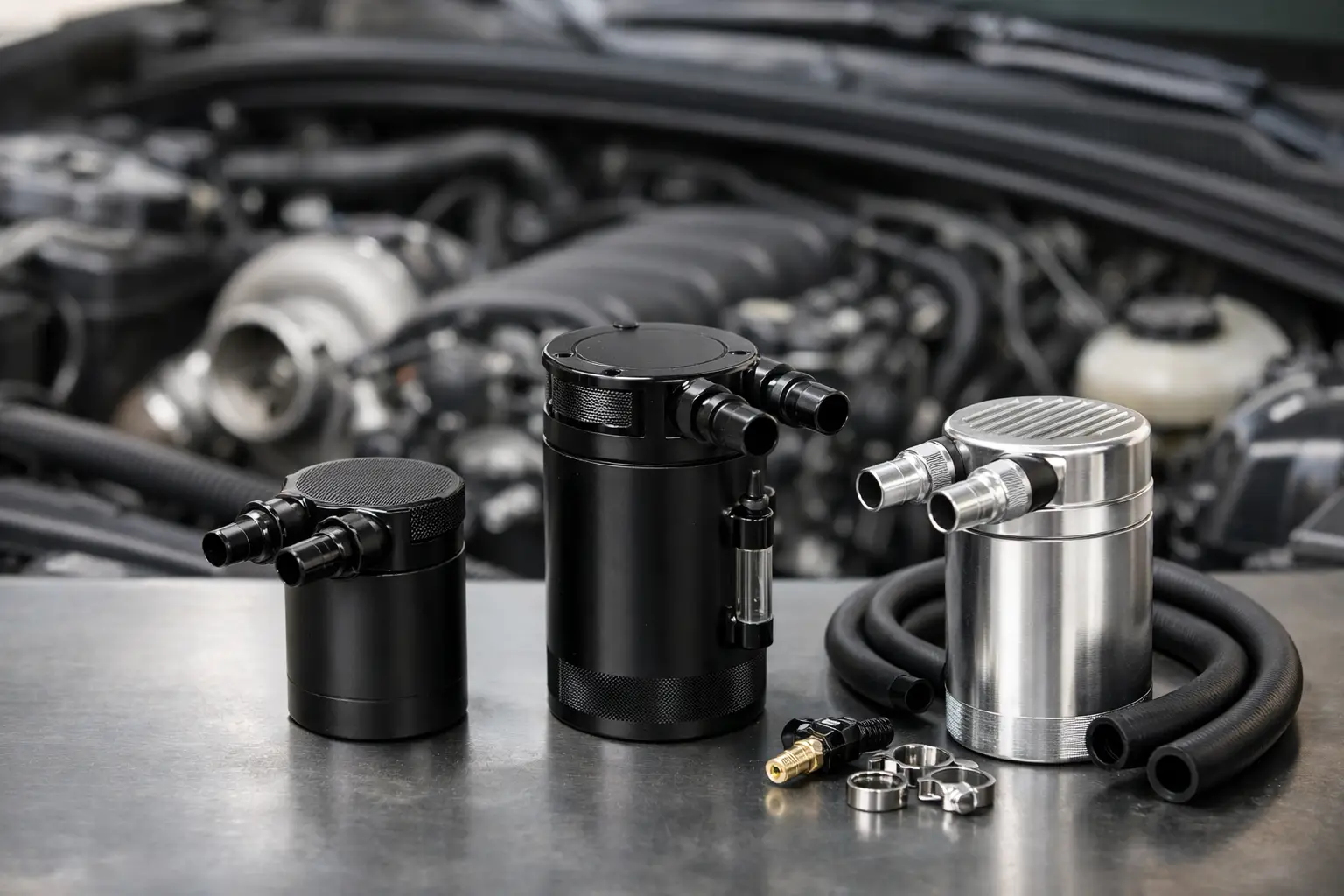
A catch can is easy to overlook when you are focused on turbos, fueling, and calibration. Yet on a direct-injected, boosted engine, crankcase vapor can leave oil residue throughout the intake tract, coat intercooler piping, and contribute to intake-valve deposits over time. Knowing how to choose a catch can means matching the system to your engine’s PCV layout, airflow demand, and real-world use – not simply buying the largest tank that fits under the hood.
For a daily-driven MQB GTI, an Audi RS3 running increased boost, or a BMW S58 built for repeated track sessions, the right catch can protects the supporting systems that make reliable power possible. The wrong one can leak, restrict crankcase ventilation, freeze in cold weather, or create a fitment headache every time it needs service.
Start With Your Engine’s PCV System
A catch can is not a universal accessory. It is part of the crankcase ventilation system, and that system behaves differently across engine families. Before comparing can capacity or hose fittings, identify how your factory PCV routes vapors under vacuum and under boost.
Most modern turbocharged European engines use two operating paths. Under light throttle and vacuum, the intake manifold pulls crankcase vapors through the PCV system. Under boost, manifold pressure closes that path and vapors are routed toward the turbo inlet, where the inlet vacuum can continue drawing them out. A properly engineered catch can system accounts for both conditions without allowing boost pressure into the crankcase.
This is why a vehicle-specific kit is usually the stronger choice for a street or track build. It should include routing designed for that platform, correct connection hardware, brackets that clear factory components, and hose sizes that preserve necessary flow. A universal can may work on a custom build, but it requires you to design the routing, mounting, fittings, and sometimes check-valve strategy yourself.
If your engine has a known weak point in the factory separator or PCV assembly, solve that issue first. A catch can cannot compensate for a failed diaphragm, blocked breather passage, or excessive blow-by from a worn engine.
How to Choose a Catch Can by Use Case
The right capacity and configuration depend on what the vehicle actually does. A lightly modified commuter needs a different solution than an 800-horsepower drag car or a road-course car that spends long periods at sustained load.
For a mostly street-driven vehicle with occasional spirited use, prioritize clean fitment, reliable sealed connections, and simple service access. You may not need a massive reservoir, but you do need effective internal separation. A small decorative can with little more than an open chamber does not give oil vapor enough surface area to separate from the airflow.
For a high-boost or track-focused build, prioritize flow capacity and separation efficiency. More cylinder pressure generally means more blow-by, especially as power levels and engine speed climb. The can must handle the volume without becoming a restriction. Restricting crankcase ventilation can raise crankcase pressure, which can push oil past seals and create problems that look like a turbo or gasket failure.
Drag-oriented builds can see intense blow-by during short, high-load pulls, while road-course cars deal with prolonged heat and sustained cornering. Track cars benefit from secure baffling, a rigid mount, and hoses routed away from hot exhaust-side components. If the car sees heavy braking and lateral G-load, verify that the can’s internal design and drain arrangement will not allow collected oil to slosh toward the outlet.
Look Inside the Can, Not Just at the Finish
Premium anodizing, a laser-etched logo, and billet construction are worthwhile only when the internal design does its job. The purpose of a catch can is to slow and separate the oil-laden vapor stream before it reaches the intake. Its effectiveness is determined by what happens inside.
Look for a baffled system that creates a controlled vapor path rather than a straight shot from inlet to outlet. Internal chambers, directional baffles, coalescing media, and properly positioned inlet and outlet ports help suspended oil droplets collect and fall into the reservoir. The goal is strong separation without a major pressure drop.
Avoid loose steel wool or improvised filter material. It can degrade, become oil-saturated, restrict flow, and shed debris into the system. Serviceable coalescing elements can be effective, but they should be designed for the application and easy to inspect. If a manufacturer does not explain the internal separation method, do not assume a polished exterior means premium function.
Can volume matters, but larger is not automatically better. Capacity determines how often you need to drain the can; it does not guarantee better vapor separation. A compact, well-baffled can designed around your engine is generally a better purchase than an oversized universal tank with poor internals and long, improvised hose runs.
Size the Hoses and Fittings for Real Airflow
Hose size is one of the most common mistakes in custom catch can installations. Small fittings may look tidy, but an undersized line can become a bottleneck on a high-output turbo engine. The plumbing needs to support crankcase vapor flow across the engine’s full operating range.
Match the factory breather-port size where possible, especially on engines making significantly more power than stock. Stepping down from a large factory outlet to a tiny catch can fitting is rarely a good trade. Use oil-resistant hose rated for under-hood temperatures, quality clamps or application-specific quick-connect fittings, and routing that avoids kinks, sharp bends, and exhaust heat.
Closed-loop systems are the right choice for most street-driven cars. They retain proper metering and route cleaned vapors back into the intake system. Vent-to-atmosphere setups may have a role in dedicated competition vehicles, but they can release odor and vapor, create a mess around the engine bay, and may not be legal for road use. They also require careful planning to prevent oil mist from escaping under high load.
Plan for Mounting and Maintenance Before Buying
A catch can that cannot be drained conveniently will eventually be neglected. That matters because the fluid inside is not always pure oil. In cold climates and on short-trip vehicles, it may contain water condensation and fuel vapor, creating a milky mixture that fills the reservoir faster than expected.
Choose a mounting location that is secure, accessible, and away from extreme heat. The can should not interfere with the hood, intake, charge piping, service points, or movement of the engine under load. A platform-specific bracket is more than a cosmetic detail: it reduces vibration, keeps hoses properly routed, and makes the installation easier to inspect.
Consider the drain method as well. A bottom drain valve can make routine service faster, provided there is enough clearance to use it. A removable base or top section can work well when the can is mounted in an accessible position. For competition cars, a remote drain can be useful, but every added fitting is another potential leak point.
Check the can frequently after installation. The first few drain intervals tell you a lot about your engine, climate, and driving pattern. A high-output car in cool weather may collect far more fluid than a warm-climate weekend car. If the can is filling unusually fast or you see oil leaks, investigate PCV function and engine condition rather than simply installing a larger reservoir.
Choose Proven Fitment Over Generic Convenience
For Volkswagen, Audi, BMW, and Mercedes performance platforms, fitment accuracy is part of performance. A catch can must coexist with factory sensors, intake components, heat shielding, and the service access your car still needs. That is especially true on tightly packaged engines such as the EA888, DAZA, S58, and M177.
At EAS Store, the strongest catch can choice is the one built for your exact engine code, intended power level, and driving use. Confirm model year, chassis, engine variant, and any intake or turbo changes before ordering. If your build has moved beyond typical bolt-ons, treat the crankcase system with the same attention you give fuel delivery and charge-air cooling.
A quality catch can will not add headline horsepower, but it can keep the intake tract cleaner and the PCV system working as intended while your build sees more boost, heat, and load. Pick one you can service, inspect, and trust every time the engine is pushed hard.