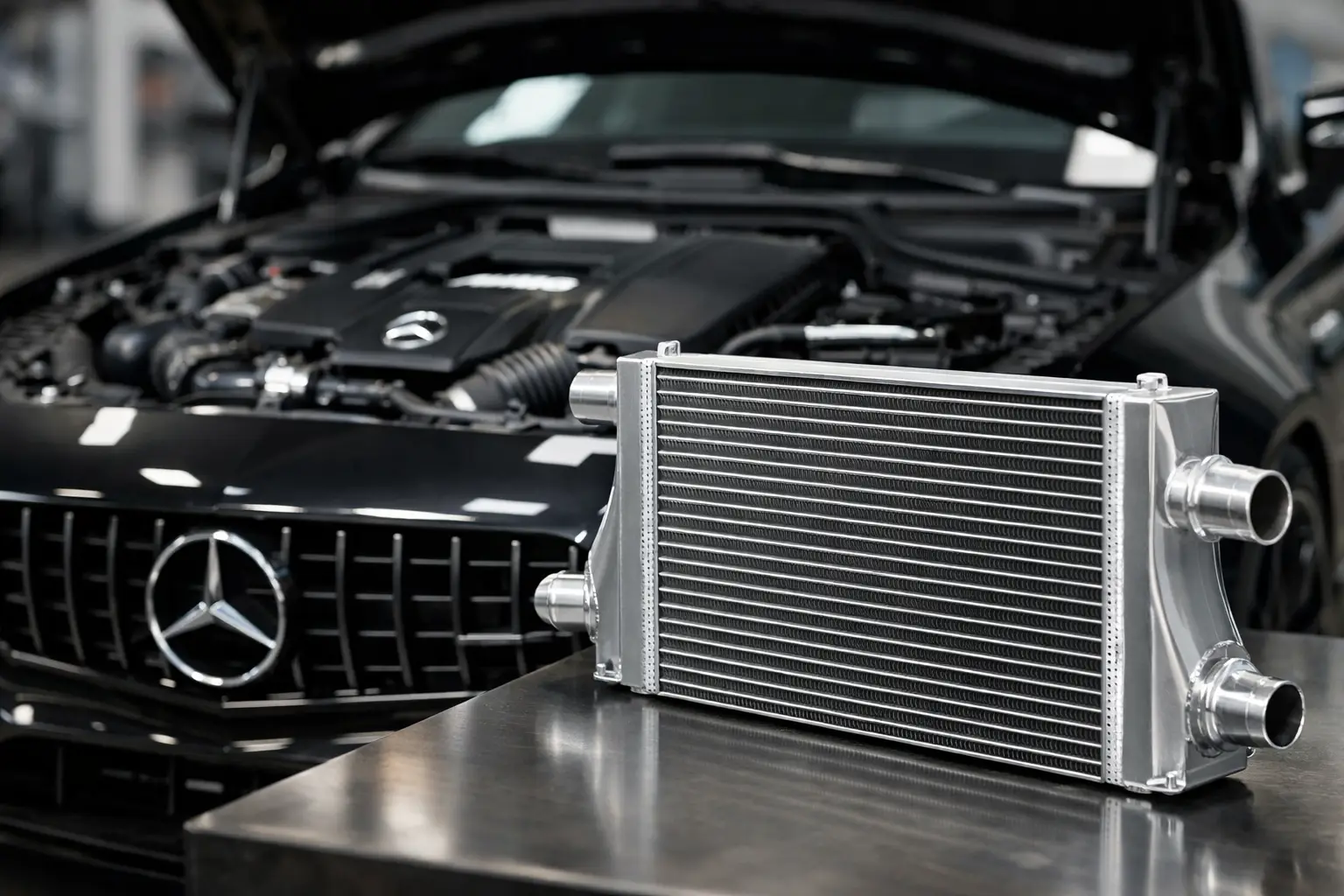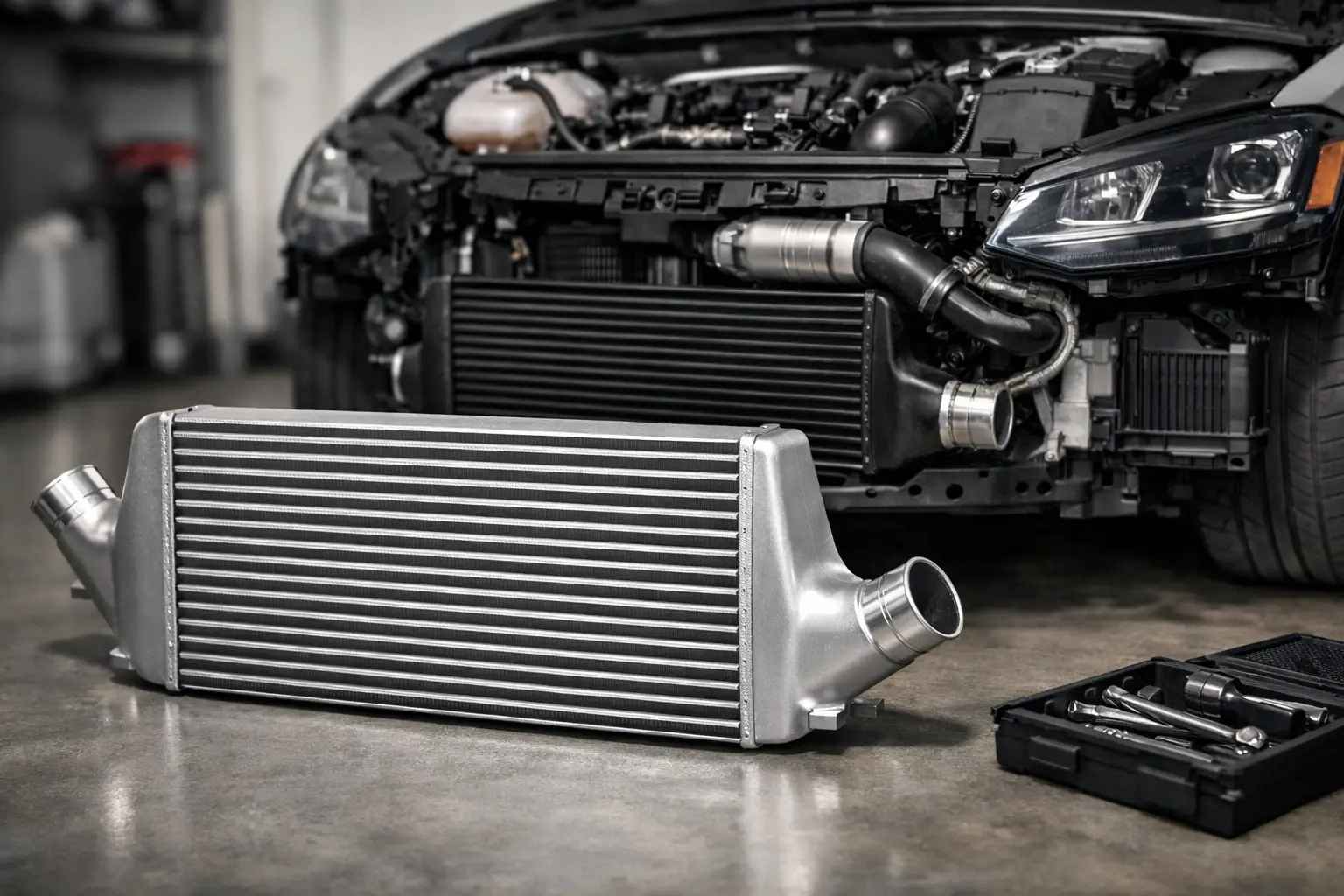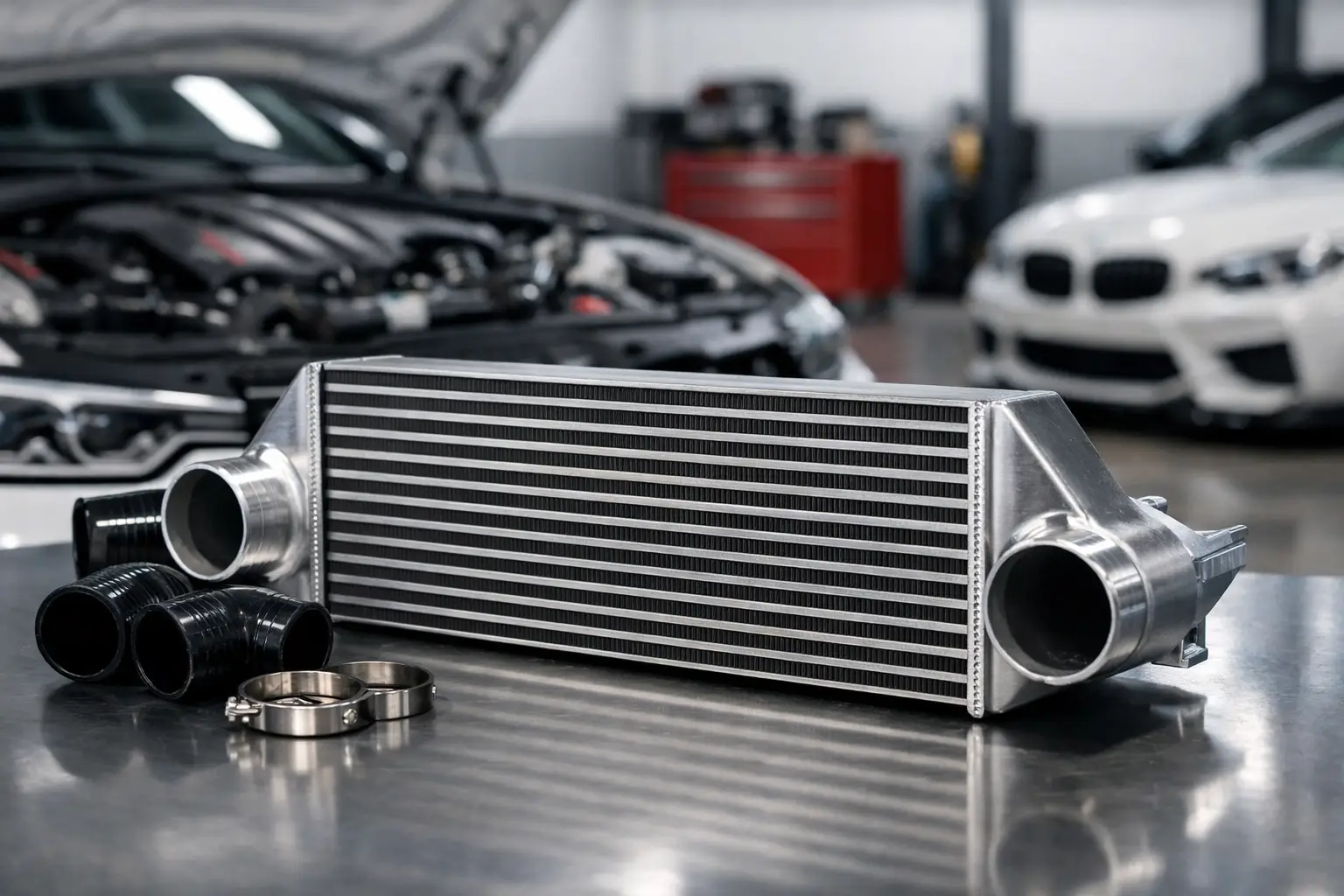
Heat shows up fast on the S58 once you start leaning on the car. A few clean pulls, a warm day, or a hard track session is all it takes for intake air temps to climb, timing to get less aggressive, and consistency to fall off. That is exactly why an s58 intercooler upgrade guide matters for G8X owners who care about repeatable power, not just one good dyno graph.
Why the S58 needs more intercooler than stock
The factory S58 cooling system is good for a stock or lightly modified street car, but BMW left headroom on the table because it had to balance packaging, cost, emissions, and broad-use drivability. Once you add a tune, turn up boost, or run the car hard in hotter conditions, that margin starts shrinking.
On the S58, rising intake air temperature does more than make the car feel soft. Higher IATs can lead to reduced ignition timing and less stable performance from pull to pull. If your goal is dependable power, especially on pump gas, intercooler performance becomes a real limiting factor.
That matters even more for owners running ethanol blends, upgraded downpipes, or hybrid turbo setups. More airflow and more boost create more heat. If the charge cooling system cannot keep up, you are asking the calibration to work around temperature instead of making full use of the hardware.
S58 intercooler upgrade guide: know what you are upgrading
Before buying parts, it helps to define what people mean when they say intercooler on the S58 platform. On many turbo cars, the term points to a traditional front-mount air-to-air unit. On the G80 M3, G82 and G83 M4, and G87 M2 with the S58, charge cooling is more involved. Depending on the product, you may be looking at a heat exchanger, charge cooler, reservoir-related component, or a complete system upgrade that improves the cooling circuit supporting the intake charge.
That distinction matters because not every cooling part addresses the same bottleneck. Some upgrades improve peak cooling capacity. Others improve recovery between pulls. Some are aimed at track abuse, while others are ideal for tuned street cars that need better consistency without overcomplicating the setup.
If you buy based on a product name alone, it is easy to end up with a part that is well-made but not the right answer for your use case.
When an upgrade makes sense
A stock daily driver in a mild climate may never expose the factory system’s limits in a serious way. But the moment the car moves beyond stock intent, cooling should be part of the conversation.
The first obvious trigger is tuning. Stage 1 and Stage 2 calibrations often increase boost and keep the engine loaded harder for longer. Even if the car feels strong on the first pull, heat soak can show up quickly after repeated acceleration.
The second trigger is environment. A G8X in Arizona, Florida, Texas, or Southern California has a very different cooling challenge than the same car in cool weather. Ambient temperature changes how much margin you have before performance starts to taper.
The third trigger is driving style. Street pulls, back-road runs, dragstrip use, and road course sessions stress the system in different ways. A drag car may care about cooldown between runs and short-burst efficiency. A track car needs sustained thermal control lap after lap. A spirited street build usually lives somewhere in between.
What to look for in an S58 cooling upgrade
Core size gets the most attention, but bigger is not automatically better. A larger core can improve thermal capacity, but only if the design still supports proper airflow, coolant flow, and fitment. Cheap oversized parts can create new issues with pressure drop, slow response, or packaging compromises.
Core construction matters just as much. Fin density, internal flow path, end tank design, and welding quality all influence how efficiently heat is transferred and how reliably the part holds up under real boost pressure. On a premium platform like the S58, this is not the place to cut corners.
Fitment should also be treated as a performance metric. If installation requires trimming that should not be necessary, or if the part interferes with factory ducting and surrounding cooling hardware, that can reduce the benefit of the upgrade. Serious buyers should want parts engineered around the chassis, not generic dimensions dressed up for a product page.
Then there is system balance. On higher-output builds, one upgraded cooling component may expose the limit of another. A stronger heat exchanger paired with marginal fluid capacity or poor circulation may not deliver the results the spec sheet suggests. This is where a consultative approach matters, especially for owners stacking multiple mods.
Street car, track car, or big-power build
The best choice depends on how the car is used.
For a tuned street car, the priority is usually better temperature control during repeated pulls and hot-weather driving, without adding unnecessary complexity. A quality upgrade focused on improved cooling efficiency and OE-like fitment is often the sweet spot. You want lower IATs, faster recovery, and predictable drivability.
For a dual-purpose street and track setup, thermal endurance becomes more important than just short-term gains. In that case, larger-capacity cooling components and a more complete approach to the charge cooling circuit make sense. You are not just trying to lower temperatures once. You are trying to stop them from climbing out of range during sustained load.
For hybrid turbo or high-boost builds, the conversation changes again. At that level, cooling needs to support the power target, fuel choice, and intended duty cycle. A part that works well on a bolt-on car may be undersized for a serious ethanol setup chasing much bigger numbers. This is where matching components as a package pays off.
Common mistakes buyers make
The biggest mistake is shopping by peak horsepower claim alone. Marketing numbers are easy to print, but they do not tell you how the car behaves after several pulls, in traffic, or on a hot day at the track. Consistency is what separates a worthwhile cooling upgrade from a part that only looks good in a catalog.
Another mistake is ignoring the rest of the build. If the car already has added boost, freer-flowing exhaust, and aggressive tuning, the cooling upgrade should be selected with those changes in mind. Otherwise, you may solve only part of the problem.
Some owners also overbuy. There is nothing wrong with premium hardware, but a full race-oriented setup is not always the best match for a street-driven car. Cost, install time, and real-world benefit should stay aligned. The right part is the one that matches the car, the climate, and the goal.
Installation and tuning considerations
A quality S58 cooling upgrade should fit cleanly, but installation still matters. Any trapped air in the system, poor bleeding procedure, or small leak can hurt performance and create frustrating drivability issues. On modern BMW platforms, details count.
After installation, it is smart to log the car rather than rely on seat-of-the-pants impressions. Intake air temperature behavior, timing consistency, and recovery between pulls tell you much more than whether the car feels faster for ten minutes. Good data confirms whether the upgrade is doing the job.
Tuning should also reflect the new thermal capacity, but with realistic expectations. Better cooling creates more stable conditions for the calibration. It does not replace good tuning, quality fuel, or proper supporting hardware.
How to buy the right parts the first time
If you are building an S58 car, part selection should be driven by platform knowledge, not guesswork. Start with your chassis, exact mods, fuel type, climate, and usage. Then choose a cooling upgrade from a manufacturer with a real reputation for BMW fitment, engineering, and repeatable results.
This is one of those categories where premium parts usually justify their price. Better materials, cleaner design, stronger fitment standards, and proven performance under load matter more than saving a little money on paper. For owners who expect serious results from serious hardware, that difference shows up quickly.
At EAS Store, this is exactly the kind of decision we encourage customers to make carefully. The strongest setup is not always the most expensive one. It is the one that supports your power level, fits your car correctly, and keeps the S58 performing the same on the third pull as it did on the first.
If your G8X is already making more power than stock, better charge cooling is not a cosmetic upgrade. It is one of the clearest ways to protect consistency, support the tune, and make the car feel as strong in real conditions as it does on paper.