Performance motor mounts for MK7 GTI are one of the most noticeable drivetrain upgrades you can make, but not because they add horsepower. Their job is to keep the EA888 engine and transmission from rotating excessively under boost, on hard shifts, and during aggressive braking. The payoff can be cleaner power delivery, reduced wheel hop, and a more connected feel from a chassis that is already exceptionally capable.
The trade-off is equally real: firmer mounts can bring more vibration and drivetrain noise into the cabin. The right setup depends on whether your GTI is a daily driver, a tuned street car, or a dedicated track build. Buying the stiffest mount package available is rarely the best answer.
What Motor Mounts Change on an MK7 GTI
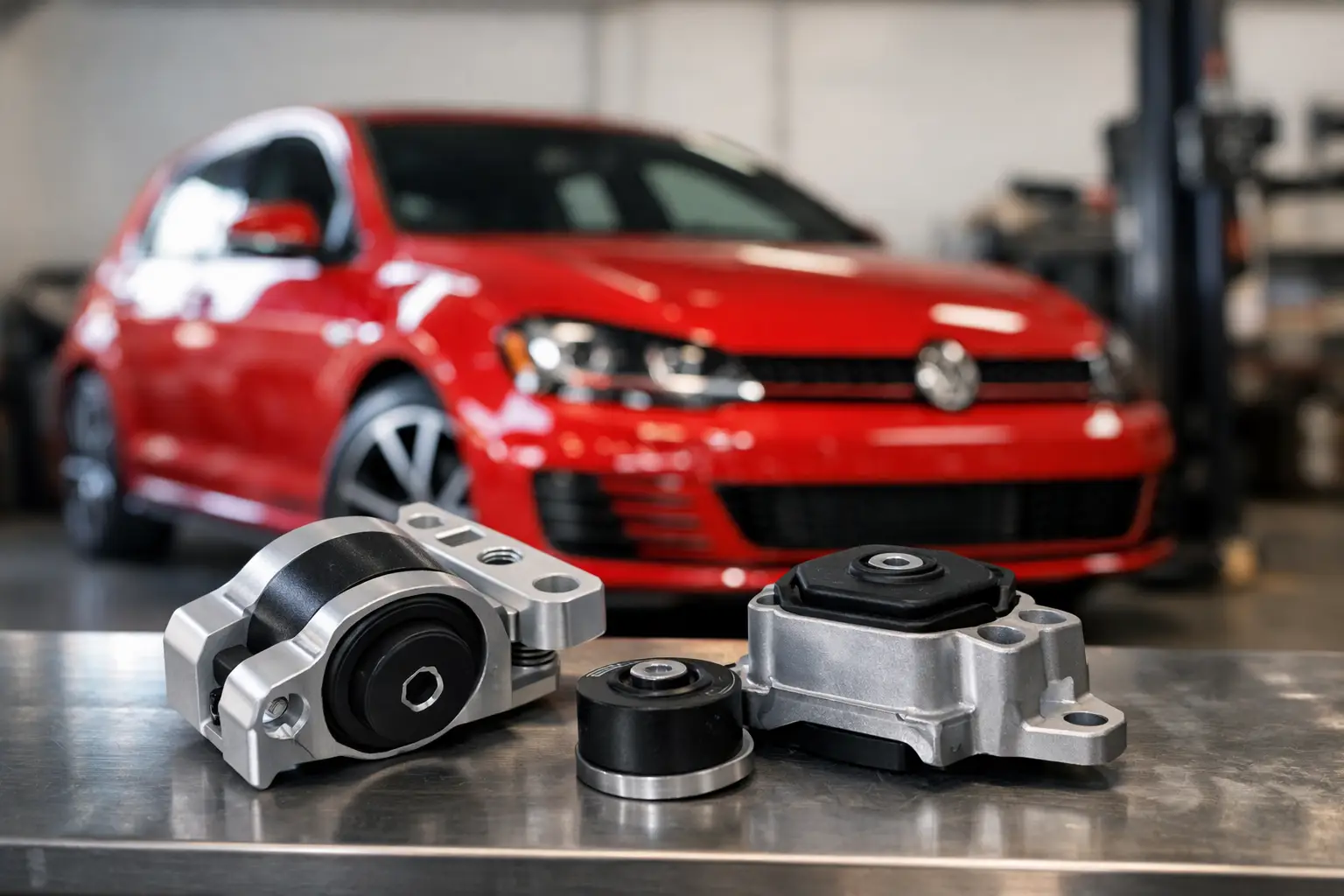
The MQB platform uses a three-point drivetrain mounting system. There is an engine-side mount, a transmission-side mount, and a lower pendulum mount, often called a dogbone mount. Together, they manage the movement of the engine and transmission assembly as torque loads change.
Volkswagen factory mounts are designed around comfort, low cabin vibration, and long-term refinement. That makes sense for a stock GTI commuting every day. Once the car receives a Stage 1 or Stage 2 calibration, upgraded clutch or DSG tuning, sticky tires, and harder launches, the soft factory rubber can allow substantial drivetrain movement.
That movement is not just an abstract engineering detail. It can show up as wheel hop in first and second gear, a delay between throttle input and vehicle response, imprecise gear engagement, or a noticeable lurch when getting on and off the throttle. On a manual car, it can also make aggressive shifts feel less consistent. On a DSG-equipped GTI, reducing drivetrain movement helps the chassis better handle the fast torque transitions that make a tuned DSG so effective.
A properly selected mount package limits that movement without turning every stoplight into an NVH event.
Start With the Lower Pendulum Mount
For many street-driven GTIs, the lower pendulum mount is the most logical first upgrade. This mount controls fore-and-aft movement of the drivetrain and is a major contributor to wheel hop under acceleration. Depending on the manufacturer, upgrades may come as a complete replacement mount, an upgraded bushing assembly, or an insert that fills voids in the factory component.
A quality pendulum mount or insert can make the car feel immediately more planted during hard acceleration. Shifts often feel sharper, especially in a manual-transmission GTI, and the front tires are less likely to alternate between gripping and unloading when torque hits.
The difference between an insert and a complete mount matters. Inserts are generally a lower-cost entry point and can deliver a meaningful improvement for lightly modified cars. They also tend to transmit more vibration because they work with the factory mount’s existing structure. A complete upgraded lower mount is typically a more controlled, purpose-built solution for drivers who want consistent behavior under repeated high-load use.
For a Stage 1 daily driver, a street-oriented lower mount is often enough. For a Stage 2 car on performance tires, or a GTI that sees autocross and track days, a complete lower mount can be a better long-term choice.
Engine and Transmission Mounts Bring the System Together
The engine-side and transmission-side mounts address a broader range of drivetrain movement. Upgrading these alongside the pendulum mount creates a more controlled system, particularly for cars making substantially more torque than stock.
This is where mount selection becomes more application-specific. A 350-wheel-horsepower GTI that spends most of its life on public roads has different needs than a big-turbo car launching on drag radials. Firmer rubber or polyurethane mounts may be appropriate for a serious street and track build, while motorsport-oriented mounts with very high durometer bushings can be excessive for a commuter.
A balanced mount setup matters more than maximum stiffness. Pairing an extremely rigid lower mount with soft upper mounts can shift the stress and movement elsewhere in the system. Conversely, installing very stiff upper mounts while leaving excessive compliance below can create unwanted vibration without fully solving wheel hop. Premium manufacturers engineer their components to work as a matched system, with bushing rates that control motion while preserving reasonable street behavior.
For high-output MQB builds, full engine, transmission, and pendulum mount packages are worth considering. They are especially useful when the car has upgraded turbocharging, aggressive DSG software, a stronger clutch, or frequent track use. At that point, drivetrain control becomes a reliability and consistency upgrade as much as a feel upgrade.
Understanding NVH Before You Buy
NVH means noise, vibration, and harshness. It is the central compromise with performance motor mounts, and it should be discussed honestly.
At idle, especially with the air conditioning engaged, firmer mounts can transmit a low-frequency vibration through the steering wheel, pedals, seat, and interior panels. Some systems produce a brief resonance at a particular RPM range. Manual cars may feel more mechanical during clutch engagement, while DSG cars may make normal drivetrain sounds more noticeable in the cabin.
That does not mean a mount upgrade makes a GTI unpleasant. Many street-focused options are engineered with softer bushing compounds, rubber isolation, or multiple durometer choices to keep added NVH manageable. But there is no mount that completely eliminates the trade-off. If a component nearly eliminates engine movement, it will generally transmit more energy into the chassis.
Be realistic about how you use the car. If the GTI handles a daily school run, long highway trips, and dense city traffic, prioritize a street-density mount package. If it is a weekend car with a tune, downpipe, tires, and a track schedule, a firmer setup may be exactly what the build needs.
Choosing the Right Setup for Your Build
A stock or lightly tuned GTI usually benefits most from a conservative lower pendulum mount upgrade. The goal is to reduce wheel hop and clean up shifts while keeping the OEM character intact.
A Stage 1 or Stage 2 GTI with an intake, intercooler, exhaust components, and performance tires can justify a more complete approach. Start with the lower mount, then add engine and transmission mounts if wheel hop, drivetrain lash, or shift consistency remain concerns. Drivers who run ethanol blends or higher-torque calibrations should pay particular attention here, since torque is what loads the mounts hardest.
For track-focused, autocross, drag racing, or big-turbo cars, complete mounts are often the correct choice. Repeated launches, heat cycles, curb strikes, and hard braking create demands that factory mounts were never intended to handle. The added cabin feedback is part of the package, but so is more predictable behavior when the car is driven at the limit.
Transmission type also matters. A manual GTI puts clutch engagement and driver shift technique directly into the equation, so improved mount control can make the car feel dramatically more precise. DSG cars benefit from reduced drivetrain oscillation during fast shifts and launches, particularly when paired with a transmission calibration.
Fitment Details That Matter on the MQB Platform
Do not assume every MQB mount fits every MQB vehicle in the same way. Product compatibility can vary by model year, engine configuration, transmission, trim, and mount revision. A component listed for an MK7 GTI may have different fitment notes for an MK7.5, Golf R, Audi S3, or SportWagen.
Pay attention to whether a part is designed for the GTI’s factory subframe and whether it requires specific hardware, a particular bushing orientation, or replacement stretch bolts. Mount hardware is not an area to cut corners. Many factory fasteners are torque-to-yield and should be replaced rather than reused. Correct torque procedures and loaded-suspension positioning also matter for preventing bushing preload and premature wear.
If your car has a downpipe, aftermarket exhaust, upgraded intercooler piping, or an aftermarket intake, verify clearance before ordering. Most reputable mount systems are designed around common performance hardware, but a heavily modified GTI deserves a full fitment check. This is where knowledgeable part support can prevent an expensive mismatch.
Installation and Post-Install Expectations
Lower pendulum mount upgrades are often manageable for experienced DIY owners with proper lifting equipment, torque tools, and access to the correct procedures. Engine and transmission mounts are more involved because the drivetrain must be safely supported and mount alignment matters. For many owners, professional installation is the smart choice.
After installation, expect an initial break-in period. Bushings can settle, and the character of the added vibration may change after several heat cycles and miles. Check hardware after the recommended interval, inspect surrounding components for clearance, and listen for anything that sounds like contact rather than normal added drivetrain feedback.
A mount upgrade will not cure every traction issue. Worn tires, poor alignment, weak suspension bushings, and an overly aggressive torque request can still create wheel spin or instability. But as part of a properly planned MQB build, mounts give every other performance upgrade a more stable foundation.
The best performance motor mounts for an MK7 GTI are the ones matched to how the car is actually driven. EAS Store can help narrow the options by power level, transmission, intended use, and the amount of NVH you are willing to accept, so your GTI feels tighter without compromising the ownership experience you built it for.