An injector that is too small does not simply limit peak horsepower. At high load, it can force excessive duty cycle, compromise fuel control, and put a hard-worked turbocharged engine in a dangerous lean condition. Knowing how to match injector flow is therefore not just a parts-selection exercise. It is part of building a fuel system that remains consistent on the street, at the drag strip, and through repeated track sessions.
For high-output European platforms, injector selection must account for more than a claimed horsepower number. An MQB EA888, Audi 2.5 TFSI, BMW S58, or Mercedes turbo application may have different factory fueling architecture, ECU strategies, injector types, and pressure limits. Start with the engine and fuel system you actually have, then size the injectors around a realistic power target and fuel choice.
What Matching Injector Flow Actually Means
The phrase can describe two related jobs. First, it means selecting injectors with enough total fuel capacity for your engine’s horsepower target. Second, it means ensuring the injectors in a set deliver closely matched amounts of fuel from cylinder to cylinder.
Both matter. A properly sized injector set gives the ECU enough capacity to command fuel safely without running injectors at their limit. Flow-matched injectors reduce cylinder-to-cylinder variation, which helps maintain more even air-fuel ratios, combustion temperatures, and power delivery.
A quality injector set is typically flow tested at a stated pressure and supplied as a matched group. The tighter the match, the less correction the ECU has to make from one cylinder to the next. This is especially valuable on boosted engines operating near the edge of their stock fuel system.
Do not confuse a set of injectors with the same part number for a verified matched set. Production tolerances exist. Serious performance builds benefit from injectors that have been tested, documented, and selected to flow within a tight range.
Calculate the Injector Flow Your Build Needs
Injector sizing begins with brake specific fuel consumption, commonly called BSFC. BSFC estimates how much fuel an engine needs to make one horsepower for one hour. Naturally aspirated gasoline engines often fall around 0.45 to 0.55 lb/hr per horsepower. Forced-induction gasoline engines commonly require 0.55 to 0.70 lb/hr per horsepower, depending on boost, efficiency, tuning, and intended safety margin.
The basic calculation is:
Injector flow in lb/hr = horsepower target × BSFC ÷ number of injectors ÷ target duty cycle
For example, consider a four-cylinder turbo engine with a 600 horsepower target on gasoline. Using a conservative 0.65 BSFC and an 85% maximum injector duty cycle:
600 × 0.65 ÷ 4 ÷ 0.85 = 114.7 lb/hr per injector
That is the minimum calculated flow requirement at the injector’s rated pressure. In practice, choosing an injector with additional headroom is wise. Fuel pressure can drop, fuel temperature can rise, and a future turbo or ethanol upgrade can quickly consume the available margin.
Most aftermarket injectors are also listed in cc/min. Gasoline conversion figures vary slightly by test fluid and fuel density, but 1 lb/hr is often estimated at roughly 10.5 cc/min for quick planning. The 115 lb/hr injector in this example is approximately a 1,200 cc/min injector. Treat that as a planning figure, not a substitute for the manufacturer’s published flow data.
Choose a Sensible Duty-Cycle Limit
Injector duty cycle is the percentage of available engine cycle time that an injector is commanded open. An 85% maximum target is a reliable rule for many port-injected performance builds. Some modern systems can operate higher, but treating 100% duty cycle as acceptable leaves little room for real-world changes and can affect fuel delivery consistency.
At 100% duty cycle, an injector is effectively held open continuously. That may appear acceptable in a log, yet it removes the headroom needed for transient enrichment, fuel-pressure variation, or a colder day that allows the engine to make more boost and power. For a street-driven 700-plus horsepower car, headroom is cheap insurance compared with rebuilding an engine.
Fuel Type Changes the Entire Calculation
A gasoline injector recommendation should not automatically be used for an ethanol blend. E85 requires substantially more fuel volume than pump gasoline because its energy content per gallon is lower. Depending on ethanol content and calibration strategy, expect to need approximately 25% to 35% more injector capacity.
That difference is why a setup that is comfortable at 650 horsepower on 93 octane may run out of injector on E85 at a lower power level. Flex-fuel tuning adds another layer: the injector and pump system must support the highest ethanol content the calibration permits, not only the fuel currently in the tank.
Methanol injection does not replace correctly sized primary injectors. It can lower intake temperatures and supplement fueling under boost, but the engine should remain safe if the meth system has a fault. Build the core injector and pump capacity around the engine’s primary fuel demand.
Injector Flow Depends on Fuel Pressure
Injector flow ratings are only meaningful at the pressure used for testing. A 1,000 cc/min injector rated at 43.5 psi does not flow 1,000 cc/min at every pressure. Flow changes with the square root of the pressure ratio:
New flow = rated flow × square root of new pressure ÷ rated pressure
Raising base pressure can increase effective injector flow, but it is not a free upgrade. More pressure places additional demand on the fuel pump, creates more heat, and may exceed the injector’s intended operating range. It can also change calibration data that the ECU needs for accurate low-load fueling.
Pressure behavior under boost matters just as much. On a return-style system, base pressure should typically rise one-for-one with manifold pressure so the injector sees stable differential pressure. If boost rises while fuel pressure does not follow, the injector’s effective flow drops precisely when the engine needs fuel most.
For this reason, match injectors with the entire fuel system: in-tank pump, lift pump where applicable, fuel lines, filter, rails, regulator, and wiring. A large injector cannot compensate for a pump that cannot maintain commanded pressure at peak load.
Port Injection, Direct Injection, and Supplemental Systems
Many modern European performance engines use direct injection, which operates very differently from conventional port injection. Direct injectors work at extremely high pressure and are controlled by application-specific hardware and ECU strategies. Their capabilities are governed by injection window, high-pressure fuel pump capacity, rail pressure, and calibration, not simply a universal cc/min rating.
On platforms such as the EA888, 2.5 TFSI, and S58, a high-power build may retain upgraded direct-injection components while adding port injection for supplemental fuel. In that case, do not size the port injectors as if they carry the entire engine load unless the tuning strategy calls for it. Determine what percentage of fuel demand the direct-injection system can reliably cover at the target power, then size the supplemental injectors for the remaining demand with margin.
This is a calibration decision as much as a hardware decision. The controller must know injector flow rate, dead time or latency data, injector characterization, base pressure, and fuel composition. Installing physically correct injectors without the correct ECU or auxiliary-controller data can create poor idle, cold-start issues, inconsistent transitions, and unsafe high-load fueling.
How to Match Injector Flow Across Cylinders
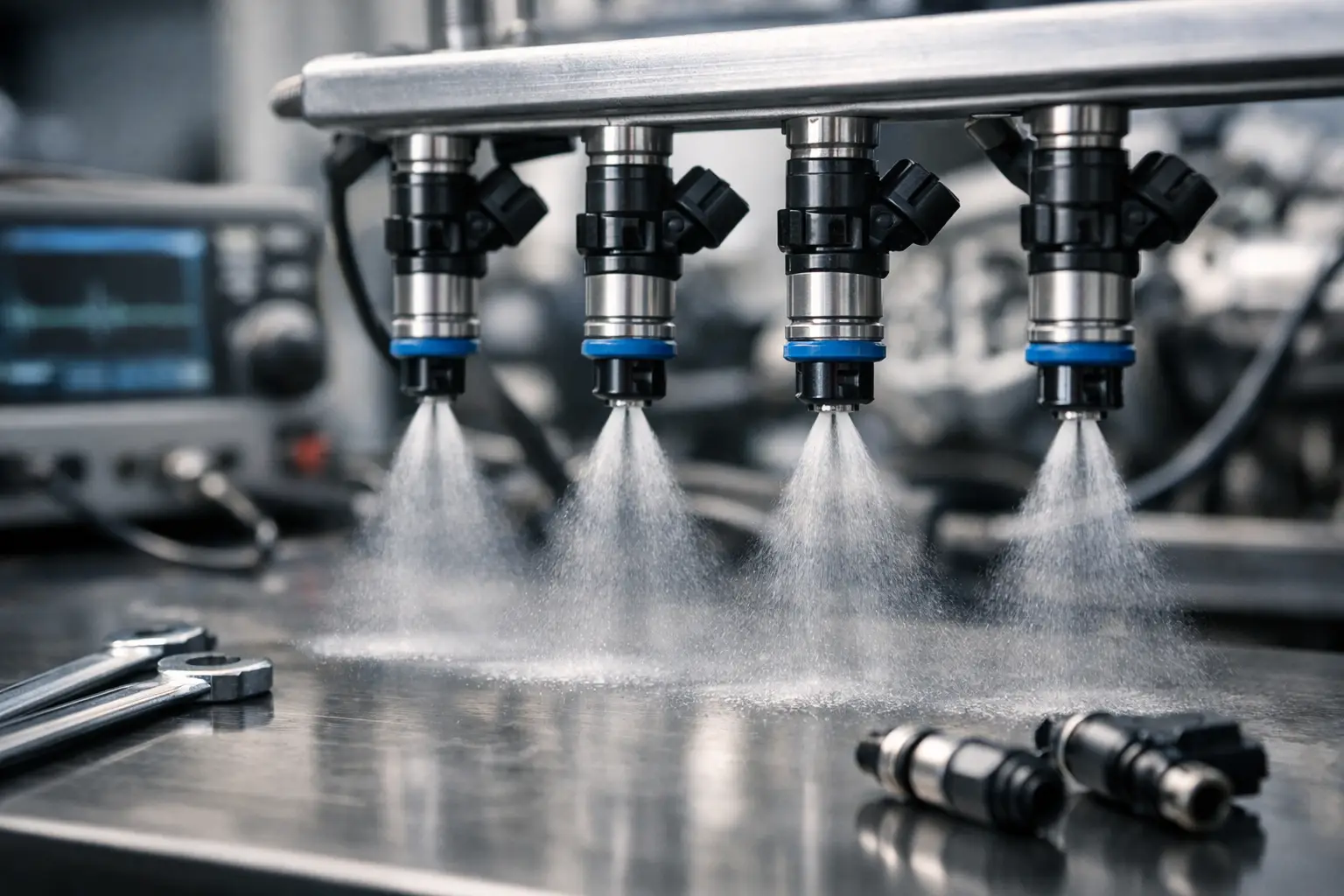
Once you have the correct capacity, verify that the injectors are matched as a set. Flow matching is normally performed on a bench using a controlled test fluid, set pressure, pulse width, and test duration. A professional report may show static flow, dynamic flow at different pulse widths, leakage results, spray pattern observations, and individual cylinder positions.
For a high-output engine, close matching is preferable, but the acceptable spread depends on the injector, test method, and application. The important point is that all injectors are evaluated under the same conditions and the supplier clearly states those conditions. A vague claim of “matched” without a pressure rating or documentation has limited value.
Injector health matters after installation, too. Contaminated fuel, debris from a new fuel-system build, damaged seals, and incorrect electrical connectors can all affect performance. Use clean components, install new seals where required, and confirm there are no leaks before tuning. On a fresh build, fuel filters should be sized for the system and checked after initial run-in.
Common Sizing Mistakes on Performance Builds
The most common mistake is buying injectors based on a future horsepower claim without calculating the fuel type or duty-cycle target. The second is focusing on injectors while ignoring the pump and pressure system. A third is assuming bigger is always better.
Oversized injectors can work exceptionally well when they are high quality and correctly calibrated. Cheap large injectors with poor low-pulse-width behavior, however, can make a car frustrating to drive at idle and cruise. For a street car, choose capacity with headroom, then prioritize injector data quality and ECU compatibility over the largest number on the box.
Another mistake is mixing injectors from different sets. Even if the part numbers match, flow and latency characteristics may not. Keep matched injectors together and label them if they are removed for service.
A fueling system should be selected with the same discipline as a turbocharger or engine build. Set the honest power goal, choose the fuel, calculate capacity with margin, verify pressure under load, and give the tuner complete injector data. When those pieces agree, the engine has the fuel delivery it needs to make serious power repeatedly rather than making one impressive pull and asking for trouble.